

Last updated: August 1, 2026
Watch the video review:
Affiliate disclosure: This review contains Amazon affiliate links. As an Amazon Associate I earn from qualifying purchases at no extra cost to you.
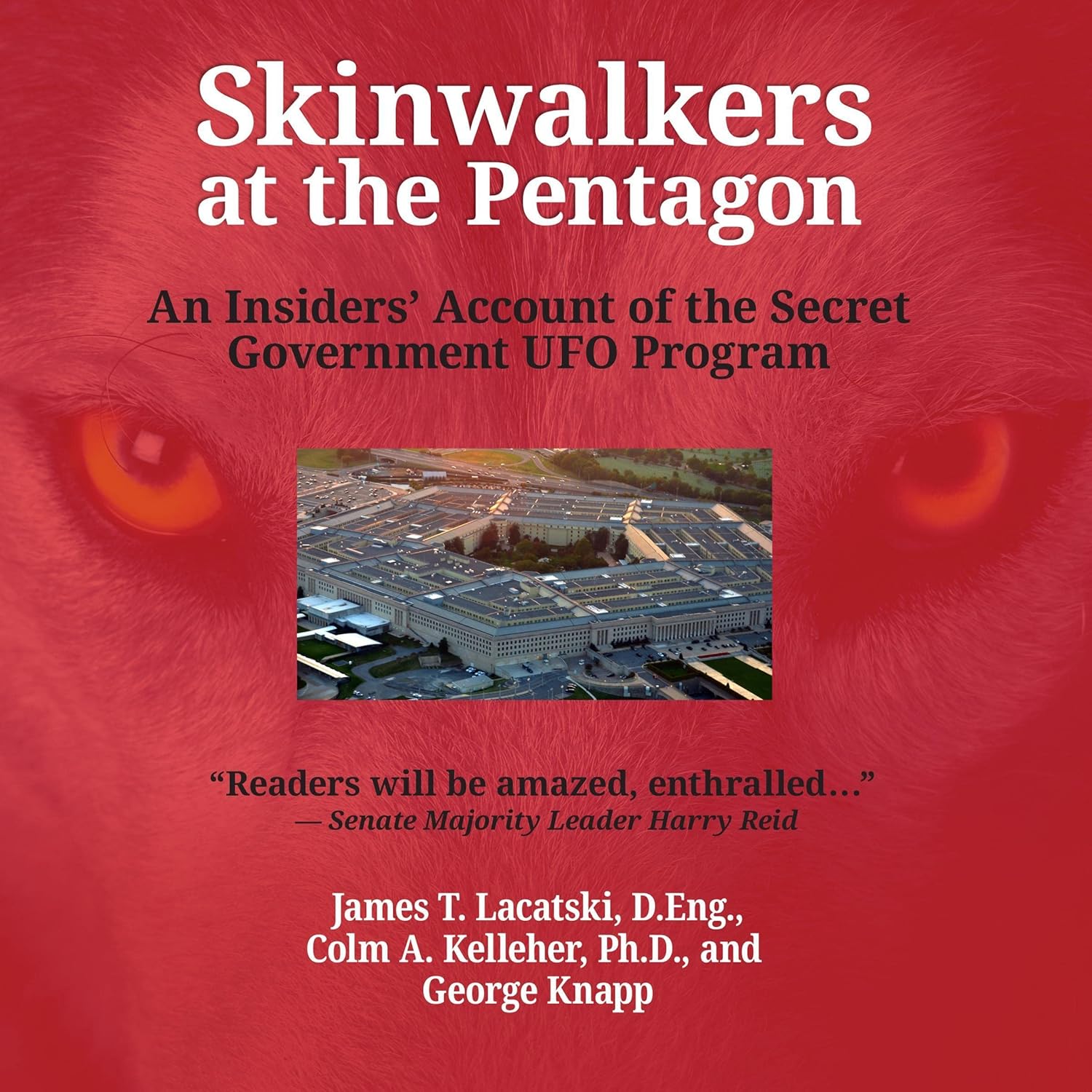
| Author | James T. Lacatski, Colm A. Kelleher & George Knapp |
| Publisher | RTMA, LLC |
| Published | 2021 |
| Rating | ★★★★☆ |
The DIA insider who says a device in a ranch kitchen changed everything he believed.
What It Covers
In 2007, James T. Lacatski — a nuclear engineer and career Defense Intelligence Agency official — read Hunt for the Skinwalker and, by his own account, could not shake it. He contacted Robert Bigelow, arranged a visit to the Utah ranch, and reported witnessing something at close range inside a building on the property that he later described only as an “unearthly technological device.” Whatever Lacatski believed he saw that day became the personal catalyst for one of the strangest chapters in recent Pentagon history: the Advanced Aerospace Weapon System Applications Program, or AAWSAP, a classified $22 million Defense Intelligence Agency research effort that ran from 2008 to 2012.
Skinwalkers at the Pentagon, published in 2021 by Lacatski alongside Hunt for the Skinwalker co-authors Colm A. Kelleher and George Knapp, is Lacatski’s insider account of how that program came to exist and what it found. The book traces AAWSAP from its origin — Senators Harry Reid, Ted Stevens, and Daniel Inouye securing the funding and running political interference to keep the program’s true purpose quiet — through its operational years investigating UAP encounters like the 2004 “Tic Tac” incident off the coast of San Diego, foreign programs including the Soviet Union’s Cold War-era “Thread-3” research, and, extensively, continued activity at Skinwalker Ranch itself, which by then Bigelow’s new company BAASS was investigating under the AAWSAP contract with far more resources than NIDS ever had.
The book’s most unusual material concerns what the authors call “attachment” phenomena: multiple AAWSAP-linked investigators who spent time on the ranch reported that unexplained activity — orbs of light, shadow figures, and in a few cases physical creature sightings — followed them home to their families afterward, in some cases persisting for years. Lacatski presents these accounts as internal case reports rather than campfire stories, complete with the same instrumentation-first framing that defined the original NIDS investigation.
What Was AAWSAP?
AAWSAP is the formal name for the DIA-funded program that ran from 2008 to 2012 under a roughly $22 million contract awarded to Bigelow Aerospace Advanced Space Studies (BAASS), a subsidiary Bigelow created specifically for the work. Its mandate was unusually broad for a government UAP program: not just aerial encounters, but underwater and space-based phenomena, foreign advanced-aerospace threats, and — controversially — consciousness and psychic-phenomena research, an area that later drew significant criticism when journalists and skeptics reviewed AAWSAP’s public-facing technical reports after the program became widely known in 2017.
AAWSAP is often confused with the Advanced Aerospace Threat Identification Program (AATIP), and the books in this space are not always careful about the distinction, so it is worth being precise. AAWSAP was the funded, BAASS-run research contract from 2008–2012. When that funding lapsed, informal UAP-related work continued inside the Pentagon on a much smaller and less resourced basis — work that eventually became associated with the name AATIP and, most publicly, with Luis Elizondo, whose own account of that later period is covered in our review of Imminent. Skinwalkers at the Pentagon is specifically an account of the earlier, larger, and more formally funded AAWSAP era — the chapter of the story that predates Elizondo’s involvement and that far fewer books have documented firsthand.
Why It Matters
What separates Skinwalkers at the Pentagon from most “secret government UFO program” books is that its lead author ran the program’s day-to-day contracting and security functions. Lacatski was AAWSAP’s DIA program manager, contracting officer’s representative, and security and counterintelligence coordinator — not a whistleblower describing something he heard about, but the official who signed off on it. According to the authors, the manuscript went through a Department of Defense pre-publication security review before release, which is a step most UAP memoirs never go through and which lends the account a degree of institutional accountability that is rare in this genre.
The book also matters because it closes the loop that Hunt for the Skinwalker left open. Kelleher and Knapp’s 2005 book ends with NIDS shutting down in ambiguity. Skinwalkers at the Pentagon picks the story back up and shows, in specific and named detail, how a self-funded ranch investigation directly seeded a classified national intelligence program three years later — a documented through-line from a Utah cattle ranch to a Defense Intelligence Agency contract that is almost unique in UAP literature.
Caveats
The book’s central claims rest heavily on Lacatski’s personal testimony and internal program recollections rather than documents that outside researchers can independently examine — AAWSAP’s technical reports have been partially released and reviewed by journalists, but the specific “attachment” incidents described here are not corroborated by any public record beyond the authors’ own accounts. Readers should also weigh the authors’ financial and reputational stake in the ranch’s mythology: Kelleher and Knapp built much of their public profile on Skinwalker Ranch material going back to 2005, which does not make their claims false, but is worth keeping in mind when assessing how the story is framed.
The claimed DoD pre-publication review is presented in the book’s own front matter and publisher materials rather than independently verified by a named government spokesperson in the text itself, so readers should treat “cleared for release” as the authors’ characterization rather than an independently audited fact. As with Hunt for the Skinwalker, the most extraordinary individual incidents — the “unearthly technological device,” the attachment phenomena — are described by named individuals but not documented on video, audio, or instrumentation.
How This Connects to Hunt for the Skinwalker
The two books are best read as a single continuous story split sixteen years apart. Hunt for the Skinwalker (2005) documents the original NIDS investigation and ends without resolution. Skinwalkers at the Pentagon (2021) explains what that book set in motion inside the U.S. government and what a far better-funded successor investigation found when it returned to the same property. Read in publication order, they form the most complete documented account available of how one Utah ranch’s reputation for anomalous phenomena became entangled with two separate, decades-apart federal UAP research efforts.
Who It’s For
Readers who finished Hunt for the Skinwalker and want to know what happened next are the obvious audience, but this book also stands on its own for anyone specifically researching AAWSAP, BAASS, or the pre-2017 history of Pentagon UAP programs — ground that Skinwalkers at the Pentagon covers in more operational detail than any other published account. Readers already familiar with Elizondo’s Imminent will find this book fills in the earlier chapter that Elizondo’s own account does not cover directly.
Where to get it
Enjoyed this review?
New reviews, reading lists, and UAP book recommendations — no spam. Drop your email on the contact page and ask to be added.
Frequently Asked Questions
What is Skinwalkers at the Pentagon about?
Skinwalkers at the Pentagon (2021) is James T. Lacatski, Colm A. Kelleher, and George Knapp’s insider account of AAWSAP, the classified $22 million Defense Intelligence Agency program that investigated UAP encounters, foreign aerospace threats, and continued anomalous activity at Skinwalker Ranch between 2008 and 2012.
What is AAWSAP?
AAWSAP (Advanced Aerospace Weapon System Applications Program) was a Defense Intelligence Agency-funded research contract, worth roughly $22 million, awarded to Robert Bigelow’s company BAASS from 2008 to 2012 to study UAP, related anomalous phenomena, and foreign advanced-aerospace programs.
Who is James Lacatski?
James T. Lacatski is a nuclear engineer and former Defense Intelligence Agency official who served as AAWSAP’s program manager, contracting officer’s representative, and security and counterintelligence coordinator. He is the lead author of Skinwalkers at the Pentagon.
Is Skinwalkers at the Pentagon a true story?
It is presented as a firsthand insider account by the DIA official who ran the AAWSAP program’s contracting and security functions, drawing on internal program records and personal recollection. The authors state the manuscript went through a Department of Defense pre-publication review before release, though that claim is not independently verified in the text itself.
How is Skinwalkers at the Pentagon connected to Hunt for the Skinwalker?
Lacatski has said his interest in UAP research began after reading Hunt for the Skinwalker in 2007, which led him to visit the ranch and, according to his account, helped set in motion the creation of AAWSAP the following year. Skinwalkers at the Pentagon is written by two of Hunt for the Skinwalker’s original authors and functions as its direct follow-up.
Did AAWSAP become AATIP?
Not exactly. AAWSAP was the funded 2008–2012 DIA contract run through Bigelow’s company BAASS. After its funding lapsed, informal UAP-related work continued inside the Pentagon on a smaller scale and became associated with the name AATIP, most publicly through Luis Elizondo. The two programs are related in lineage but distinct in scope, funding, and time period.
Was Skinwalkers at the Pentagon reviewed by the Department of Defense?
The authors state in the book’s front matter that the manuscript underwent a Department of Defense pre-publication security review and was cleared for public release. This claim comes from the publisher and authors rather than an independently documented government statement within the text.