

This article contains affiliate links. If you buy a book through one of them, UAP Disclosure Reads earns a small commission at no extra cost to you. See our Affiliate Disclosure for details. Nothing below should be read as a claim of proven fact — it is a synthesis of published research, decades-old field reports, and current commentary, offered as the most internally consistent working theory available, not a verdict.
| Core sources | John Keel, Jacques Vallée, José Antonio Caravaca |
| Also featured | Nathaniel Gillis (ultra-terrestrial shared reality model) |
| Framework | Ultraterrestrial hypothesis / Control system / Distortion Theory |
| Reading time | ~16 minutes |
Three unrelated YouTube channels, posted months apart, keep landing on the same idea. A retired F-16 pilot tells his audience they’ve been asking the wrong question about UFOs. A podcaster spends an hour on the final, strangest chapter of a 1970 book about “ultraterrestrials.” A demonologist tells a comedian-turned-interviewer that aliens, demons, djinn, and shadow people might be the same thing wearing different masks. None of them cite each other. All three are re-deriving a theory that John Keel, Jacques Vallée, and a Spanish researcher named José Antonio Caravaca built, piece by piece, across more than fifty years. This is that theory — what it says, who built it, and what’s actually been declassified versus what’s still just a very good story.
We Keep Asking the Wrong Question
In late 2025 and mid-2026, three very different corners of the UAP media landscape put out content that, on the surface, has nothing to do with one another: a hardware-and-pilot-testimony-focused channel argued publicly that the field has been asking the wrong question about UFOs; a long-form breakdown spent over an hour on the closing chapter of a 1970 book about “ultraterrestrials”; and religious demonologist Nathaniel Gillis, in a wide-ranging interview, laid out what he calls an “ultra-terrestrial shared reality model.” None of these were coordinated, and none cite each other directly.
Pull the material apart and a pattern emerges. No one here is arguing that little green men are flying saucers from Zeta Reticuli. All of it is circling the same reframe: that the question “are UFOs alien spacecraft?” may be the wrong question entirely, and that the right question is closer to “what kind of reality-altering intelligence has been showing up in the historical record under a hundred different names?” That reframe isn’t new. It’s the entire career of three researchers: John Keel, Jacques Vallée, and José Antonio Caravaca.
John Keel and the Ultraterrestrials
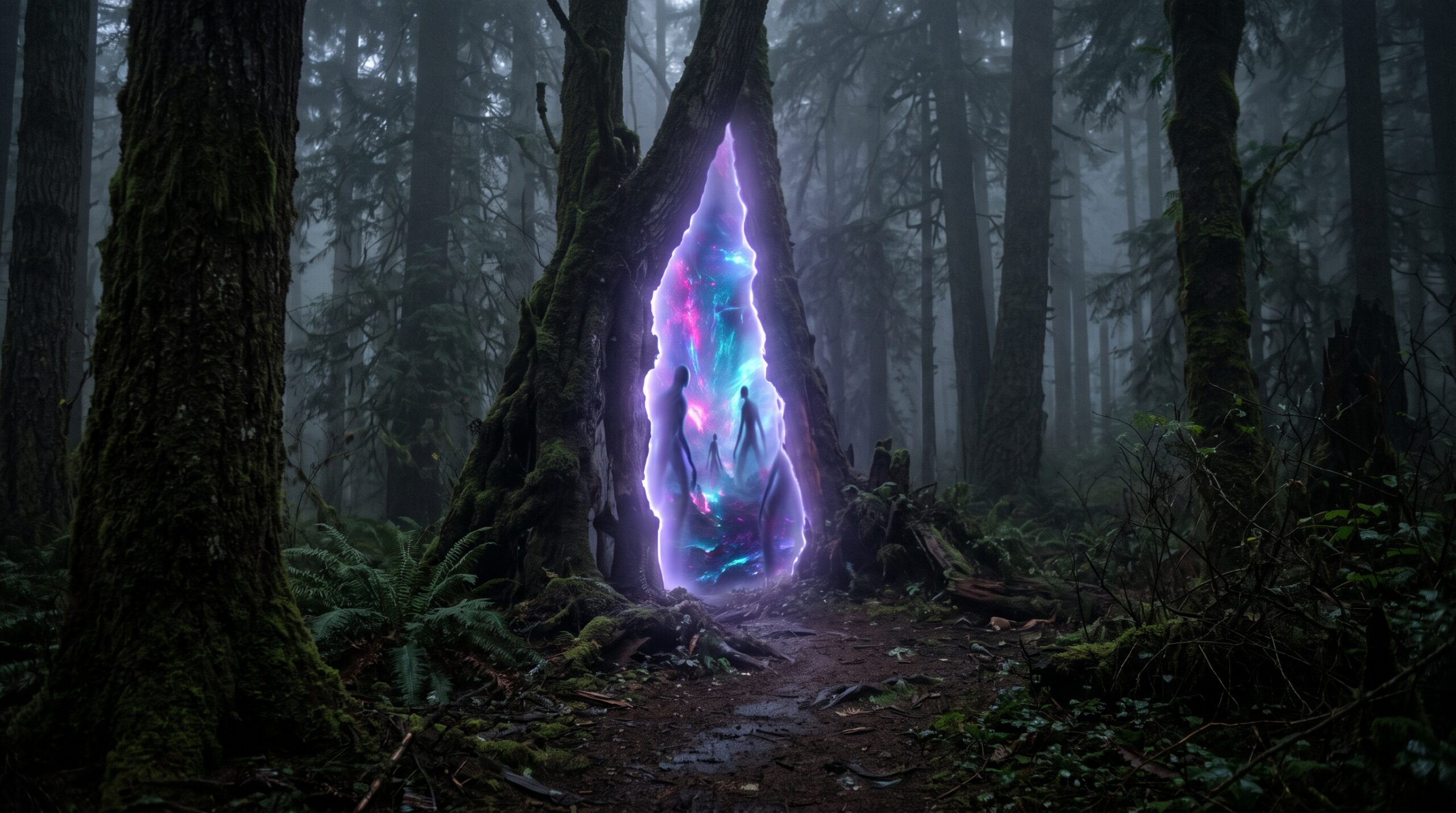
John Keel spent the 1960s chasing UFO reports around the United States as a working journalist, and came out the other side convinced that the extraterrestrial hypothesis didn’t fit the data. In Operation Trojan Horse (1970) and later The Eighth Tower (1975), he proposed that UFO occupants aren’t visitors from another planet at all, but “ultraterrestrials” — non-human intelligences that have coexisted with humanity throughout recorded history, showing up as demons, angels, fairies, monsters, and apparitions in earlier eras and as “aliens” now that space travel is culturally plausible.
Keel’s mechanism for this was the superspectrum: a vast range of energy and information beyond ordinary human perception, within which these intelligences operate, using it to appear, disappear, and reshape themselves into whatever a witness’s culture expects to see. He mapped what he called window areas — Point Pleasant, West Virginia (of Mothman fame) chief among them — where high-strangeness encounters cluster, often around geological features like waterways, fault lines, and mineral-rich rock. To Keel, the membrane between our world and the superspectrum wasn’t just psychological; it had a physical address.
The chapter worth dwelling on is the one where Keel poses the question that this whole article is built around: is the phenomenon technological or ontological? Are the lights, entities, and high-strangeness encounters visitors from another star, or “expressions of a deeper intelligence woven through the very structure of reality” — what the ancients called spirits, daimons, angels, and gods? And, more unsettling: is their goal to invade, or to initiate?
Jacques Vallée and the Control System
Jacques Vallée arrived at a similar place from a completely different direction. Trained as an astronomer and computer scientist (and later a venture capitalist), Vallée worked on some of the earliest UFO cataloguing databases and, in Passport to Magonia (1969), laid out five specific reasons the extraterrestrial hypothesis doesn’t hold up on its own terms:
- The sheer volume of reported close encounters is far larger than any plausible physical survey of Earth would require.
- The humanoid body plan of the reported occupants doesn’t look like something biologically adapted to space travel or evolved on another world.
- The behavior described in thousands of abduction reports doesn’t match what a scientific or genetic research program would actually look like.
- The phenomenon isn’t new. It shows up throughout recorded history — long before “spacecraft” was a concept anyone had.
- The apparent ability of the phenomenon to bend space and time points toward something far stranger than interstellar travel.
Vallée’s own alternative, refined over decades including in Dimensions and Confrontations, is the control system hypothesis: an intelligence — not necessarily conscious in a way we’d recognize — that regulates human perception and belief through a mix of psychological, cultural, and physical means, and that has apparently been doing this for as long as we have folklore. He was struck by how closely UFO contact reports mirror centuries-old fairy abduction lore: missing time, altered size perception, “medical” procedures, and entities who lie constantly and inconsistently to the people they contact, as if consistency were never the point. If it looks less like first contact and more like a very old, very persistent training program aimed at human belief itself, Vallée argued, that’s worth taking seriously as a hypothesis rather than dismissing as a coincidence.
José Antonio Caravaca and the Distortion Theory
The name least familiar to English-language readers on this list is likely the most rigorous in one specific way: José Antonio Caravaca has spent decades compiling and cross-referencing more than a thousand UFO and “unorthodox phenomena” case files, largely out of Spain, and currently contributes the “Expediente Caravaca” segment to Iker Jiménez’s long-running Cuarto Milenio program. His contribution is the Distortion Theory (Teoría de la Distorsión), laid out most fully in his book Distorsión: Ovnis, apariciones marianas, bigfoots, hadas, fantasmas y extrañas criaturas — ¿una teoría explicativa?
Caravaca’s proposal is that UFO encounters, Marian apparitions, bigfoot sightings, fairy lore, ghost hauntings, and cryptid encounters are not separate categories of anomaly at all, but surface expressions of contact with a single underlying force he calls the External Agent. In his model, this agent doesn’t manufacture hardware so much as it projects an augmented, hybridized experience directly at the intersection of the physical and the psychic — meaning a witness’s own neurology, expectations, and cultural framework become part of the “display,” which is why a devout Catholic in 1950s rural Spain sees the Virgin Mary, a contactee in 1970s New Mexico sees a Nordic alien, and a hiker in the Pacific Northwest sees Bigfoot, even though — in Caravaca’s reading — all three may have brushed against the same phenomenon. It’s a modern, data-driven descendant of exactly the argument Vallée was making forty years earlier, arrived at independently through a completely different case archive.
A Contemporary Convergence: The Ultra-Terrestrial Shared Reality Model
The clearest modern restatement of this whole argument doesn’t come from a UFO researcher at all. Religious demonologist Nathaniel Gillis, working from a background in comparative theology rather than ufology, has proposed what he calls an ultra-terrestrial shared reality model: these entities are not from space, but share specific layers of physical reality with us — present enough to interact, absent enough that most of what we’d call “our” reality simply doesn’t register for them. His central claim, worth stating plainly because it’s the cleanest one-sentence summary of this entire article, is that djinn, demons, aliens, and shadow people may be variations of one underlying phenomenon, expressed differently depending on the beliefs a given witness — or culture — projects onto it.
Gillis raises three threads that map directly onto the older literature: a pattern of the phenomenon disproportionately targeting or interacting with children, echoed throughout Keel’s Mothman-era case files and Vallée’s abduction research; a “consciousness hijacking” component that sounds a great deal like Caravaca’s External Agent hypothesis; and claims about reverse-engineered craft that nod toward the hardware side of the story — the physical-evidence layer the declassified paper trail below is built on, and that the technological-versus-ontological fork Keel posed in 1970 never fully resolved.
The Synthesis: A Control System With a Psychic Interface
Line these four positions up — Keel, Vallée, Caravaca, and the shared thread running through all three 2025–2026 videos — and the most internally consistent working theory available today looks something like this:
There may well be a real, physical component to at least part of the UAP phenomenon: unexplained aerospace performance, recovered materials, the kind of hardware-focused claims that David Grusch and others have put into congressional testimony and that AARO has been tasked with investigating. That’s the layer most mainstream UAP journalism and hardware-focused researchers operate on, and it’s real enough to generate the declassified paper trail in the next section.
But hardware alone has never explained the full case record — the missing time, the shapeshifting entities, the folkloric continuity stretching back centuries before anyone had a word for “spacecraft,” the disproportionate targeting of children, the sense witnesses consistently report of being deliberately deceived rather than studied. That’s the layer Keel, Vallée, and Caravaca were each independently mapping, and it’s the layer Nathaniel Gillis is describing when he collapses aliens, demons, djinn, and shadow people into one phenomenon wearing different cultural masks.
The synthesis isn’t “it’s aliens” or “it’s demons” or “it’s all hallucination.” It’s that a genuine non-human intelligence — indifferent to which cosmology we use to describe it — appears to operate at the seam between physical reality and human perception, using a witness’s own belief system as part of its interface, the way a control system uses whatever input format a machine already understands. Keel called that seam the superspectrum. Vallée called the intelligence behind it a control system. Caravaca calls it the External Agent. Gillis calls it the ultra-terrestrial shared reality model. Four names, one shape.
The Paper Trail: What’s Actually Been Declassified
None of the five documents below prove the ultraterrestrial or psychic-interface hypothesis — no government paper ever will, since it’s a hypothesis about the nature of the phenomenon rather than a claim any agency has been tasked with testing. What they do show is the hardware-and-national-security half of the story: the half that keeps this from being dismissed as pure folklore, and the half every synthesis theory has to account for.
- The Twining Memo (1947) — Gen. Nathan Twining’s “AMC Opinion Concerning ‘Flying Discs,'” the earliest official Air Force document treating the phenomenon as “something real and not visionary or fictitious,” written weeks after the Roswell and Kenneth Arnold incidents.
- The Robertson Panel Report (1953) — the CIA-convened scientific panel whose recommendations shaped decades of official ridicule and debunking policy toward UFO witnesses, and which Vallée has repeatedly pointed to as the origin of the modern stigma he spent his career pushing back against.
- ODNI’s Preliminary Assessment: Unidentified Aerial Phenomena (June 2021) — the first modern unclassified government report to admit, in writing, that the majority of 144 military-reported incidents remained unexplained.
- The AARO Historical Record Report, Volume I (March 2024) — the Pentagon’s own 63-year retrospective on U.S. government involvement with UAP, including its review (and non-confirmation) of retrieval and reverse-engineering claims.
- NASA’s UAP Independent Study Team Final Report (September 2023) — the civilian science-agency companion piece, notable for recommending NASA shed the topic’s stigma and apply mainstream scientific method to future data collection.
All five are downloadable further down this page. Read together, they document an institution that keeps confirming something is happening in the sky without ever being positioned — by charter or by culture — to ask Keel’s actual question: technological, or ontological?
Closing Recommendation
This theory will satisfy almost no one completely, and that’s arguably a point in its favor. Strict extraterrestrial-hypothesis readers will find the psychic and folkloric layer frustratingly unfalsifiable. Strict skeptics will find the whole framework unfalsifiable in the other direction. What it does offer is the best current fit to an unusually wide dataset: centuries of fairy and demon lore, decades of abduction case files, a stack of government reports that keep saying “unexplained” without ever changing their instruments, and — as of this year — three unconnected media voices independently re-deriving the same shape from three different starting points.
If you’re new to this argument, start with Keel’s Operation Trojan Horse for the ultraterrestrial framing, then Vallée’s Passport to Magonia for the folkloric case against pure ETH, and use Caravaca’s Distortion Theory (currently best accessed through his Spanish-language books and Cuarto Milenio segments) as the modern, data-heavy bridge between the two. Bottom line: the most plausible theory of the UAP phenomenon on the table right now isn’t extraterrestrial or psychological — it’s both, at once, mediated by something that has been doing this to us for a very long time.
Download the Declassified & Official Files
Each button below links directly to the PDF at its original official or archival host — click to download, no landing page in between:
1947 Twining MemoPDF · NICAP archive
1953 Robertson Panel ReportPDF · The Black Vault
2021 ODNI Preliminary Assessment on UAPPDF · ODNI via Wikimedia
2024 AARO Historical Record Report, Vol. IPDF · DoD via Wikimedia
2023 NASA UAP Independent Study Team Final ReportPDF · NASA
Want more like this?
Subscribe for weekly breakdowns of the books, documents, and researchers shaping the UAP disclosure conversation.