
Last updated: July 11, 2026
This roundup is based on our own review of the primary-source documents and video/photo files released by the Department of War, cross-checked against national news coverage and independent analysis of the release. It reflects our own reporting, not the view of any single outlet.
On July 10, 2026, the Department of War published the fourth release under the Presidential Unsealing and Reporting System for UAP Encounters (PURSUE) — the ongoing declassification effort ordered by President Trump earlier in the year. The batch is the largest yet in some respects: 40 files in total, made up of 14 documents spanning 1948 to 2020, 19 military sensor videos, 3 NASA photographs, and 4 NASA audio recordings, pulled from the Pentagon, NASA, the CIA, the FBI, and the Department of Energy.
We went through the release ourselves and pulled out the ten cases that matter most — whether because the evidence is genuinely hard to explain or because the paper trail tells us something new about how long the government has been quietly studying this problem. Every video and document below is embedded directly from the government’s own public archives — DVIDS (the Defense Visual Information Distribution Service) for video, and WAR.GOV for documents — so you can watch and read the originals right here. We’ve also included two “solved” cases at the end, because a disclosure project only has credibility if it shows its work on the mundane explanations too.
1. The Pantex Nuclear Facility Intrusion (2015)
The single most sensitive file in the release. In September 2015, ground surveillance radar at the Pantex nuclear weapons plant near Amarillo, Texas — where the U.S. assembles and disassembles nuclear warheads — picked up an unidentified object near the facility. Security personnel responded under the plant’s unmanned-aircraft protocol, tracked the object by camera for three to five minutes at roughly 100–200 feet off the ground, and placed the facility on lockdown. Two officers pursued it in a vehicle; once outside, they reported it made no sound and that they could not identify any propulsion system using binoculars. The object then sped up, changed direction, and left the area heading north. Statements, video, and other evidence were turned over to the FBI.
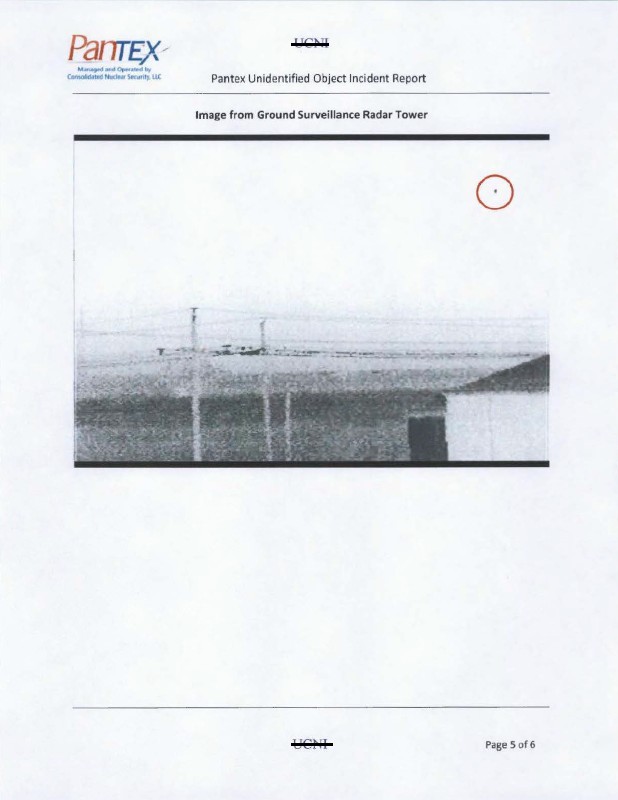
Read the Full Incident Report (PDF) on WAR.GOV
2. “Unlike Anything I Had Seen” — Eastern U.S., 2019
A Navy Range Fouler debrief — the standardized form used when an unauthorized object intrudes on controlled military airspace — describes an object seen in 2019 by five military-affiliated observers. One aviator wrote that it showed “flight characteristics unlike anything I had seen” in 28 years between the Air Force and Navy: a small, rectangular-looking object moving in a straight line at high speed, gone from view within 10–15 seconds even at lower zoom. Several observers with comparable experience couldn’t identify it either.
View on DVIDS (Official DoD Archive)
3. The “Deformed Balloon” — Atlantic Ocean, 2020
Another Range Fouler debrief, this one heavily redacted, describes a darker maroon object roughly 12–15 feet tall encountered over the Atlantic. A Navy weapons systems officer wrote that “structurally, it appeared as a large, somewhat deformed balloon,” though the crew wasn’t able to verify that before passing it at the merge. It’s a good example of a file that reads far less dramatically than the headlines around this release suggest — genuinely unresolved, but not obviously exotic either.
View on DVIDS (Official DoD Archive)
4. A Small Metallic Object — Eastern U.S., 2020
A third Range Fouler case describes a very small object moving in a constant direction with a metallic appearance and a reflective underside. Taken together with the 2019 and 2020 Atlantic cases, this cluster of Navy debriefs is arguably the most consistent, least sensationalized evidence in the whole release — trained observers, standardized paperwork, and an object nobody could identify.
View on DVIDS (Official DoD Archive)
5. A “Six-Pointed Star” on Sensor — Yellow Sea, 2025
The most recent case in the release, from the military’s Indo-Pacific Command. A military sensor video over the Yellow Sea shows what the file describes as “an area of contrast resembling a six-pointed star” — an unusual enough signature that it made the cut for public release rather than being resolved as a known object.
View on DVIDS (Official DoD Archive)
6. Tracked for Several Minutes — East China Sea, 2025
A companion case from the same 2025 Indo-Pacific timeframe, showing a sensor tracking an unidentified object over the East China Sea continuously for several minutes — notable simply for how long the object stayed on-screen compared to most of the other clips in the release, which last seconds.
View on DVIDS (Official DoD Archive)
7. A 90-Degree Turn — Middle East, 2023
One of the more visually striking clips in the release: a thin, line-like object appears to execute a sudden 90-degree change in direction before shrinking to a point in the frame. It’s one of the harder clips in this release to wave away as a simple optical or sensor artifact, though as with most of this release, no independent technical analysis has been done yet to rule out drone or balloon explanations.
View on DVIDS (Official DoD Archive)
8. A Formation of Objects — South China Sea, 2024
A separate 2024 clip shows several objects moving together in a narrow formation before the group moves out of frame. Multiple-object formation footage is rarer in these releases than single-object sightings, which is part of why this one stands out.
View on DVIDS (Official DoD Archive)
9. The 1996 Space Shuttle Columbia Photograph
A NASA still image taken through a window during the STS-80 Columbia mission shows an unidentified object in low Earth orbit that appears to tumble or rotate in a way consistent with a free-floating object. It’s a genuinely eerie image — and also a good illustration of how “unresolved” doesn’t always mean “unexplainable”: with thousands of fragments of human-made debris currently in orbit, the leading mundane explanation is space junk that simply wasn’t catalogued at the time.

Image 1
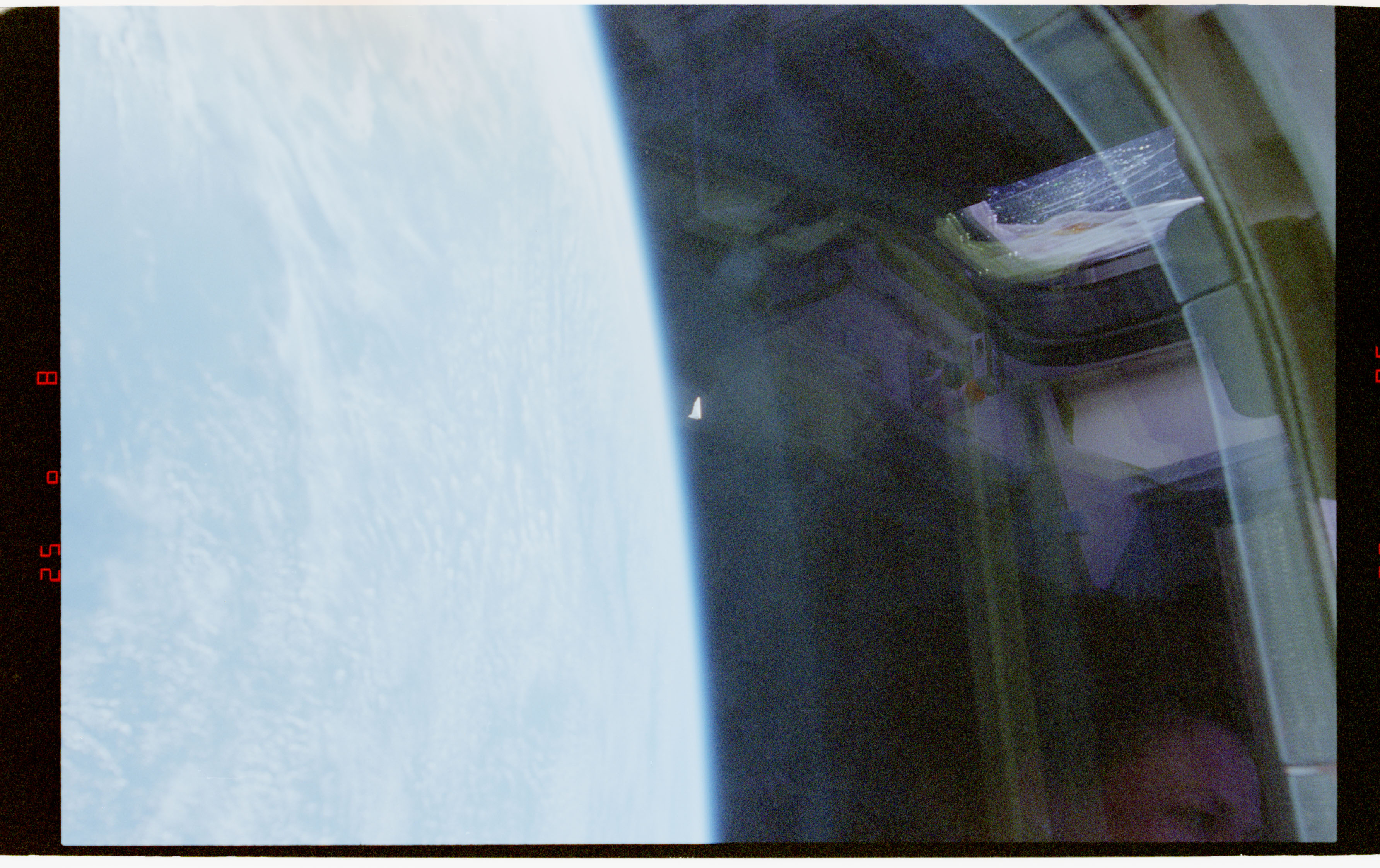
Image 2
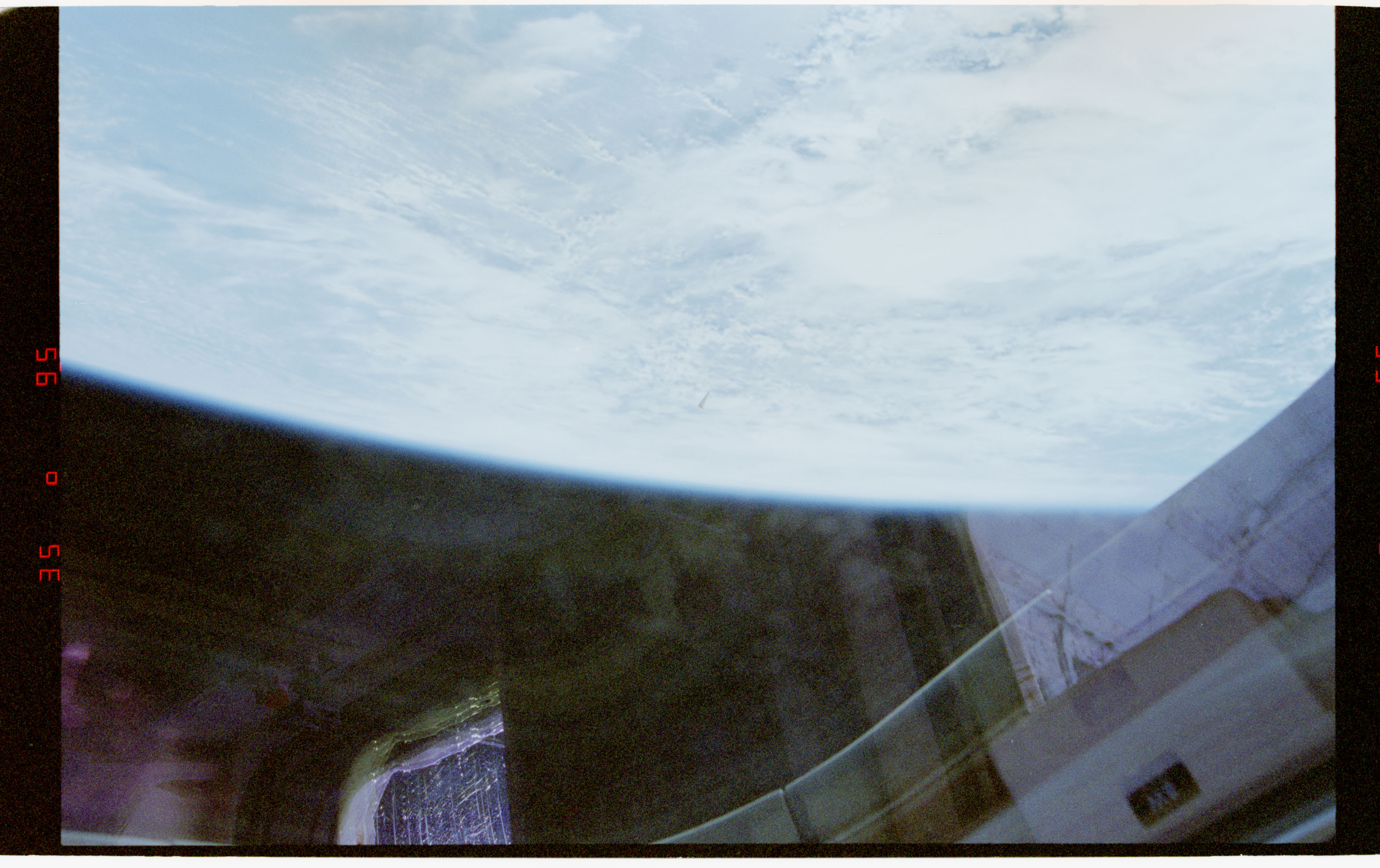
Image 3
All three NASA photos from the STS-80 Columbia mission (1996). Click any image to view it full size in a new tab. (Credit: NASA / Department of War)
View Full-Resolution Photo on WAR.GOV
10. The 1949 Los Alamos “Green Fireballs” Conference
The oldest and, in some ways, most historically significant document in the release: the full transcript of a February 1949 conference at Los Alamos convened to investigate a wave of “green fireball” sightings near the lab and other sensitive atomic sites. The attendee list alone is remarkable — physicist Edward Teller, later known as the father of the hydrogen bomb, ran the discussion, and future Nobel laureate Fred Reines was among the participants. Physicist Lincoln LaPaz described one sighting, the “Starvation Peak event,” as a sudden yellow-green light traveling nearly horizontally for about two seconds — inconsistent with a typical meteor. The lab director closed the conference admitting the objects’ horizontal paths and total silence remained unexplained. The group never reached consensus.
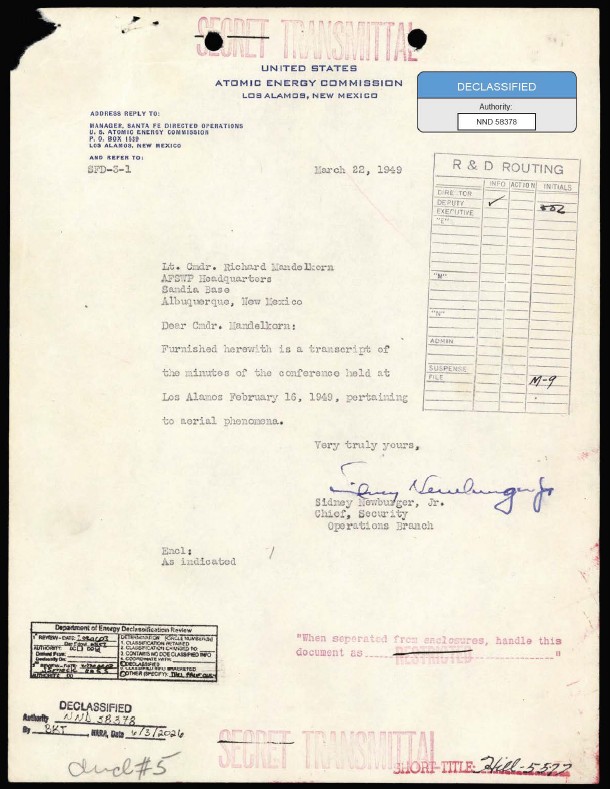
Read the Full 1949 Transcript (PDF) on WAR.GOV
Also in the Release: Two Cases That Have Real Explanations
Because a disclosure archive is only as trustworthy as its willingness to show its work, it’s worth mentioning two files from this release that come with credible, mundane explanations attached — proof that “unresolved” case files aren’t automatically evidence of anything exotic.
The 1948 Horten flying wing study. A Top Secret intelligence study from 1948 reproduces photographs of the Horten flying wing, a tailless German aircraft that looked remarkably like a flying disc. A glider prototype reportedly reached 14,200 feet as early as 1938 — the study’s own explanation for a number of early “flying disc” reports in the immediate postwar years.
Apollo 14 and 17 “light flash” debriefs. Astronaut debriefing records describe flashes of light seen during spaceflight. These are now well understood as a biological effect — high-energy cosmic rays passing through the eye and striking the retina — rather than an external visual phenomenon.
What This Release Actually Tells Us
Taken as a whole, the fourth PURSUE release doesn’t hand anyone a smoking gun — but it does widen the paper trail in a useful way. The Pantex incident and the cluster of Navy Range Fouler debriefs are the strongest evidence in the batch precisely because they’re the least sensational: trained personnel, standardized reporting forms, and objects that simply don’t match anything in the observers’ own frame of reference. The historical material — the 1949 Los Alamos transcript in particular — is arguably just as valuable, because it shows this has been a serious, if quiet, scientific question inside the government for more than 75 years.
The Department of War has said this won’t be the last release. You can browse the full database, filter by agency, release, or file type, and download the underlying documents and videos yourself at war.gov/UFO.
Follow UAP Disclosure Reads for continued coverage of the PURSUE releases and how they connect to the broader disclosure literature.