
Last updated: June 27, 2026
Affiliate disclosure: This review contains Amazon affiliate links. As an Amazon Associate I earn from qualifying purchases at no extra cost to you.
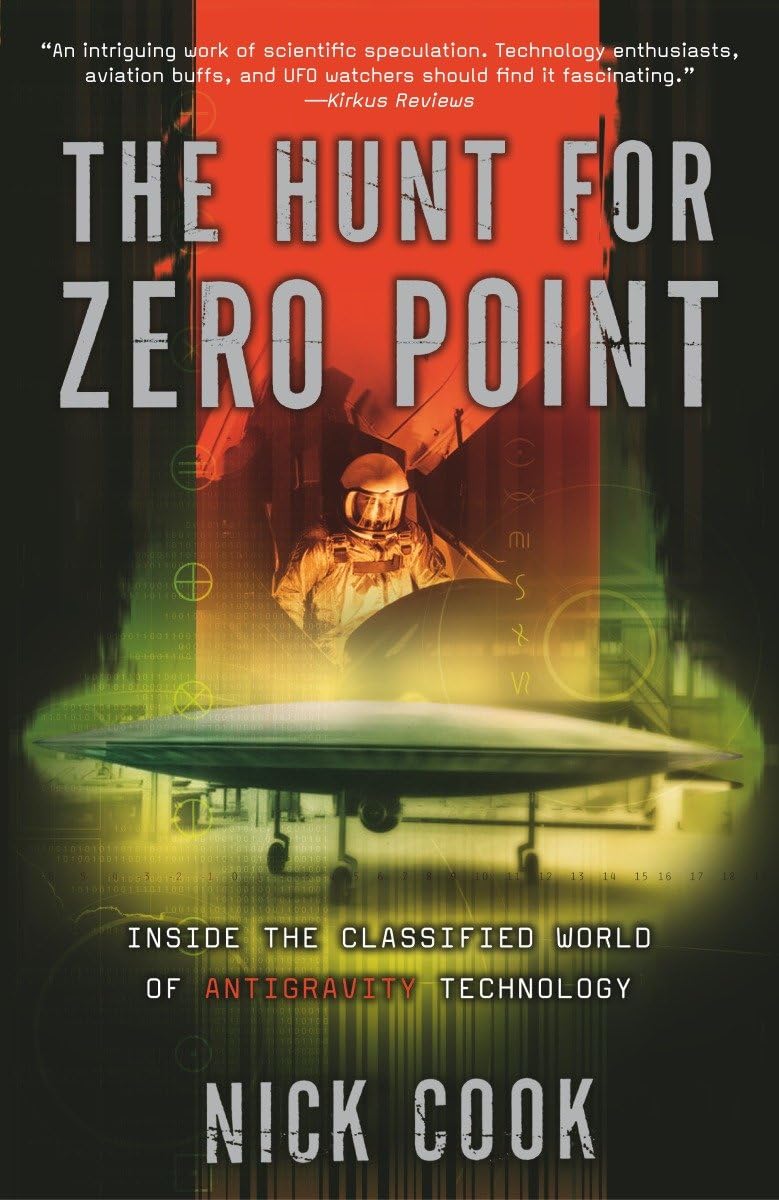
Inside the classified world of antigravity
In 2001, Jane’s Defence Weekly editor Nick Cook began investigating one of the most persistent rumors in aerospace history: that both Nazi Germany and the postwar United States had conducted serious research into gravity control. What he found — in declassified files, conversations with former defense insiders, and the physical evidence of a covert postwar technology transfer — was far more substantial than he expected, and far more unsettling.
What It Covers
The book traces a single thread: the possibility that Nazi Germany developed antigravity and zero-point energy propulsion technology during World War II, and that the United States quietly absorbed both the scientists and the research through Operation Paperclip. Cook’s investigation moves through several interlocking areas:
- Die Glocke (The Bell): Cook investigates accounts of a mysterious Nazi experimental device — described as a bell-shaped apparatus that allegedly manipulated gravitational and electromagnetic fields. He interviews witnesses, reviews fragmentary documents, and traces the postwar fates of the scientists who worked on it.
- Operation Paperclip and the technology transfer: The U.S. government’s recruitment of Nazi scientists is well-documented history, but Cook digs into which programs and research lines may have been absorbed into classified American projects beyond the publicly known rocket work.
- T. Townsend Brown: Cook examines the career of this American physicist, whose experiments with electrogravitics in the 1950s appeared to produce measurable thrust — and who subsequently disappeared into classified work. Brown’s file was heavily redacted when Cook reviewed it.
- The black budget world: Drawing on his years of defense industry journalism, Cook maps the architecture of classified aerospace spending — the programs that consume billions of dollars with no public accounting — and argues that the scale of that secrecy requires something more significant than conventional stealth aircraft to justify it.
- Zero-point energy: Cook engages seriously with the physics of zero-point energy — the quantum vacuum energy that permeates all space — and interviews credentialed scientists who believe it could one day be harnessed for propulsion. He is careful to distinguish speculation from documented research.
Why It Matters
Cook is not a fringe writer. He is an aerospace journalist who spent his career inside the defense industry, with access to facilities, programs, and officials that few outsiders ever see. That background makes The Hunt for Zero Point a distinctive entry in the UAP literature: it approaches the subject not through witness testimony or government documents, but through the architecture of classified military-industrial research.
Several elements give the book unusual credibility:
- Cook never overclaims. He presents evidence, documents the gaps, and is transparent when he has reached the edge of what he can verify. He explicitly distinguishes between what he knows, what he suspects, and what remains opaque.
- His sources include retired aerospace engineers, defense contractors, and officials who spoke on background — the kind of sourcing that reflects real access, not internet conjecture.
- The structural argument — that the black budget is too large to be explained by known programs — is not a conspiracy theory. It is an accounting observation that has since been echoed by serious defense analysts and, more recently, by U.S. congressional testimony on UAP-related programs.
- Published in 2002, the book preceded the current era of government UAP disclosure by nearly two decades, yet several of its core concerns — hidden programs, recovered materials, non-human technology — have since migrated into congressional hearings and official government reports.
Readers interested in the intersection of classified aerospace, advanced propulsion, and the UAP question will find The Hunt for Zero Point essential reading. It provides the industrial and scientific context that pure witness-testimony books often lack.
Closing Recommendation
The Hunt for Zero Point is one of the most carefully constructed investigative books in this space. Nick Cook brings genuine journalistic discipline to a subject that attracts a great deal of undisciplined speculation. The book does not resolve its central question — Cook is honest that it cannot — but it maps the territory with rigor and leaves readers with a more sophisticated understanding of why the question may matter more than mainstream sources have acknowledged.
If you are new to the UAP literature, this is an excellent starting point for understanding the classified aerospace dimension of the phenomenon. If you are already deep in the subject, Cook’s insider access and methodical approach will add a layer of industrial and historical context that few other books provide.
Highly recommended for anyone serious about understanding the full scope of what may have been hidden — and why.
Frequently Asked Questions
What is The Hunt for Zero Point by Nick Cook about?
The Hunt for Zero Point (2001) is investigative journalist Nick Cook’s decade-long investigation into classified anti-gravity and propulsion research, tracing a thread from Nazi wartime experiments through American black programs to the present. Cook — the aviation editor of Jane’s Defence Weekly — argues a classified breakthrough in propulsion physics may explain UAP performance.
Who is Nick Cook?
Nick Cook is a British aviation journalist who served as the aerospace consultant and aviation editor at Jane’s Defence Weekly for over two decades. His professional standing gave him unusual access to aerospace industry insiders who shared information about classified research programs they could not discuss publicly.
What is zero-point energy?
Zero-point energy refers to the lowest possible energy state of a quantum mechanical system — a theoretical baseline energy inherent in the fabric of space. Cook investigates claims that classified programs have attempted to harness this energy for propulsion, which would explain some reported UAP performance characteristics.
How does The Hunt for Zero Point connect to UAP research?
Cook’s investigation suggests that some UAP sightings may involve classified human aerospace technology rather than non-human craft — a hypothesis some researchers call “USAPs” (Unacknowledged Special Access Programs). Understanding what human technology can do is essential context for evaluating genuinely anomalous UAP cases.