
Last updated: June 27, 2026
Affiliate disclosure: This review contains Amazon affiliate links. As an Amazon Associate I earn from qualifying purchases at no extra cost to you.
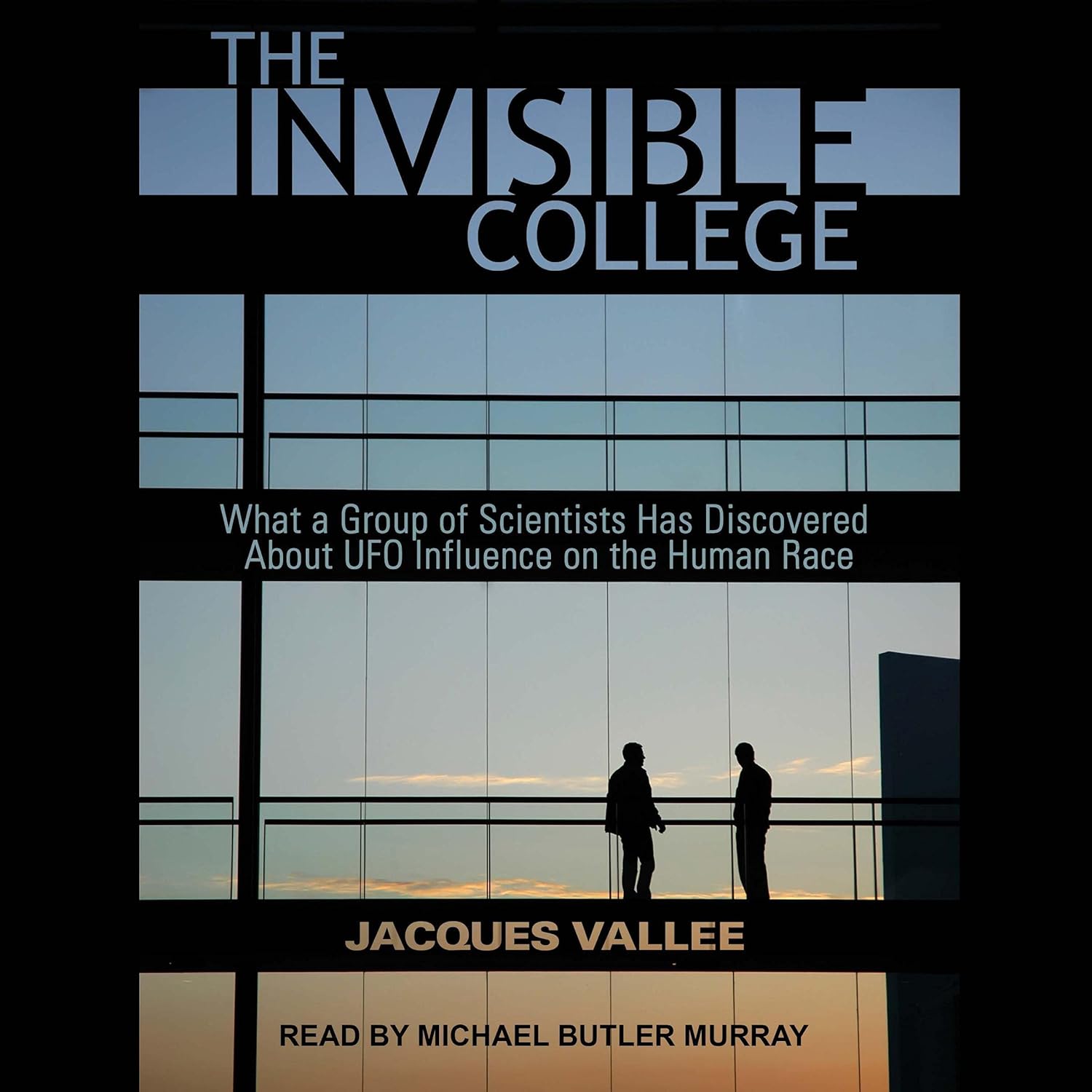
| Author | Jacques Vallée |
| Publisher | Anomalist Books |
| Published | 1975 |
| Rating | ★★★★★ |
The research framework behind the phenomenon
Published in 1975, The Invisible College remains one of the most rigorous early arguments for treating the UFO phenomenon as a legitimate subject of scientific inquiry. Jacques Vallée assembles a decade of case data and proposes a theoretical framework that goes beyond both the extraterrestrial hypothesis and the dismissive skeptical position — arguing that the phenomenon is real, structured, and exerting a measurable influence on human consciousness and culture.
What It Covers
The Invisible College is built around two interlocking arguments: that the UAP phenomenon is real and data-rich enough to demand scientific attention, and that the institutions we would normally trust to investigate it are structurally incapable of doing so. Vallée addresses both in turn.
- The case for the phenomenon: Vallée draws on a global case database accumulated over more than a decade to demonstrate that UAP reports share consistent physical, psychological, and behavioral characteristics across cultures and continents. The pattern, he argues, is too coherent to dismiss as misidentification or mass delusion.
- The control system hypothesis: Building on arguments first developed in Passport to Magonia, Vallée proposes that the phenomenon functions as a kind of control system — something that shapes human belief and behavior across time, adapting its apparent form to the expectations of each era. It appeared as angels and demons to medieval observers, as airships to the Victorians, and as spacecraft to the twentieth century.
- The sociology of science: A significant portion of the book examines why mainstream institutions — universities, government agencies, professional scientific societies — have collectively refused to investigate the phenomenon. Vallée identifies the mechanisms of stigma, career risk, and institutional incentive that enforce silence among researchers who have privately encountered compelling evidence.
- The invisible college itself: Vallée describes the informal network of scientists, engineers, military personnel, and academics who were quietly sharing data, comparing notes, and building a picture of the phenomenon outside any official framework. He argues this is both a necessity and a model — the only way serious research can proceed when institutions fail.
- The impact on witnesses: The book documents the psychological and physiological effects reported by close-encounter witnesses, presenting them as data points rather than curiosities, and arguing they constitute some of the most significant evidence the phenomenon produces.
Why It Matters
Few books in the UAP literature have aged as well as The Invisible College. Written in 1975 — nearly five decades before Luis Elizondo testified before Congress and before the Pentagon acknowledged the existence of classified UAP programs — it diagnosed with remarkable precision the structural problems that would delay serious inquiry for another generation.
- The research model Vallée described — credentialed scientists collaborating informally, outside institutional channels, to build a serious evidentiary record — is exactly the model that AATIP ultimately adopted. Elizondo has acknowledged Vallée’s influence directly.
- The control system hypothesis remains one of the most intellectually serious frameworks for interpreting the phenomenon. It does not require the phenomenon to be extraterrestrial, does not require it to be supernatural, and is compatible with the pattern of data that fifty years of additional research has produced.
- Vallée’s analysis of the sociology of scientific silence — why competent researchers stay quiet even when they have compelling data — reads today as a precise description of what whistleblowers like David Grusch have described from inside the classified world.
- The book is rigorous without being dry. Vallée writes as a scientist who has genuinely grappled with anomalous data, and his frustration with institutional timidity is measured rather than polemical. The result is a model of how to think carefully about a subject that attracts enormous amounts of careless thinking.
For readers coming to the UAP subject from the current wave of congressional hearings and government acknowledgments, The Invisible College provides the intellectual history that explains how the field got here. It shows that the serious questions were being asked decades ago — and that the delay in public acknowledgment was a function of institutional failure, not absence of evidence.
Closing Recommendation
The Invisible College is one of the handful of books that genuinely shaped how serious UAP research developed. Vallée’s dual contribution — a methodological framework for investigation and a theoretical framework for interpretation — has proven more durable than almost anything else written in this space. The invisible college he described eventually became visible, and the questions he posed in 1975 are now being asked in Senate hearings and Pentagon briefings.
If you have read Vallée’s other works — Passport to Magonia, Dimensions, Confrontations — this is the book that explains the research philosophy underlying all of them. If you are new to his work, it is an excellent starting point: shorter and more accessible than the case-study books, and focused on the fundamental question of how and why the phenomenon should be studied.
Essential reading — one of the most important books in the UAP literature.
Frequently Asked Questions
What is The Invisible College by Jacques Vallée about?
The Invisible College (1975) proposes that UAP represents a control system — an external intelligence deliberately managing human evolution and belief systems. Vallée argues a small network of serious researchers (“the invisible college”) has quietly gathered evidence outside official channels, pointing to a phenomenon far more significant than publicly acknowledged.
What does Vallée mean by a “control system”?
Vallée’s control system hypothesis holds that the UAP phenomenon — with its apparent ability to appear and disappear at will, its behavioral adaptation to human expectations, and its historical consistency — suggests an intelligence deliberately shaping human development rather than simply observing it.
Who was “the invisible college” Vallée refers to?
Vallée used the term to describe a network of scientists, government officials, and researchers quietly studying UAP while publicly maintaining professional distance from the subject — a hidden community of serious investigators working outside official programs.
How does The Invisible College’s thesis hold up today?
The book’s core argument — that UAP is studied seriously in classified settings while being publicly dismissed — has been substantially confirmed by the revelation of AATIP, AARO, and the PURSUE portal. The “invisible college” dynamic Vallée described in 1975 turns out to have been operational within the U.S. government itself.