Last updated: June 27, 2026
Affiliate disclosure: This review contains Amazon affiliate links. As an Amazon Associate I earn from qualifying purchases at no extra cost to you.
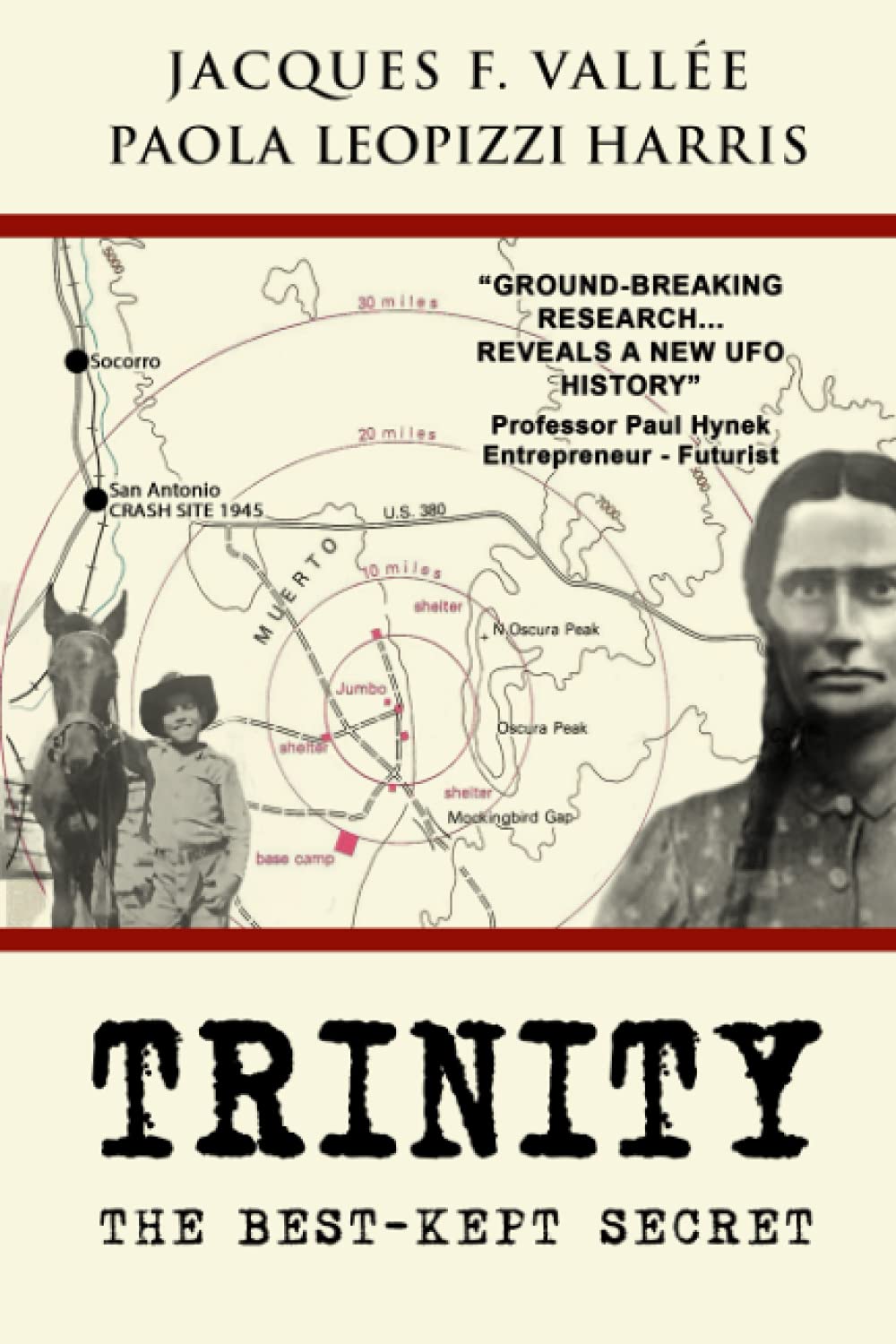
| Authors | Jacques F. Vallée & Paola Leopizzi Harris |
| Publisher | Starworks USA |
| Published | 2021 |
| Rating | ★★★★☆ |
Roswell isn’t the beginning of the story. It’s two years late.
What It Covers
In August 1945 — just weeks after the Trinity nuclear test detonated in the New Mexico desert — two farm boys stumbled across something in a remote arroyo near San Antonio, NM. José Padilla, age nine, and Remigio Baca, age seven, found a damaged craft partially embedded in the earth. Avocado-shaped, roughly twenty-five feet long, with unusual surfaces unlike any metal either boy had ever touched. They returned to the site repeatedly over the following days, and they brought pieces of the wreckage home.
This is the case at the center of TRINITY: The Best-Kept Secret. Jacques Vallée and Paola Leopizzi Harris spent years investigating it — conducting multiple site visits, interviewing the now-elderly witnesses at length, and subjecting alleged material samples to metallurgical analysis. The book documents their methodology in full: the topographical surveys, the cross-referencing of witness accounts across decades, the anomalous properties of material that reportedly returned to its original shape after being bent.
What makes the case structurally different from most crash-retrieval claims is the timeline. The Trinity nuclear test occurred on July 16, 1945. The alleged crash followed weeks later, in the same region. Vallée does not overlook the proximity. He raises the question directly: was there a connection between the first nuclear detonation in human history and the appearance of this craft? He doesn’t answer it conclusively — but the question itself is the kind of thing only Vallée would think to ask.
Why It Matters
The credibility of this book lives and dies with its primary author. Jacques Vallée is not a sensationalist. He is the scientist who inspired the character of Lacombe in Close Encounters of the Third Kind, a computer scientist with a PhD in astronomy, and the researcher whose interdimensional hypothesis remains the most intellectually rigorous challenge to the conventional extraterrestrial model. When Vallée puts his name on a crash-retrieval case, it commands a different kind of attention than the standard fare.
The witnesses — Padilla and Baca — maintained consistent accounts across more than seven decades without seeking publicity or financial gain. Harris, who had cultivated relationships with both men over many years, provides the biographical context that transforms their testimony from isolated claims into something more coherent. The accounts hold together under scrutiny in ways that cannot be easily dismissed.
If the account is accurate, the implications extend well beyond adding another case to the retrieval literature. A 1945 crash predates Roswell. It places the phenomenon in the specific context of the atomic age’s first moment — and raises the possibility that what we’ve been calling the modern UAP era began not in 1947 but in the summer America tested its first nuclear weapon. That reframing alone is worth the read.
Caveats
The book is not without its critics, and some of the pushback is legitimate. The primary witnesses were children at the time of the events, and their accounts — however consistent — cannot be corroborated by government documentation. Vallée himself is careful to note the limits of what can be established. The metallurgical analysis of the material samples is suggestive but not definitive; chain of custody over seven decades is inherently compromised.
The writing is also uneven. The investigative sections, driven by Vallée’s analytical precision, are compelling. Other passages, where the narrative reconstructs events from memory, read more loosely. This is a field investigation report as much as it is a book, and it reads that way. Readers expecting the literary rigor of Vallée’s earlier solo works like The Invisible College will notice the difference.
Who It’s For
Researchers focused on crash-retrieval cases, anyone tracking the pre-Roswell history of the phenomenon, and readers who understand that Vallée’s participation in any investigation raises its floor of seriousness considerably. Also essential for anyone interested in the intersection of the UAP phenomenon with the nuclear era — a dimension of the subject that remains underexplored.
Where to get it
Enjoyed this review?
New reviews, reading lists, and UAP book recommendations — no spam. Drop your email on the contact page and ask to be added.
Frequently Asked Questions
What is TRINITY: The Best-Kept Secret about?
TRINITY (2021) by Jacques Vallée and Paola Leopizzi Harris investigates the alleged 1945 UAP crash near San Antonio, New Mexico — which they argue predates the 1947 Roswell incident by two years. The book presents testimony from elderly witnesses, physical evidence analysis, and an argument that Trinity may be the most important UAP crash case in history.
Who are Jacques Vallée and Paola Harris?
Jacques Vallée is a French-American computer scientist and UAP researcher who has been investigating the phenomenon since the 1960s. Paola Leopizzi Harris is an Italian-American author and researcher who conducted fieldwork in the San Antonio, New Mexico area and collected firsthand testimony from surviving witnesses to the alleged 1945 crash.
What is the Trinity crash case?
In August 1945, two young boys near San Antonio, New Mexico allegedly witnessed a large, egg-shaped craft crash in a field near the Trinity test site — location of the first atomic bomb detonation just weeks earlier. Vallée and Harris argue this case has been overlooked despite compelling physical evidence and consistent witness testimony.
How does Trinity compare to the Roswell case?
The Trinity crash, if real, predates the 1947 Roswell incident by approximately two years and occurred near the site of the world’s first nuclear test — a coincidence Vallée and Harris consider significant. Unlike Roswell, Trinity has received little mainstream attention despite what the authors argue is more accessible physical evidence and surviving witnesses.