
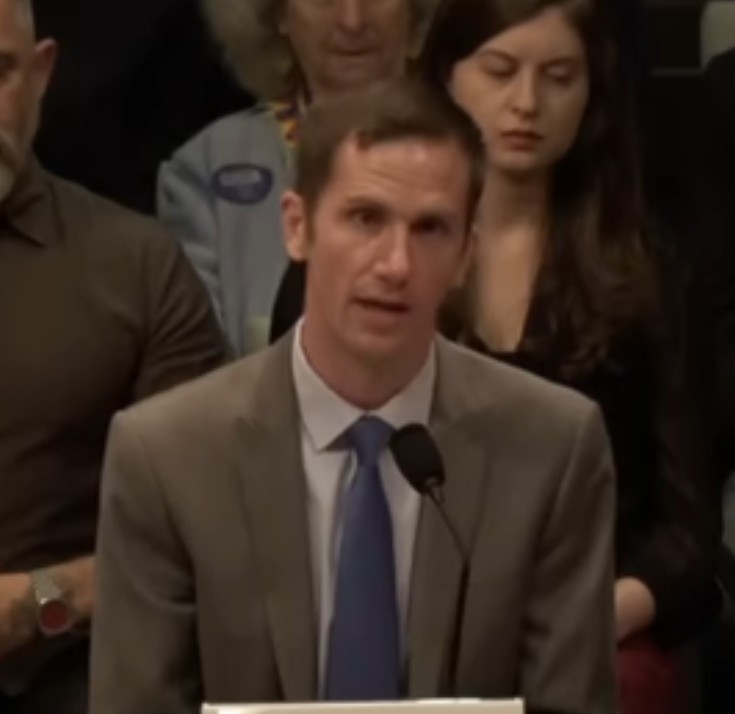
Dylan Borland is a former U.S. Air Force geospatial intelligence specialist who became a federal whistleblower after claiming his career was systematically destroyed following a 2012 UAP encounter at Langley Air Force Base. A 1N1 imagery analyst who served from 2010 to 2013, Borland testified publicly for the first time before the U.S. House Committee on Oversight and Government Reform on September 9, 2025, describing a triangular craft encounter he says he reported through official channels — and alleging that a decade of professional retaliation followed.
Biography & Background
(Photo to be added — U.S. House Committee public domain testimony photo from September 9, 2025 hearing)
Dylan Borland served on active duty in the United States Air Force from 2010 to 2013 as a 1N1 Geospatial Intelligence (GEOINT) Specialist — an imagery analyst trained to analyze video, radar returns, and advanced electro-optical data. During his active duty service, Borland was assigned to Langley Air Force Base in Hampton, Virginia, where he performed overnight intelligence duties.
Following his active duty service, Borland transitioned to the defense contracting sector, working as a senior analyst at BAE Systems and Intrepid Solutions. These roles continued his work analyzing geospatial intelligence imagery and video — the same skill set he had developed in the Air Force.
Borland describes himself as a federal whistleblower who formally reported his UAP encounter to the Intelligence Community Inspector General (ICIG) and to the All-domain Anomaly Resolution Office (AARO). He alleges that the act of reporting triggered sustained professional retaliation — including workplace harassment and deliberate efforts to deny him security clearances — spanning more than a decade.
The Langley AFB UAP Encounter (2012)
In 2012, while on overnight duty at Langley Air Force Base, Borland stepped outside for a break and observed a silent triangular craft hovering approximately 100 feet above him. In his congressional testimony and subsequent interviews, Borland described the encounter in precise and consistent terms.
The craft was triangular in shape and appeared to be made of a material he described as “fluid or dynamic” — not rigid or metallic in the conventional sense. It produced no sound and no visible propulsion system. Notably, Borland testified that the craft interfered with his mobile phone during the encounter, rendering it inoperable while the object was present.
After hovering for several minutes, the craft ascended rapidly — reaching what Borland described as commercial jet altitude in a matter of seconds — with zero kinetic disturbance, no sound, and no wind displacement. This behavior matches characteristics reported in other military UAP encounters: instantaneous or near-instantaneous acceleration with no observable propulsion or acoustic signature.
Borland produced detailed drawings of the craft in the aftermath of his sighting. These sketches became part of his official disclosures to the ICIG and AARO. As a trained geospatial imagery analyst, Borland’s professional background — specifically in the analysis of aerial and electro-optical data — informed both the detail of his recollection and the rigor of his documentation.
Borland has claimed direct firsthand knowledge not only of the 2012 encounter but of “craft and technologies that are not ours and are reportedly operating without congressional oversight.” The full scope of his classified disclosures has not been made public.
Congressional Testimony (September 9, 2025)
On September 9, 2025, Borland testified publicly before the House Committee on Oversight and Government Reform at a hearing titled “Restoring Public Trust Through UAP Transparency and Whistleblower Protection.” It was his first time testifying publicly, though he had previously made confidential disclosures to government oversight bodies.
In his written testimony submitted to the committee, Borland outlined the 2012 Langley encounter in detail and described the professional consequences he alleges followed: sustained workplace harassment, deliberate obstruction of his security clearance applications, and what he characterized as a coordinated effort to force him out of intelligence work entirely.
Borland’s testimony was part of a broader hearing that included other military UAP witnesses. His appearance was significant for two reasons: first, he represented a lower-ranking enlisted/contractor witness rather than a senior officer or intelligence official, offering a ground-level account of both the encounter and its aftermath. Second, his allegations of sustained retaliation over more than a decade provided concrete evidence for the argument that the UAP stigma Graves and others have described is not merely cultural but actively enforced.
Committee members from both parties questioned Borland on the specifics of the alleged retaliation, the chain of custody of his ICIG and AARO reports, and the nature of his classified knowledge claims.
Whistleblower Status & Significance
Borland’s case sits at the intersection of two parallel debates in the UAP disclosure space: the question of what military personnel have actually seen, and the question of what happens to them when they report it. Where witnesses like David Fravor and Ryan Graves were senior officers whose careers were largely intact when they began speaking publicly, Borland represents a category of witness whose post-reporting experience was markedly worse.
His formal status as a federal whistleblower — with disclosures on record at both the ICIG and AARO — provides a documented paper trail that distinguishes his case from informal or anecdotal accounts. The existence of those disclosures also means that, unlike many UAP witnesses, his claims have formally entered the government’s own investigative record.
Borland’s testimony and the hearing at which it was delivered were part of a post-2023 wave of congressional action on UAP — a legislative environment substantially shaped by the July 2023 Grusch/Fravor/Graves hearing and the subsequent provisions in the 2023 and 2024 National Defense Authorization Acts requiring the DoD to establish formal UAP reporting channels and whistleblower protections.
Frequently Asked Questions
What did Dylan Borland claim to see at Langley Air Force Base?
In 2012, while on overnight duty at Langley AFB, Borland observed a silent triangular craft hovering approximately 100 feet above him. The craft appeared to be made of a fluid or dynamic material, produced no sound, interfered with his mobile phone, and then ascended to commercial jet altitude within seconds with no visible propulsion and no wind displacement.
What is Dylan Borland’s military background?
Borland served on active duty in the U.S. Air Force from 2010 to 2013 as a 1N1 Geospatial Intelligence Specialist — an imagery analyst trained to assess aerial video, radar returns, and electro-optical data. After leaving the military, he worked as a senior analyst at BAE Systems and Intrepid Solutions in defense contracting roles.
When did Dylan Borland testify before Congress?
Borland testified publicly before the House Committee on Oversight and Government Reform on September 9, 2025, at the hearing “Restoring Public Trust Through UAP Transparency and Whistleblower Protection.” It was his first public testimony, though he had previously filed formal disclosures with the Intelligence Community Inspector General and AARO.
What retaliation does Borland claim he faced?
Borland alleges more than a decade of sustained professional retaliation following his UAP reports, including workplace harassment, deliberate obstruction of his security clearance applications, and systematic efforts to push him out of intelligence work. He describes his career as having been “deliberately obstructed” by government agencies in response to his disclosures.
Did Dylan Borland formally report his sighting to the government?
Yes. Borland filed formal disclosures with both the Intelligence Community Inspector General (ICIG) and the All-domain Anomaly Resolution Office (AARO), making him a federal whistleblower with a documented record. His sketches of the craft and written accounts are part of those official filings.
Why is Borland’s testimony significant?
Borland represents a category of UAP witness rarely heard in congressional testimony: a lower-ranking enlisted analyst rather than a senior officer. His account of sustained retaliation provides concrete evidence for the argument that institutional stigma around UAP reporting is actively enforced — not merely cultural — and directly supports legislative arguments for formal whistleblower protections for UAP reporters.