
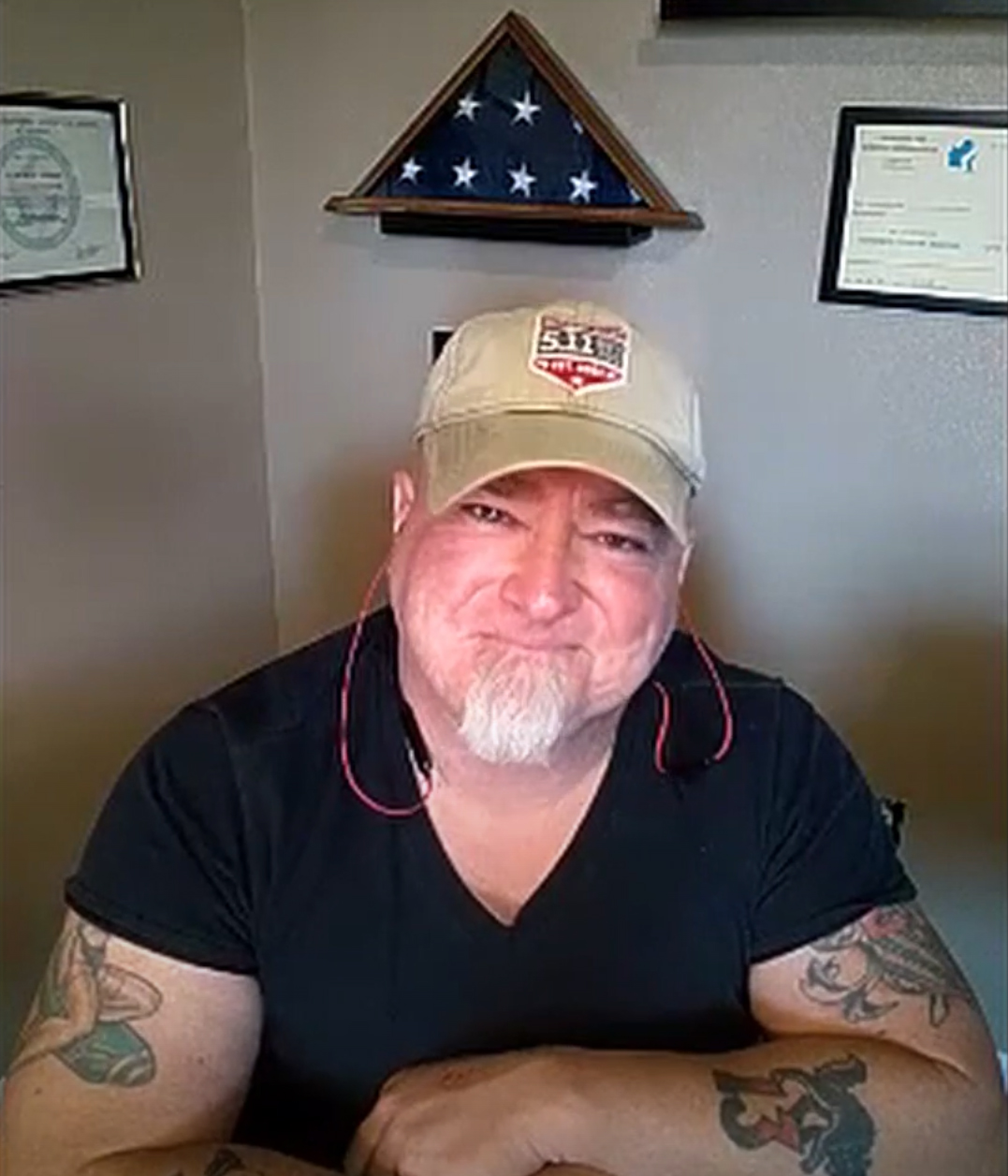
Luis “Lue” Elizondo is a former U.S. Army counterintelligence special agent and retired Defense Intelligence Senior Level (DISL) civilian official who directed AATIP — the Pentagon’s classified Advanced Aerospace Threat Identification Program — from approximately 2010 until his resignation in October 2017. His departure from the DoD and subsequent public advocacy helped trigger the most significant wave of U.S. government UAP transparency in decades.
Biography & Background
Born in Miami, Florida, to a Cuban-American family, Elizondo developed an early interest in national security and intelligence. After studying at the University of Florida, he joined the U.S. Army as a counterintelligence special agent — a career that would span more than two decades and take him to some of the most sensitive programs in the U.S. intelligence community.
Over his DoD career, Elizondo held roles spanning biodefense, counterterrorism, and national security special programs under multiple administrations. He eventually reached the Defense Intelligence Senior Level — the civilian equivalent of a general officer — serving within the Office of the Under Secretary of Defense for Intelligence (OUSDI). It was in that capacity that he was assigned to oversee AATIP, the program that would define his public legacy.
AATIP & Pentagon Years
The Advanced Aerospace Threat Identification Program was a classified Pentagon effort funded through a $22 million black budget earmark secured by Senator Harry Reid (D-NV), along with Senators Ted Stevens and Daniel Inouye. Its mandate: assess potential aerospace threats to national security — including Unidentified Aerial Phenomena (UAP) — with an emphasis on determining whether foreign adversaries had achieved technological breakthroughs beyond U.S. capabilities.
As AATIP’s director, Elizondo coordinated with the U.S. Navy and other military branches to catalog and analyze UAP encounters. Among the cases his team examined were the 2004 USS Nimitz incident — documented in the now-famous FLIR1 “Tic Tac” video — and two similar encounters from 2015 recorded off the U.S. East Coast (the Gimbal and GoFast videos).
From that classified case work, Elizondo developed what he calls the “five observables” — a taxonomy of characteristics that appeared consistently across the most credible UAP encounters:
- Sudden and instantaneous acceleration — beyond what current physics or known propulsion can explain
- Hypersonic velocities without signatures — moving at extreme speed with no sonic boom or heat trail
- Low observability — objects that evade radar and sensor systems in anomalous ways
- Trans-medium travel — transitioning seamlessly between air, water, and apparent near-space
- Positive lift — appearing to defy conventional aerodynamics without visible propulsion
Growing frustrated with what he characterized as bureaucratic resistance and institutional dismissiveness inside the Pentagon, Elizondo resigned in October 2017. In his resignation letter to then-Secretary of Defense James Mattis, he wrote that AATIP’s work had been blocked, stymied, and marginalized — leaving the United States without an adequate response to an unresolved national security question.
Key Disclosures
The December 2017 New York Times Exposé
On December 16, 2017, The New York Times published “Glowing Auras and ‘Black Money’: The Pentagon’s Mysterious U.F.O. Program” by Helene Cooper, Ralph Blumenthal, and Leslie Kean. The article named Elizondo as AATIP’s director, publicly confirmed the program’s existence for the first time, and was published alongside the first public release of the FLIR1 (Tic Tac) video. It is widely regarded as the moment that initiated the modern era of U.S. government UAP transparency.
The Three UAP Videos
Elizondo played a central role in the declassification and public release of three military UAP videos that became the cornerstone of the contemporary disclosure debate:
- FLIR1 (“Tic Tac”) — Filmed November 14, 2004, during the USS Nimitz carrier strike group exercises off San Diego. The object was tracked by Navy pilots including Commander David Fravor and Lieutenant Commander Alex Dietrich. It exhibited all five observables and outmaneuvered the F/A-18s pursuing it.
- Gimbal — Filmed in January 2015 off the U.S. East Coast. The object appears to rotate against the wind with no visible propulsion, prompting the now-famous “Look at that thing!” from the cockpit audio.
- GoFast — Also from 2015, showing a small object skimming at extreme speed near the ocean surface, tracked by an F/A-18 targeting pod.
The U.S. Navy officially confirmed the authenticity of all three videos in April 2020, stating they had not been “cleared for public release” when first published in 2017.
Inspector General Complaint (2022)
In 2022, Elizondo filed a formal complaint with the Department of Defense Inspector General, alleging illegal retaliation — including revocation of security clearances and deliberate defamation of his credentials — for his public UAP advocacy. The Pentagon confirmed the investigation in 2023. The complaint helped inform the whistleblower protection provisions included in the 2024 National Defense Authorization Act.
Congressional Testimony (November 2024)
On November 13, 2024, Elizondo testified before the House Oversight Committee at a landmark hearing titled Unidentified Anomalous Phenomena: Exposing the Truth. Testifying alongside Rear Admiral Tim Gallaudet (Ret.), former NASA official Michael Gold, and journalist Michael Shellenberger, Elizondo stated plainly: “UAP are real. Advanced technologies not made by our Government — or any other government — are monitoring sensitive military installations around the globe.” He described a “small cadre” within the federal government engaged in a culture of suppression and intimidation, telling lawmakers: “Excessive secrecy has led to grave misdeeds against loyal civil servants, military personnel and the public, all to hide the fact that we are not alone in the cosmos.” He also testified that documents submitted to Congress showed the U.S. government had been dealing with the UAP issue since the early 1950s.
Media Appearances & Key Links
- December 2017: Named as AATIP director in the landmark New York Times investigation
- 2018: Multiple interviews on Fox News with Tucker Carlson — among the first major televised discussions of AATIP
- 2019–2020: History Channel’s “Unidentified: Inside America’s UFO Investigation” — co-executive producer and primary on-screen subject across two seasons
- May 2021: CBS 60 Minutes interview with Bill Whitaker — estimated 10–15 million viewers; widely credited with mainstreaming UAP as a legitimate national security topic
- 2021: CNN interview with Anderson Cooper following the 60 Minutes broadcast
- September 2024: Imminent: Inside the Pentagon’s Hunt for UFOs (William Morrow) — Elizondo’s memoir and account of AATIP
Frequently Asked Questions
What is AATIP and why does it matter?
AATIP — the Advanced Aerospace Threat Identification Program — was a classified Pentagon program funded with $22 million in black budget money, initially secured by Senator Harry Reid. It represented the first officially confirmed U.S. government effort in decades to systematically study UAP using classified military sensor data and witness accounts. AATIP’s existence, confirmed publicly in 2017 largely through Elizondo’s actions, proved that the U.S. government had never stopped studying the phenomenon despite decades of official denial.
Did Luis Elizondo personally witness UAP?
Elizondo has stated that he reviewed classified evidence — including sensor data, video footage, and testimony from military witnesses — that convinced him UAP represent a genuine, unexplained phenomenon. He has been circumspect about personal sightings, consistently emphasizing the weight of the institutional and evidentiary record over personal anecdote. In multiple interviews, he has described the evidence as compelling enough that he would stake his professional reputation on its authenticity — which he effectively did by resigning and going public in 2017.
What happened to Elizondo after he left the Pentagon?
After resigning in October 2017, Elizondo joined To The Stars Academy of Arts & Science — co-founded by musician Tom DeLonge — as Director of Global Security and Special Programs. He co-produced the History Channel’s “Unidentified” series, became a prominent public advocate for UAP transparency, filed a DoD Inspector General complaint alleging government retaliation, testified before Congress in November 2024, and in September 2024 published Imminent: Inside the Pentagon’s Hunt for UFOs.
Are Elizondo’s claims credible?
His core claims have been confirmed by independent sources. The DoD confirmed AATIP’s existence. The U.S. Navy confirmed all three UAP videos are authentic military footage. The Senate Intelligence Committee cited UAP as a national security priority. His IG complaint alleging retaliation is under active DoD review. His wider claims about the nature of the phenomena remain consistent with testimony from other cleared witnesses, including David Grusch.
What was the significance of the 60 Minutes interview?
The May 2021 CBS 60 Minutes segment, in which Elizondo appeared alongside active-duty Navy pilots who had witnessed UAP first-hand, reached an estimated 10–15 million viewers. It is widely credited with legitimizing UAP as a serious national security topic in mainstream American discourse and directly accelerating the Congressional hearings and legislative activity — including the UAP Disclosure Act — that followed in 2022 and 2023.