
Last updated: June 16, 2026
Affiliate disclosure: This review contains Amazon affiliate links. As an Amazon Associate I earn from qualifying purchases, at no extra cost to you.
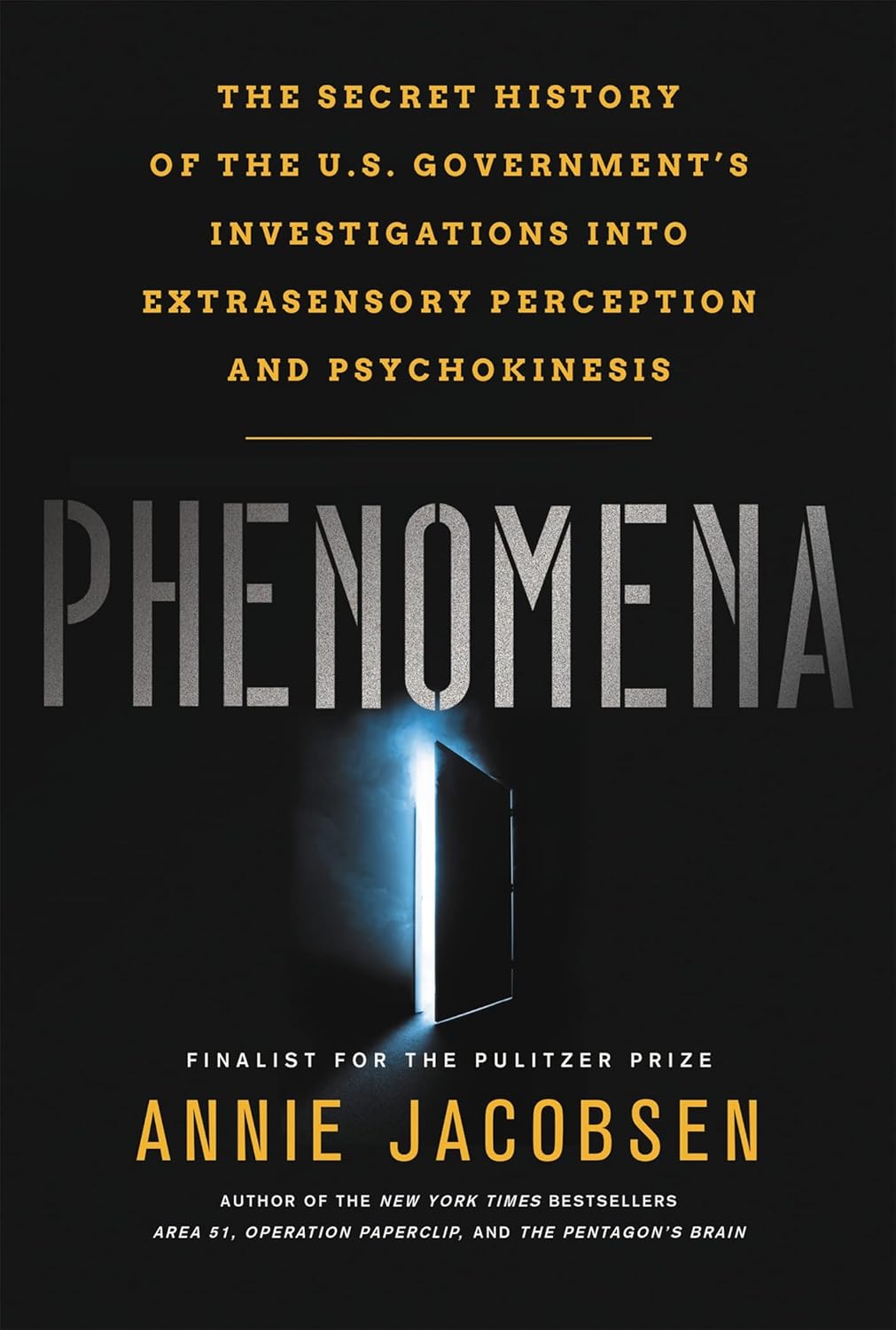
| Author | Annie Jacobsen |
| Publisher | Little, Brown and Company |
| Published | 2017 |
| Narrator | Annie Jacobsen |
| Rating | ★★★★★ |
For more than forty years, the U.S. government funded a classified program to investigate whether psychic phenomena — remote viewing, telepathy, precognition — were real enough to use as intelligence tools. Phenomena is the definitive account of that program, reported with the same rigor Annie Jacobsen brought to Area 51 and The Pentagon’s Brain. It reads like a thriller because the underlying story actually is one.
What It Covers
Phenomena (2017) traces the arc of U.S. government interest in psychic research from the Cold War through the post-9/11 era. Jacobsen draws on declassified documents, FOIA requests, and interviews with dozens of participants — scientists, military officers, intelligence analysts, and the psychics themselves.
Central to the book is the STARGATE program — the umbrella project that included remote viewing research conducted at Stanford Research Institute by physicists Russell Targ and Hal Puthoff, and later operationalized by the Defense Intelligence Agency. The book covers:
- The origins of government psychic research in the Cold War arms race, driven by fear that the Soviets had weaponized ESP
- Uri Geller’s classified testing at Stanford — and the genuine scientific puzzlement his results produced
- Operational remote viewing — cases where psychic intelligence was actually used in real-world missions
- The congressional investigation that led to STARGATE’s termination in 1995 — and the questions left unanswered
- The scientific debate that continues: were the results genuine anomalies, or statistical noise?
Why It Matters
Jacobsen is not a true believer and not a debunker. She’s a journalist, and Phenomena reads that way — she presents the evidence and lets readers decide. That discipline makes this one of the most credible books in the space. She had access to participants who had never spoken on record before, and the documentary foundation is unusually solid.
For UAP researchers, Phenomena matters because it establishes something important: the U.S. government has, for decades, taken seriously the idea that human consciousness can interact with reality in ways that defy conventional physics. That context is directly relevant to understanding how the same government approaches UAP — particularly the non-physical or “high strangeness” aspects of the phenomenon that mainstream coverage still avoids.
Closing Recommendation
Who should listen: Essential for anyone interested in the government’s classified research into human consciousness and paranormal phenomena. Pairs naturally with Dean Radin’s Real Magic for a science-focused double feature.
Who can skip it: If you’re exclusively focused on hardware — craft, propulsion, materials — this book covers adjacent territory. Still worth your time, but prioritize Hastings or Jacobsen’s Area 51 first.
Bottom line: Rigorous, surprising, and deeply reported. One of the best-researched books on any UAP-adjacent topic.
🎧 Listen on Audible 🛒 Buy on Amazon
Frequently Asked Questions
What is Phenomena by Annie Jacobsen about?
Phenomena (2017) investigates the U.S. government’s decades-long secret research into psychic phenomena — remote viewing, telekinesis, and human consciousness — conducted under programs like STARGATE at the Stanford Research Institute. Jacobsen draws on declassified documents and interviews with participants.
Who is Annie Jacobsen?
Annie Jacobsen is a Pulitzer Prize finalist and investigative journalist known for her books on classified U.S. government programs, including Area 51 and The Pentagon’s Brain. She is known for rigorous sourcing and extensive access to participants in the programs she covers.
How does Phenomena relate to UAP research?
The government’s interest in anomalous human consciousness research overlaps significantly with UAP investigations — many of the same scientists, programs, and agencies appear in both domains. Understanding the psychic research programs documented in Phenomena provides context for why UAP investigators often include non-physical or consciousness-related phenomena in their scope.
Did the U.S. government’s psychic research programs produce real results?
Jacobsen documents that government-funded remote viewing programs produced results that were difficult to explain by chance — leading to continued funding for over two decades. The programs were officially closed in 1995, but declassified records show analysts found the data “statistically significant and above chance.”