

Last updated: August 1, 2026
Watch the video review:
Affiliate disclosure: This review contains Amazon affiliate links. As an Amazon Associate I earn from qualifying purchases at no extra cost to you.
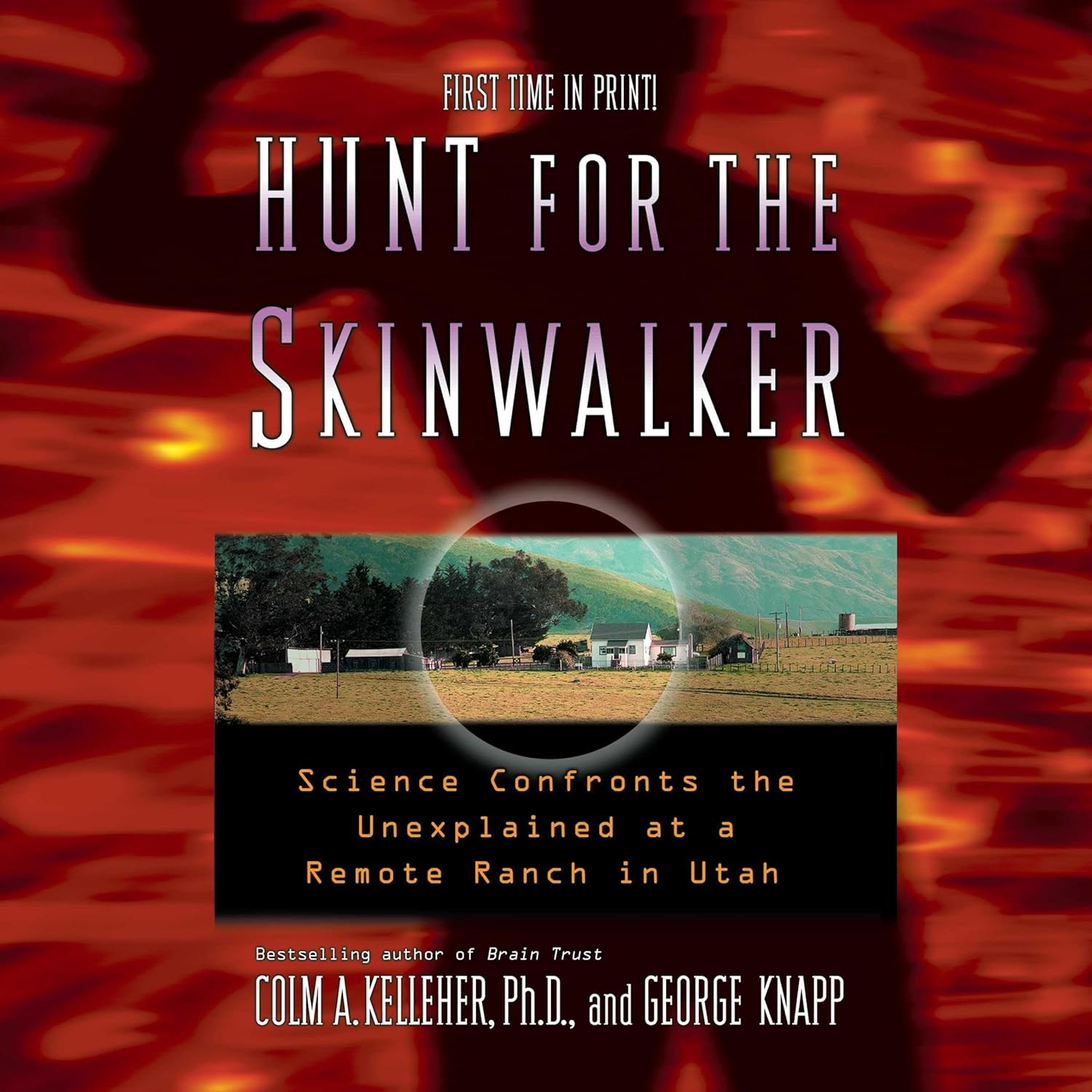
| Author | Colm A. Kelleher & George Knapp |
| Publisher | Paraview Pocket Books |
| Published | 2005 |
| Rating | ★★★★☆ |
The scientists who spent years chasing lights, orbs, and a shapeshifter on a Utah cattle ranch.
What It Covers
In 1996, a Utah family named the Shermans sold their cattle ranch in the Uintah Basin after two years of experiences they could no longer explain — a hulking, bulletproof wolf that walked directly into rifle fire and shrugged it off, floating orbs of blue light that hovered over the pasture at night, cattle found mutilated with surgical precision and no blood at the scene, and a recurring, shape-shifting presence the local Ute and Navajo communities have described for generations as a skinwalker. The buyer was Robert Bigelow, a Las Vegas real estate and aerospace magnate who had already funded the National Institute for Discovery Science (NIDS) to investigate exactly this kind of phenomenon.
Hunt for the Skinwalker, published in 2005 by NIDS biochemist Colm A. Kelleher and investigative journalist George Knapp, is the first full account of what happened next. Kelleher spent hundreds of days and nights on the property between 1996 and the mid-2000s as part of a small NIDS science team that installed cameras, motion sensors, and magnetometers, and tried — largely without success — to capture the phenomena on instruments rather than relying on witness testimony alone. Knapp, a Peabody and Emmy-winning reporter for Las Vegas’s KLAS-TV, was the only journalist NIDS allowed onto the ranch to observe the investigation directly, which is what makes the book’s access unusual: it is not a secondhand retelling of rumors, it is researchers describing what they personally logged.
The book moves chronologically through the Sherman family’s original ordeal, then into the NIDS team’s own field seasons — cattle mutilations discovered within hours of the animals being seen alive and healthy, unexplained tunnels and holes appearing overnight in solid ground, orange orbs that seemed to respond to being watched, and a night in 1997 when three NIDS investigators say they watched a large unidentified craft hover silently over the property before shooting away. Kelleher is careful throughout to separate what he personally witnessed from what was reported secondhand, and the book repeatedly notes when instruments failed to register something that a human observer swore they saw.
Is Skinwalker Ranch Real?
The ranch itself is real, and its unusual reputation predates Bigelow’s ownership by decades — Ute oral tradition describes the Uintah Basin as a site of skinwalker activity long before any modern UAP interest existed, and local ranching families in the area independently reported cattle mutilations and strange lights going back to at least the 1950s. What remains genuinely disputed is not the ranch’s existence or its reputation, but the specific claims of anomalous phenomena described in the book: none of the NIDS team’s most dramatic encounters were captured on video, audio, or instrumentation in a way that would satisfy independent scientific verification, and Kelleher acknowledges this limitation directly rather than papering over it.
This is the central tension that makes Hunt for the Skinwalker different from most UFO literature: it was written by a credentialed scientist describing the failure of scientific method to pin down a phenomenon, rather than a witness insisting on what they saw. Whether “real” means the land has a genuinely anomalous history, or means the specific 1990s NIDS observations are independently verifiable, are two different questions — and the book is honest that it can only answer the first one with confidence.
Why It Matters
Two things elevate Hunt for the Skinwalker above the enormous volume of ranch-lore and cryptid literature it superficially resembles. First, the investigators were not paranormal enthusiasts — Kelleher held a Ph.D. in biochemistry and had worked in pharmaceutical research before NIDS, and the institute’s approach was explicitly modeled on standard scientific field investigation: instrumentation, logs, chain-of-custody for physical evidence, and an internal culture that actively tried to debunk sightings before accepting them. Second, the book’s account did not stay confined to fringe circles. It went on to inspire feature coverage in The New York Times, Wired, and Newsweek, a widely discussed appearance on The Joe Rogan Experience, a 2018 documentary, and — most consequentially — it directly shaped official U.S. government interest in the subject a decade later.
That government connection is not incidental. According to later reporting and the authors’ own follow-up book, Skinwalkers at the Pentagon, a Defense Intelligence Agency official who read Hunt for the Skinwalker in 2007 was disturbed enough by its claims to contact Bigelow directly and arrange a personal visit to the ranch — a visit that helped set in motion the chain of events leading to the creation of the classified Advanced Aerospace Weapon System Applications Program (AAWSAP) the following year. In other words, a self-published-feeling ranch investigation from 2005 became, without either author intending it, one of the direct catalysts for a $22 million Pentagon research effort. Few UAP books can claim that kind of downstream institutional impact.
Caveats
Readers should go in with calibrated expectations. As several critics have noted, the book’s most dramatic incidents — the bulletproof wolf, the tunnels, the craft sighting — occurred before the NIDS science team arrived or in the earliest, least-instrumented period of the investigation. Once cameras, sensors, and a more rigorous protocol were in place, the phenomena reported grew rarer and less dramatic, and none were captured on film, video, or any instrument in a way that resolved the question either way. The book is candid about this decline rather than hiding it, but it does mean the most extraordinary claims rest on witness memory rather than physical evidence.
The narrative also follows a fairly repetitive pattern — lights in the sky, cattle mutilations, unexplained animal encounters — recurring across multiple field seasons without ever building to a documented resolution. Readers looking for a scientific conclusion will not find one; NIDS itself closed in 2004, and Kelleher and Knapp are explicit that the investigation ended in ambiguity rather than proof. That ambiguity is arguably the most honest thing about the book, but it will frustrate readers who want answers rather than a well-documented mystery.
What Happened After NIDS Left
NIDS shut down in 2004, but Bigelow’s interest in the ranch and its phenomena did not. In 2016 he sold the property to Adamantium Real Estate LLC, whose ownership group later partnered with the History Channel for the long-running series The Secret of Skinwalker Ranch, which continues active on-site investigation using modern equipment and has introduced the ranch to a far larger audience than the book ever reached on its own. Separately, and more consequentially, the interest the book generated inside the Defense Intelligence Agency helped lead directly to AAWSAP in 2008 — the program later revealed publicly in 2017 reporting that also introduced AATIP and Luis Elizondo to mainstream audiences, and which is documented in detail in the authors’ 2021 follow-up, Skinwalkers at the Pentagon.
Who It’s For
Readers who want the origin story behind the modern Skinwalker Ranch phenomenon — including anyone who has watched the History Channel series and wants the original, more scientifically framed source material — should start here. It is also essential reading for anyone tracing the actual documented path from a 2005 ranch investigation to a classified 2008 Pentagon UFO program, a connection that is rarely explained clearly outside these two books. Skeptical readers will appreciate Kelleher’s candor about the limits of the evidence; readers looking for a tidy resolution should adjust their expectations accordingly.
Where to get it
Enjoyed this review?
New reviews, reading lists, and UAP book recommendations — no spam. Drop your email on the contact page and ask to be added.
Frequently Asked Questions
What is Hunt for the Skinwalker about?
Hunt for the Skinwalker (2005) is Colm A. Kelleher and George Knapp’s account of the National Institute for Discovery Science’s investigation into anomalous phenomena — UAP sightings, cattle mutilations, and a shapeshifting entity described in Ute tradition as a “skinwalker” — on a Utah cattle ranch owned by Robert Bigelow.
Is Skinwalker Ranch real?
Yes, Skinwalker Ranch is a real property in Utah’s Uintah Basin with a documented reputation for unusual reports going back decades before Robert Bigelow purchased it in 1996. What remains disputed is not the ranch’s existence but whether the specific anomalous phenomena described by NIDS investigators can be independently verified — most of the events in the book were witnessed but not captured on instruments.
Who are Colm Kelleher and George Knapp?
Colm A. Kelleher, Ph.D., is a biochemist who served as a lead scientist on the National Institute for Discovery Science’s Skinwalker Ranch investigation. George Knapp is a Peabody and Emmy Award-winning investigative journalist at Las Vegas’s KLAS-TV, and was the only reporter NIDS allowed to observe the investigation directly.
What is NIDS (National Institute for Discovery Science)?
NIDS was a privately funded research organization created by Robert Bigelow in 1995 to investigate paranormal and UAP-related phenomena using scientific methodology. It ran the Skinwalker Ranch field investigation from 1996 until closing in 2004.
Is Hunt for the Skinwalker based on true events?
Yes. The book is a firsthand account by scientists and a journalist who were directly involved in the investigation, describing what they personally observed and logged during their time on the ranch, rather than a dramatized or fictionalized retelling.
What happened to Skinwalker Ranch after the book was published?
NIDS closed in 2004. Bigelow sold the ranch in 2016 to Adamantium Real Estate LLC, whose ownership group partnered with the History Channel for the ongoing series The Secret of Skinwalker Ranch. Separately, interest generated by the book helped lead the Defense Intelligence Agency to launch the classified AAWSAP program in 2008, detailed in the follow-up book Skinwalkers at the Pentagon.
Is there a sequel to Hunt for the Skinwalker?
Kelleher and Knapp, joined by former DIA official James T. Lacatski, published Skinwalkers at the Pentagon in 2021, which picks up the story and describes how the original ranch investigation helped spark a classified $22 million Pentagon UAP research program.
Is skinwalker real?
There is no independently verified evidence that a skinwalker, the shapeshifting entity described in Ute and Navajo tradition, exists as a literal being. What is documented is decades of unusual reports at Skinwalker Ranch itself, described by NIDS investigators, ranching families, and local oral tradition going back generations, though the specific paranormal claims have never been captured on video, audio, or instrumentation in a way that satisfies independent scientific verification.
Where is Skinwalker Ranch located?
Skinwalker Ranch is located in the Uintah Basin of northeastern Utah, near the town of Ballard in Uintah County. The roughly 512-acre property has been owned since 2016 by Adamantium Real Estate LLC, whose ownership group produces the History Channel series The Secret of Skinwalker Ranch and continues active on-site investigation.