
Last updated: June 27, 2026
Affiliate disclosure: This review contains Amazon affiliate links. As an Amazon Associate I earn from qualifying purchases at no extra cost to you.
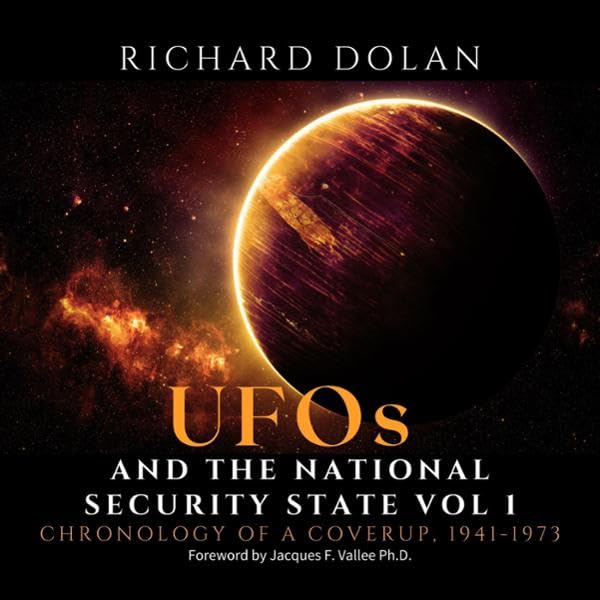
| Author | Richard Dolan |
| Publisher | Keyhole Publishing Co. |
| Published | 2002 |
| Rating | ★★★★★ |
The definitive historical record
Richard Dolan’s two-volume UFOs and the National Security State is the most thoroughly sourced historical overview of US government involvement with the UAP phenomenon ever published. Where most books in this field rely on secondhand accounts and circumstantial evidence, Dolan — a historian trained at Alfred University with graduate study at Oxford — builds his case from FOIA documents, declassified records, congressional archives, and more than a thousand footnoted sources. The result is the closest thing the field has to an authoritative historical record.What it covers
Volume One covers 1941–1973, documenting the US government’s encounter with UAP from the earliest military reports through Project Blue Book’s termination. Volume Two covers 1973–1991, tracing the development of what Dolan calls the “breakaway civilization” — the hypothesis that a classified parallel program, operating outside normal oversight, has been studying and possibly reverse-engineering recovered UAP technology for decades. Dolan’s method is rigorous: he presents primary documentation where it exists, witnesses where documents are unavailable, and is transparent about the distinction. His central argument — that the cover-up of UAP information is not a fringe hypothesis but a documented fact supported by the historical record — is built brick by brick across two volumes.Why it matters
These two volumes are the essential reference work for understanding the institutional history of UAP secrecy. Researchers, journalists, and policy staffers who want to understand how the current disclosure environment emerged need this history. The 2023 congressional hearings, David Grusch’s testimony, and the push for the UAP Disclosure Act all make far more sense in the context Dolan provides. The books also demonstrate something methodologically important: that the history of government UAP involvement can be written from verifiable sources, without relying on unverifiable insider claims. That distinguishes Dolan’s work from most in the genre.Caveats
The scope is enormous and the reading is dense. Volume Two’s “breakaway civilization” hypothesis moves beyond what the documentary record can fully support, into more speculative territory. And the two-volume set demands a significant time commitment. But there is no substitute.Who it’s for
Serious researchers, historians, and policy readers. The single most important reference work on the institutional history of UAP secrecy. Start with Volume One.Where to get it
Frequently Asked Questions
What is UFOs and the National Security State by Richard Dolan about?
UFOs and the National Security State (2000) is a meticulously documented history of U.S. government involvement with UFO phenomena from 1941 to 1973, drawing on declassified documents, government archives, and witness accounts. Dolan argues a systematic policy of secrecy was established early and maintained across administrations.
Who is Richard Dolan?
Richard Dolan is a historian and author who holds a master’s degree from the University of Rochester. He is one of the most rigorous academic-style researchers in the UAP field, known for extensive documentation and careful sourcing. His multi-volume National Security State series is considered a foundational reference.
Does UFOs and the National Security State present new evidence?
Dolan draws primarily on declassified government documents, congressional records, and military archives rather than witness testimony alone. His methodology is to reconstruct government behavior from paper trails — making the book particularly useful for understanding institutional responses to UAP rather than the phenomena themselves.
Is this book still relevant given recent UAP disclosures?
Highly relevant. The institutional patterns Dolan documented in 2000 — compartmentalization, unofficial study programs, public dismissal combined with private concern — have been confirmed by whistleblowers testifying before Congress in 2023–2024 and by the structure of the PURSUE portal releases.