

Last updated: August 1, 2026
In June 2023, UAP whistleblower David Grusch told journalist Ross Coulthart on NewsNation something that, if true, would rewrite the timeline of government UFO crash retrievals: that the earliest known recovery of a non-human craft happened not in Roswell in 1947, but in Magenta, Italy, in 1933 — fourteen years earlier, under Benito Mussolini’s fascist government, with an alleged assist from the Vatican. This piece lays out exactly what Grusch said, where the underlying story comes from, what images and documents exist, and — because the claim rests entirely on unverified 1930s paperwork surfaced by two Italian researchers in the late 1990s — what historians and skeptics say is still missing.
Watch the video review:
What Grusch Actually Said — and Where He Said It
This is worth getting precise about, because the claim is often misremembered as sworn congressional testimony. It wasn’t. Grusch made the Magenta claim in his June 2023 interview with Ross Coulthart on NewsNation — a separate appearance from his July 26, 2023 testimony before the House Oversight Committee. In that congressional hearing, Grusch (alongside fellow witnesses Ryan Graves and David Fravor) testified under oath about a broader alleged “multi-decade UAP crash retrieval and reverse-engineering program” and the recovery of alleged non-human “biologics” — but he did not name Italy, 1933, Magenta, or the Vatican in that sworn testimony. The specific Italy/Vatican story comes from the NewsNation interview alone.
In that interview, Grusch told Coulthart:
“1933 was the first recovery in Europe, in Magenta, Italy. They recovered a partially intact vehicle, and the Italian government moved it to a secure airbase in Italy until around 1944-1945. The Pope back-channeled that, and told the Americans what the Italians had and we ended up scooping it.”
When Coulthart asked him directly whether he was saying the Catholic Church knew about the existence of non-human intelligence, Grusch replied: “Certainly.”
Coulthart, who has reported on UAP whistleblower claims for years, covers this same interview and the broader crash-retrieval allegations in his book In Plain Sight — see our full review for more on his reporting and sourcing.
The Underlying Story: Where the Magenta Claim Comes From
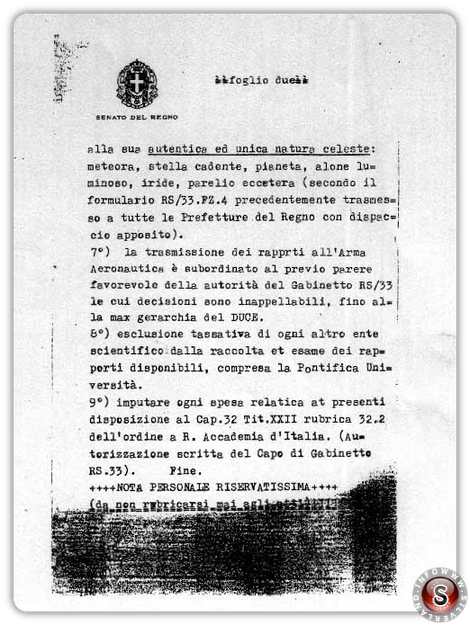
Grusch didn’t invent the Magenta story — he was repeating a decades-old Italian ufology claim. It traces back to Roberto Pinotti, founder of Italy’s Centro Ufologico Nazionale (CUN), and his colleague Alfredo Lissoni. Starting around 1996 and publicized more widely in 2000, the pair say they received a cache of documents anonymously from a source they refer to only as “Mr. X,” who claimed to have inherited them from a relative connected to Mussolini’s regime.
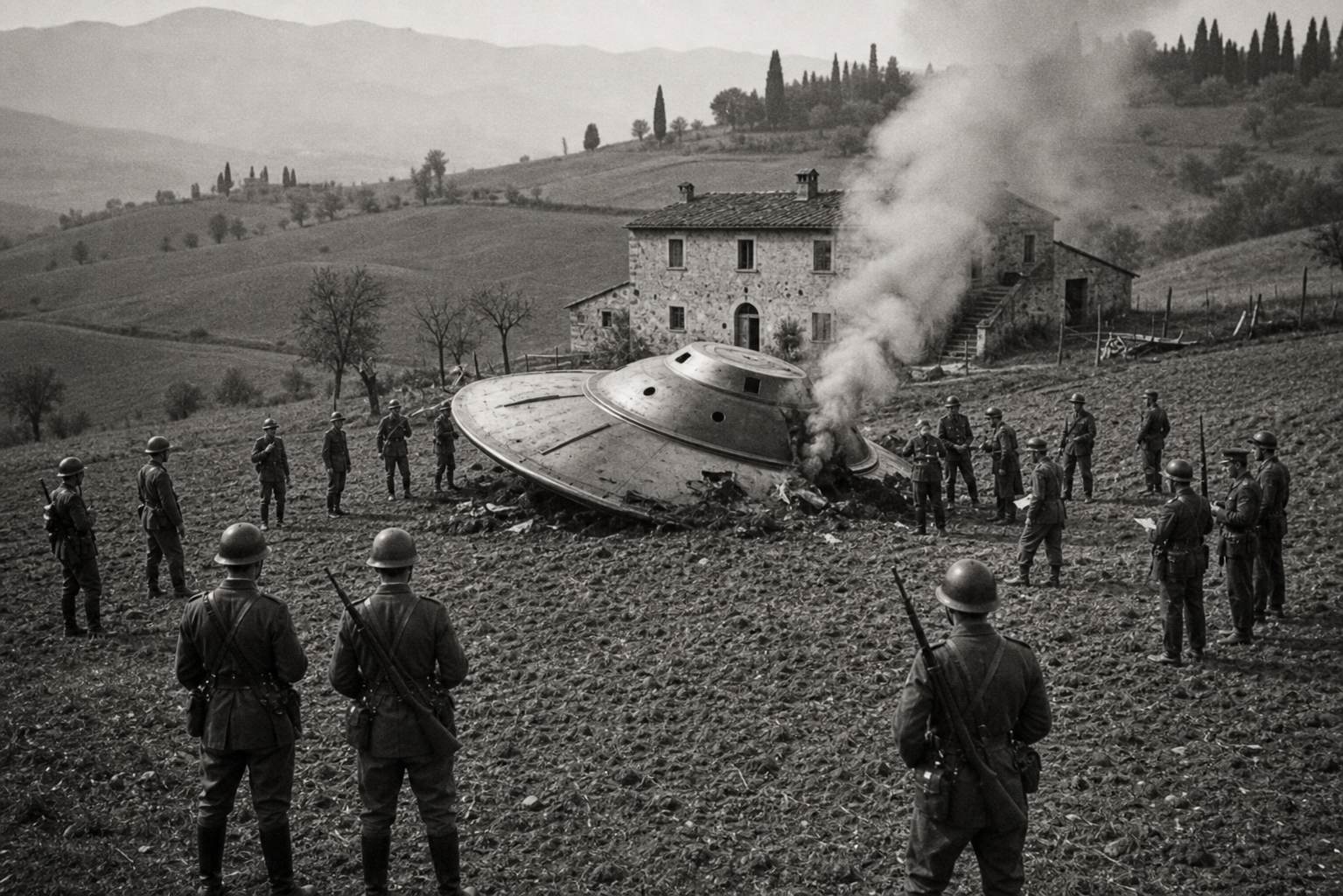
The documents describe an unconventional, bell- or disc-shaped craft roughly 10–12 meters across that crashed or made a forced landing on 13 June 1933 in Lombardy, in northern Italy — variously pinned to the town of Magenta (west of Milan) or the Vergiate area near Lake Maggiore, where the wreckage was said to be stored. Mussolini allegedly ordered a total press blackout and created a secret study group, Gabinetto RS/33 (“Ricerche Speciali,” Special Research, 1933), nominally placed under Nobel laureate Guglielmo Marconi. Later retellings add that the wreckage sat at the SIAI-Marchetti aircraft works in Vergiate until roughly 1944–1945, when it was allegedly taken by U.S. intelligence personnel — the point at which Grusch’s Vatican “backchannel” claim connects to the older Italian story.
The Telegrams: What the Documents Say
Two of the most frequently cited documents in the Pinotti/Lissoni collection are telegrams dated June 1933. One demands “absolute silence” over an “alleged landing on national soil of unknown aircraft.” Another, dated June 13, threatens journalists with “immediate arrest” and “maximum penalties” for reporting on an “aircraft of unknown nature and origin.” Lissoni has said he separately located roughly 500 copies of telegrams sent by Kingdom of Italy prefects to the central government between 1933 and 1938, some of which reference “unconventional flying vehicles.”
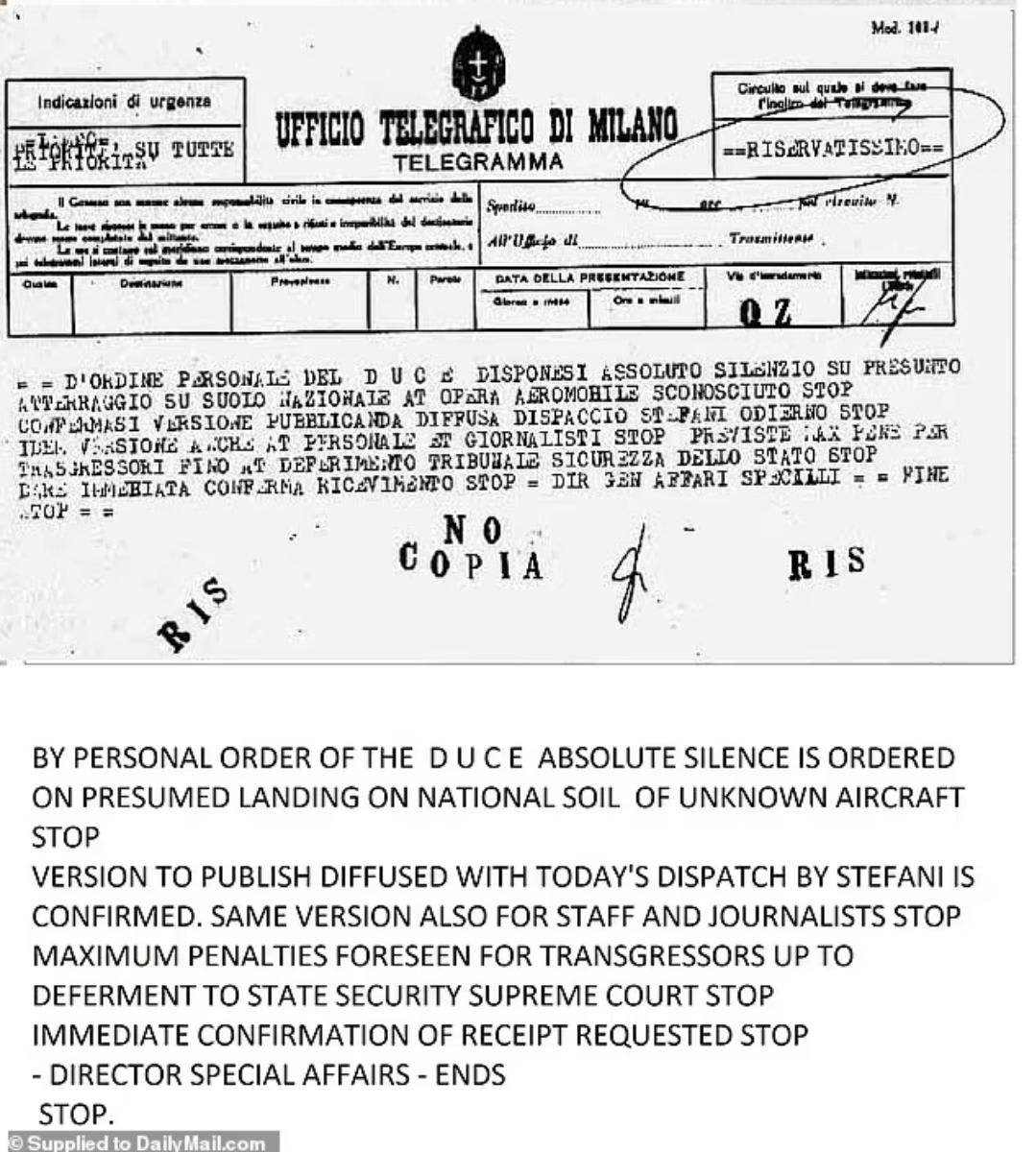
A second telegram in the collection reportedly threatens journalists with arrest for reporting on the incident.
The Vatican Angle: What NewsNation’s Own Investigation Found
To its credit, NewsNation didn’t just air Grusch’s claim and move on — it investigated it. Reporter Susie Pinto traveled to Magenta itself, and the network separately sought comment from the Vatican for roughly a week without receiving a public response. According to NewsNation’s reporting, a source with access to Vatican archival records searched on the network’s behalf and found no listed reference to the alleged Magenta incident and no record of any communication about it having been sent to a pope. That doesn’t conclusively disprove Grusch’s claim, but it directly undercuts the specific assertion that documentary evidence of a papal “backchannel” sits in the Vatican archives.
More broadly, the Vatican has never issued an official statement addressing Grusch’s claims directly. The Vatican Observatory has historically avoided the UFO topic in public commentary altogether; a former director once described it as “a very touchy” subject “tainted badly by the charlatans who have poisoned the topic.” Separately, in 2010, Vatican Observatory astronomer Brother Guy Consolmagno discussed the theological question of extraterrestrial life in general terms — arguing intelligent alien beings could in principle possess souls — but that was a philosophical discussion, not a comment on the Magenta case or any Vatican archive.
Why Historians Aren’t Convinced
Set against the claim is a fairly long list of unresolved problems:
- No independent corroboration. No Italian historian has produced a Marconi diary entry, a directive from Air Minister Italo Balbo, a note from Foreign Minister Galeazzo Ciano, an OVRA secret-police log, or a SIAI-Marchetti inventory record confirming RS/33 existed.
- Single-source provenance. Every document in circulation traces back to the same anonymous “Mr. X” source who approached Pinotti and Lissoni in the 1990s — not to a public archive with a verifiable chain of custody.
- Authenticity concerns from Italian skeptics. The Italian skeptic organization CISU has said the documents have not met basic authenticity checks; forensic dating of the ink and paper has been claimed but never published in full.
- Shifting geography. The crash site is sometimes given as Magenta and sometimes as Vergiate/Lake Maggiore, roughly 40 km apart — the kind of detail that tends to drift as a story is retold rather than documented.
- A mundane alternative exists. In 1950, Italian engineer Giuseppe Belluzzo publicly claimed Italy and Germany had experimented with disc-shaped aircraft prototypes in the early 1940s — real, human-built designs, not alien technology. Some skeptics argue a 1933 “unconventional aircraft” story, if it has any basis at all, may be tangled up with this later, mundane engineering history rather than describing a genuine non-human craft.
None of this proves the Magenta case is false. It means the case currently rests on documents whose origin cannot be independently verified, repeated by a whistleblower who has said he is relaying what others told him rather than something he investigated firsthand.
Why This Case Matters for UAP Disclosure
If the Magenta case were ever independently confirmed, it would push the timeline of alleged government crash-retrieval programs back fourteen years before Roswell, and it would tie a Cold War-era American program to a pre-war European one — the same throughline that shows up in claims around Majestic 12 and the postwar U.S. crash-retrieval apparatus described in Project Blue Book-era documents. It’s exactly this kind of claim — old, compelling, and undocumented — that the current wave of U.S. disclosure efforts, including the UAP Disclosure Act and the Pentagon’s PURSUE portal, is nominally supposed to help resolve by getting historical records declassified rather than relayed secondhand.
Frequently Asked Questions
What is the Magenta UFO case?
It’s a claim that an unconventional aircraft crashed or made a forced landing near Magenta, Italy, on June 13, 1933, and was secretly studied by a group called Gabinetto RS/33 under Mussolini’s government. The story comes from documents two Italian researchers, Roberto Pinotti and Alfredo Lissoni, say they received anonymously starting in the 1990s. It has never been independently verified.
Did David Grusch really say the U.S. recovered a UFO in Italy in 1933?
Yes, in a June 2023 interview with Ross Coulthart on NewsNation, Grusch said the U.S. “scooped” a partially intact craft from Italy that had been recovered in Magenta in 1933, with the Pope allegedly “backchanneling” knowledge of it to American officials.
Did Grusch mention Italy or the Vatican in his congressional testimony?
No. Grusch’s Italy/Vatican claim was made specifically in his NewsNation interview with Ross Coulthart, not in his sworn July 26, 2023 testimony before the House Oversight Committee, where he discussed a general crash-retrieval and reverse-engineering program without naming this specific case.
Has the Vatican responded to these claims?
Not directly. NewsNation reported it sought Vatican comment for about a week without a response. A source with access to Vatican archives, searching on the network’s behalf, found no listed reference to the incident and no record of any related communication to a pope.
Who are Roberto Pinotti and Alfredo Lissoni?
Pinotti is the founder of Italy’s Centro Ufologico Nazionale (CUN); Lissoni is a journalist and archivist. Together they publicized the “Fascist UFO Files” starting around 1996–2000, the documents that underlie the entire Magenta narrative.
Is the Magenta case considered credible by historians?
No official Italian archive has confirmed the existence of Gabinetto RS/33, and Italian skeptic organizations like CISU say the documents haven’t passed basic authenticity checks. All known copies trace back to a single anonymous source rather than a verifiable government archive.
How does the Magenta case relate to Roswell?
If accurate, it would predate the 1947 Roswell incident by fourteen years, making it the earliest alleged government UFO crash retrieval on record. But unlike Roswell, which has an extensive paper trail of contemporaneous press releases and military records, the Magenta case rests entirely on undated photocopies from a single anonymous source.