

Last updated: August 1, 2026
Watch the video review:
Affiliate disclosure: This review contains Amazon affiliate links. As an Amazon Associate I earn from qualifying purchases, at no extra cost to you.
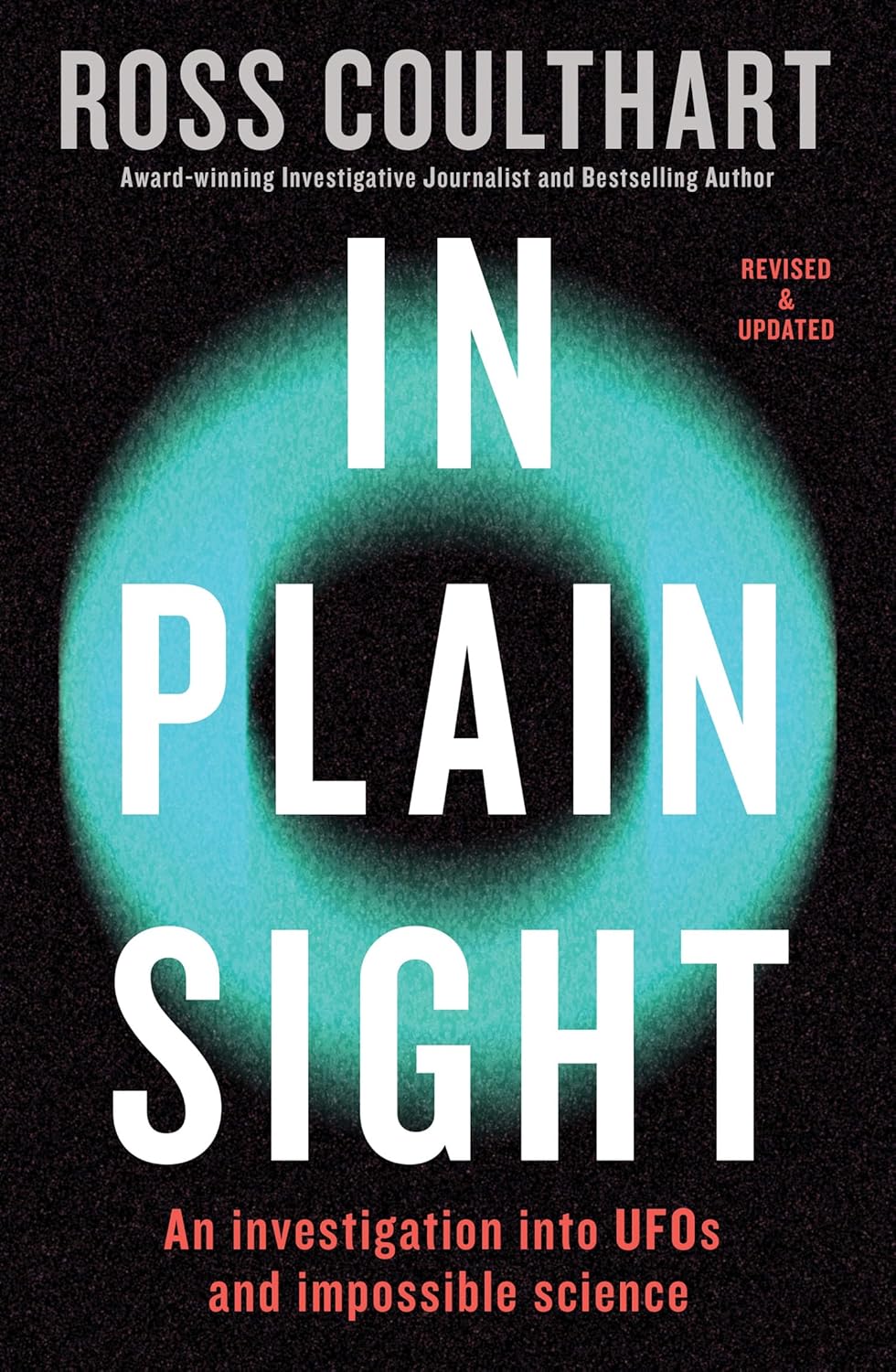
| Author | Ross Coulthart |
| Publisher | HarperCollins |
| Published | 2021 |
| Narrator | Ross Coulthart |
| Rating | ★★★★½ |
Most UAP books are written by believers, researchers, or insiders with an obvious stake in the conclusions. In Plain Sight is different. Ross Coulthart came to this subject as a decades-long award-winning investigative journalist, someone whose career was built on testing claims, protecting sources, and following evidence rather than ideology. That distinction matters more than it might sound. It means the sourcing is held to a professional standard. It means the book can be handed to a skeptic without the usual caveats. And it means that when Coulthart concludes, methodically and without sensationalism, that UAP are real, that they represent technology beyond known human capability, and that governments have actively worked to suppress serious inquiry into them, that conclusion carries weight that most books in this field simply cannot claim.
What the Book Covers
Coulthart opens with a global survey of UAP history that immediately signals his intent: this is not another American-centric investigation. From Aboriginal Australian oral traditions and the Swedish “ghost rockets” of 1946, to Rendlesham Forest, to pilot and radar cases from South America and the Pacific, he establishes a pattern of encounters too geographically distributed to be explained by any single government’s secrecy apparatus. This is not folklore collection. It is methodical documentation designed to establish a pattern that no single country’s classification system could have manufactured or suppressed.
The investigative core runs on three tracks. The first is suppression: how the CIA systematically discredited civilian UAP research organizations like NICAP, how classified programs like Operation Moon Dust operated outside normal oversight, and how institutional denial across multiple administrations and multiple countries is more consistent with managed concealment than with genuine ignorance. The second is physical evidence, anchored in cases where documentation still exists: Roswell treated with appropriate skepticism and openness, the USS Nimitz encounter reconstructed from primary source pilot interviews, and the Kaikoura lights — a case Coulthart has natural proximity to as an Australian journalist. The third is witnesses: a larger number of named, on-record sources than comparable books manage, held to a professional sourcing standard.
Throughout, Coulthart’s argument stays tight. He does not claim to know what UAP are. He argues, carefully, with evidence, that they are real, that no known human technology explains them, and that the suppression of serious inquiry has been a deliberate and sustained institutional choice.
What Coulthart Gets Right
The global framing is arguably the book’s most underappreciated contribution. By opening with cases from Australia, Sweden, New Zealand, and South America before addressing a single American incident, Coulthart implicitly answers the most common dismissal: that UAP is a product of American cultural anxiety. It is not. The pattern is the same everywhere, documented by governments with no particular reason to coordinate their confusion.
The treatment of government suppression is equally strong. Coulthart does not assert a conspiracy and then reach for evidence to support it. He documents the mechanics: how NICAP was infiltrated and discredited, how Operation Moon Dust operated as a classified retrieval program outside normal oversight, how the pattern of official denial across multiple administrations and multiple countries is more consistent with managed concealment than with genuine ignorance. The argument is built from records and named sources, not inference.
The Grusch connection, which postdates the book, adds retrospective weight: David Grusch chose Coulthart as the journalist to give his first major interview to. That is not a minor detail. It reflects how seriously Coulthart is regarded by those closest to the evidence.
Where It Falls Short
The book’s most significant limitation is structural rather than intellectual: a substantial portion of its most consequential claims rest on anonymous sources. Coulthart is more transparent than most about this, noting when sources requested protection and explaining why he judged them credible regardless. But transparency about the limitation does not dissolve it. Readers looking for a chain of verifiable evidence from claim to document will find sections of the book frustrating — not because the journalism is careless, but because the subject matter exists precisely in the space where documentation has been systematically destroyed or classified.
There is also a chapter on UAP and consciousness that sits uneasily alongside the rest of the book. Coulthart earns his credibility through rigorous sourcing and methodical argument, then applies that same earnest seriousness to territory where the evidentiary standards are far looser. The chapter does not undermine what comes before it, but it is a noticeable tonal departure, and readers who came for the journalism will feel it.
Finally, the book was published in 2021 and the UAP landscape has moved quickly since. The 2023 congressional hearings, and in particular the testimony of David Grusch, have added significant texture to claims Coulthart could only partially document at the time. The book holds up remarkably well given the pace of events, but it is best read as the foundation of an argument still being built rather than its conclusion.
Who Should Read It
In Plain Sight is the book to start with if you are new to UAP and want something that will survive contact with a skeptical reader. It does not require prior belief or existing knowledge of the field, and it builds its case from scratch with enough sourcing discipline that it can be recommended without the usual caveats that come with most UAP titles.
For readers already deep in the literature, it sits in a specific and valuable position. It covers different ground than Vallée’s interdimensional work, which is concerned with the phenomenology and ontology of the phenomenon rather than its political suppression. It is more rigorously sourced than Corso, more journalistically grounded than Pasulka, and more globally scoped than most American authors who treat UAP as a domestic story. Paired with Kean’s UFOs: Generals, Pilots, and Government Officials and Dolan’s UFOs and the National Security State, it forms a strong evidential foundation for understanding the suppression side of the UAP story.
The Bottom Line
The most important UAP book of the 2020s. Start here.
Rating: ★★★★½
Frequently Asked Questions
What is In Plain Sight by Ross Coulthart about?
In Plain Sight (2021) is investigative journalist Ross Coulthart’s account of a two-year investigation into UAP, drawing on interviews with military insiders, scientists, and government officials in the U.S. and Australia. He argues that non-human intelligence is real, has been known to governments for decades, and that controlled disclosure is already underway.
Who is Ross Coulthart?
Ross Coulthart is an award-winning Australian investigative journalist known for breaking major stories across print and television. He has covered UAP for News Nation and has broken multiple major stories in the disclosure space, including early reporting on David Grusch before his congressional testimony.
What does In Plain Sight reveal about UAP secrecy?
Coulthart documents testimony from military and intelligence sources suggesting crash retrieval programs exist, that UAP has been weaponized against military personnel, and that multiple governments coordinate on UAP secrecy. He also investigates Australian cases and UAP activity near nuclear facilities.
Is In Plain Sight a good starting point for someone new to UAP research?
Yes. Coulthart writes as a skeptic turned believer, making his reporting accessible to general readers. His journalistic standards — named sources where possible, documented evidence, careful qualification — make In Plain Sight one of the more trustworthy entry points into serious UAP literature.