
Last updated: June 27, 2026
Affiliate disclosure: This review contains Amazon affiliate links. As an Amazon Associate I earn from qualifying purchases, at no extra cost to you.
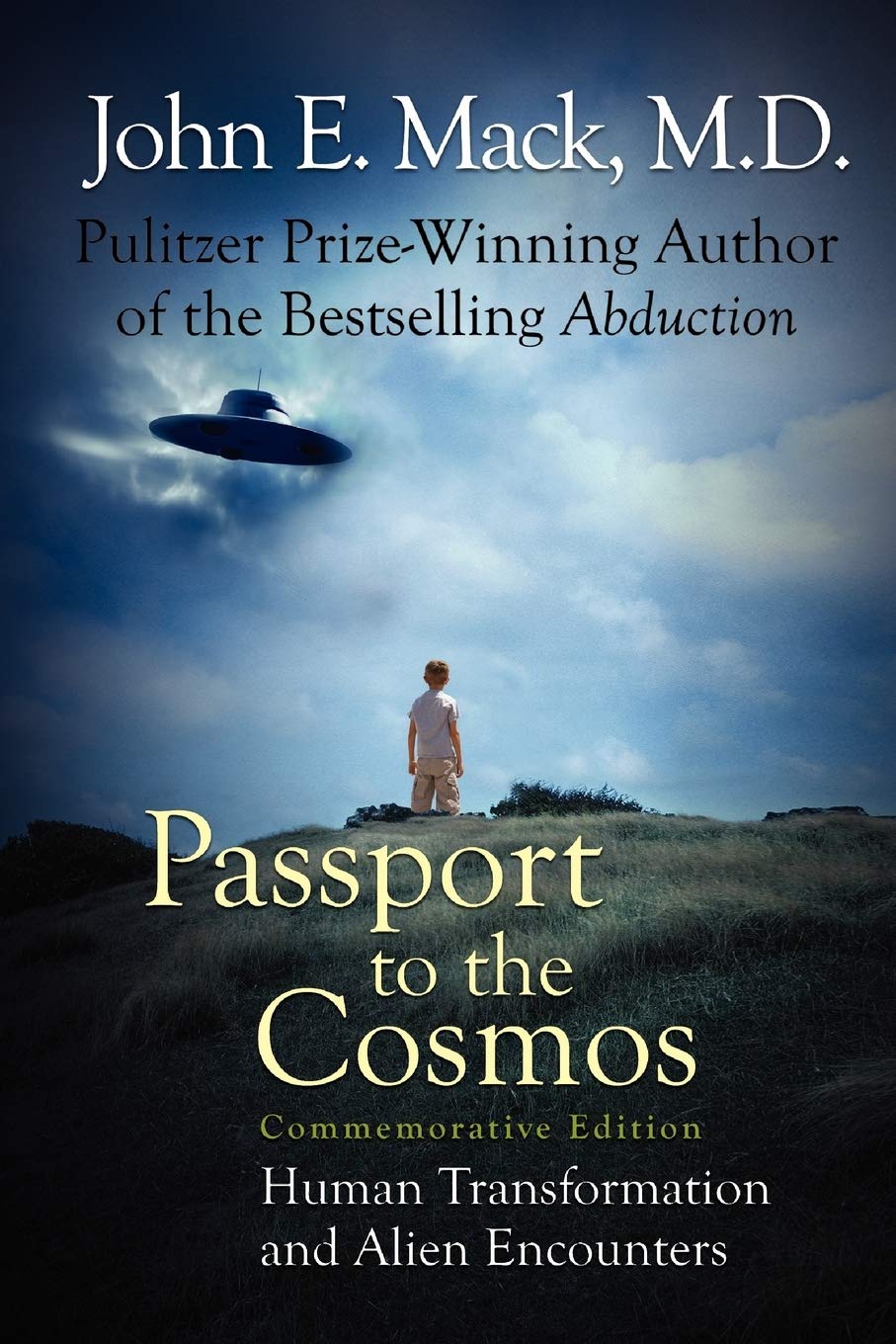
| Author | John E. Mack, MD |
| Publisher | Crown Publishers |
| Published | 1999 |
| Narrator | Check Audible listing |
| Rating | ★★★★★ |
What happens when a Harvard psychiatrist — a Pulitzer Prize winner with everything to lose — decides that the people in his office aren’t mentally ill, but are reporting something real? John Mack made exactly that decision, and Passport to the Cosmos is where he laid out what he found. This is not a book about little grey aliens. It’s a book about what the contact experience might be doing to human consciousness — and what that might mean for the rest of us.
What It Covers
Passport to the Cosmos (1999) is Mack’s follow-up to his landmark Abduction and represents the maturation of his thinking after years of working with experiencers. Where Abduction was case-heavy, Passport is more philosophical — Mack uses individual accounts as a lens to examine broader questions about reality, identity, and the nature of consciousness.
The book draws on Mack’s clinical work with dozens of experiencers across cultures, including participants from indigenous traditions who framed their encounters in spiritual rather than scientific terms. Mack argues that this cross-cultural consistency is itself significant — that the contact phenomenon cannot be explained away as Western cultural contamination.
- The ontological shock of the encounter experience — the way it fundamentally destabilizes the experiencer’s sense of reality
- Cross-cultural dimensions of contact, including comparisons with indigenous worldviews that don’t draw hard lines between physical and spiritual realms
- Ecological messaging — many experiencers report being shown visions of environmental destruction, raising questions about the phenomenon’s agenda
- The limits of Western materialism as a framework for understanding anomalous experience
Why It Matters
Mack brought something rare to UAP research: genuine academic credibility, clinical rigor, and the willingness to follow the evidence wherever it led, even when it cost him professionally. Harvard launched a formal inquiry into his work — not because he was wrong, but because he refused to dismiss what his patients were telling him.
Passport to the Cosmos matters because it forces a question most UAP books avoid: what if the phenomenon isn’t primarily about technology or national security? What if it’s fundamentally about consciousness? Mack doesn’t answer that question definitively — he’s too honest a researcher for that — but he makes it impossible to dismiss.
For serious readers of the UAP literature, this book sits alongside Vallée and Keel as one of the foundational texts that pushes beyond the “nuts and bolts” frame. It won’t give you a smoking gun. It will give you a better set of questions.
Closing Recommendation
Who should listen: Anyone interested in the experiencer side of UAP research, particularly readers drawn to consciousness studies, transpersonal psychology, or the philosophical dimensions of the phenomenon. Essential reading if you’ve already worked through the government/military literature and want to go deeper.
Who can skip it: Readers who want hard evidence — documents, radar tracks, military witnesses. This is not that book. Start with Hastings or Jacobsen first, then come back.
Bottom line: One of the most intellectually serious books in the UAP canon. Mack’s willingness to risk his reputation for the truth makes this essential.
🎧 Listen on Audible 🛒 Buy on Amazon
Frequently Asked Questions
What is Passport to the Cosmos by John Mack about?
Passport to the Cosmos (1999) is Harvard psychiatrist John Mack’s second book on alien abduction, expanding on his 1994 Abduction study. Mack frames abduction experiences as transformative encounters with non-human intelligence — real in some meaningful sense that cannot be reduced to hallucination or mental illness.
Who was John Mack?
John Mack was a Harvard Medical School professor of psychiatry and Pulitzer Prize winner who spent years investigating claims of alien abduction. His decision to take abductee accounts seriously — and his refusal to pathologize them — made him a controversial figure in academic psychiatry but a respected one in UAP research.
What does Mack conclude about alien abduction?
Mack concluded that abduction experiences are genuine encounters with some form of non-human intelligence — not delusions, hoaxes, or psychological disorders. He documents consistent cross-cultural patterns in the experiences that he found impossible to explain through conventional psychiatric frameworks.
How does Passport to the Cosmos differ from his earlier book Abduction?
While Abduction (1994) focused on individual case studies and clinical analysis, Passport to the Cosmos takes a more philosophical and spiritual view — exploring what the encounters might mean for human consciousness, identity, and relationship to the cosmos, drawing on indigenous traditions and other worldviews.