
Last updated: June 27, 2026
Affiliate disclosure: This review contains Amazon affiliate links. As an Amazon Associate I earn from qualifying purchases at no extra cost to you.
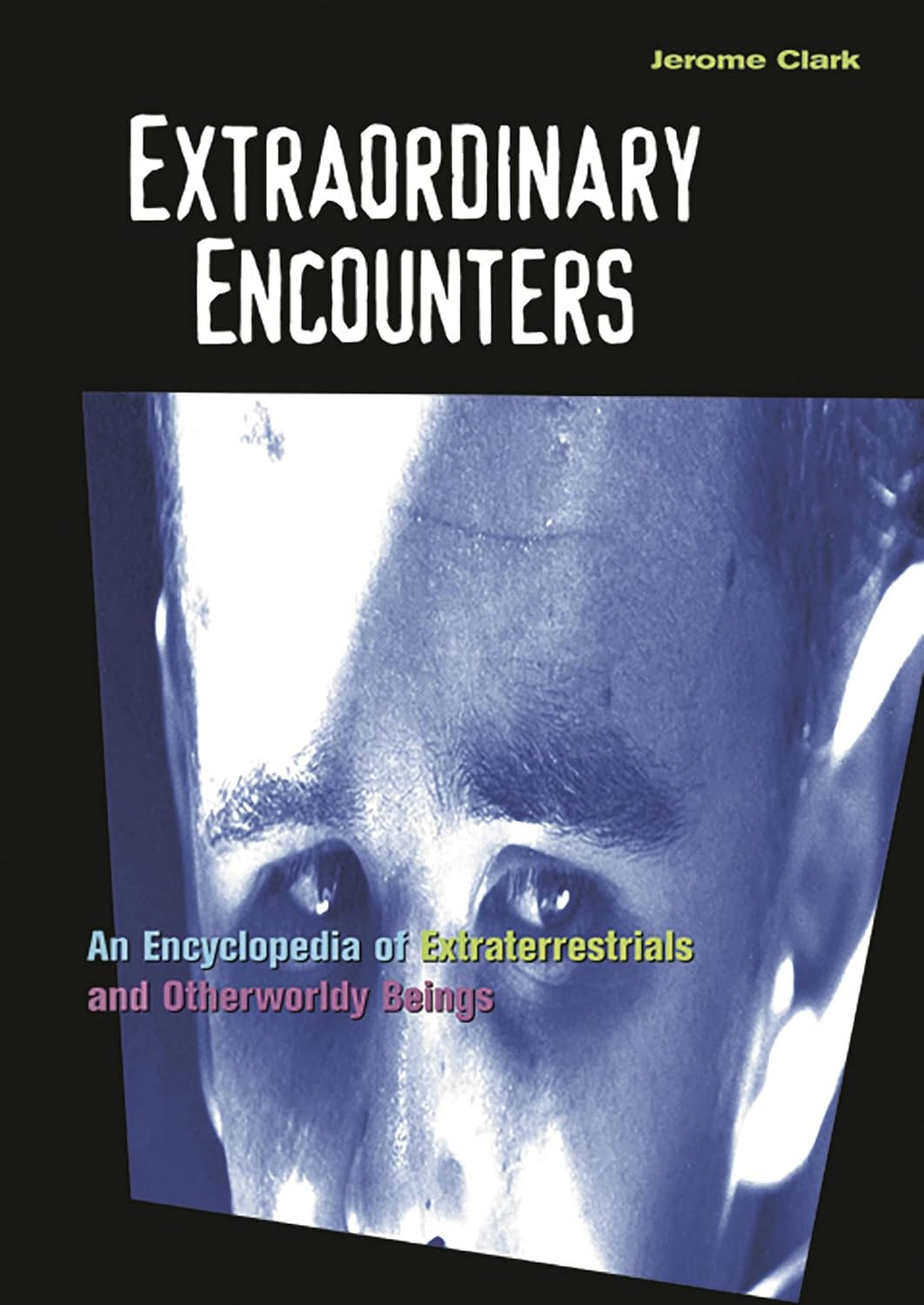
The only reference work that takes the full range of entity encounters seriously — and documents all of them.
Most UAP books focus on craft, radar returns, and government documents. Extraordinary Encounters goes somewhere most researchers don’t: the beings themselves. Jerome Clark’s encyclopedia catalogs hundreds of reported non-human entity encounters drawn from first-hand testimony and historical records spanning centuries and cultures. The format is A-to-Z, each entry covering a specific case, being type, or phenomenon with consistent rigor.
The breadth is genuinely staggering. Frogmen reported in England. A fairy encounter in London. The Mothman of Point Pleasant. Classic grey extraterrestrials. Reptilian entities. Interdimensional beings reported by indigenous cultures long before the modern UFO era. Clark treats each entry with the same even hand, not dismissing the stranger cases to protect the credibility of the conventional ones. That intellectual honesty is what separates this volume from lesser reference works.
What It Covers
What emerges across the entries is a pattern that’s hard to ignore: non-human entity encounters are not a modern American phenomenon. They appear across continents, across centuries, and across wildly different cultural frameworks — and the phenomenology overlaps in ways that are difficult to explain as coincidence or cultural contamination.
Why It Matters
Jerome Clark is not a fringe figure. He served as editor of International UFO Reporter for decades and is the author of the multi-volume UFO Encyclopedia, the most comprehensive academic reference work in the field. When Clark compiles a reference book, it carries weight. Extraordinary Encounters is the only single volume that attempts to document the full spectrum of non-human contact phenomena at this level of detail — and it does so with sourcing and seriousness that hold up to scrutiny.
For researchers focused on the entity dimension of UAP — increasingly relevant as congressional testimony and whistleblower accounts reference non-human intelligence directly — this is an indispensable reference. Nothing else in print covers this ground as systematically.
Caveats
The encyclopedic format means depth varies. Well-documented cases get substantive treatment; obscure or poorly-sourced entries are necessarily thinner. This is a reference work, not a narrative investigation, and it reads like one. Use it alongside books like John Mack’s Passport to the Cosmos or Jacques Vallée’s Passport to Magonia for the analytical depth this format can’t provide.
Who It’s For
Serious UAP researchers, anyone exploring the contact and entity dimension of the phenomenon, and readers who want a single authoritative catalog of reported non-human encounters across history. Also valuable as a starting point: find a case here, then go deeper in primary sources.
Where to get it
Frequently Asked Questions
What is Extraordinary Encounters by Jerome Clark about?
Extraordinary Encounters (2000) is an encyclopedia of UAP and paranormal encounters compiled by veteran researcher Jerome Clark, covering documented cases across multiple categories — contact claims, abductions, close encounters, and entity reports — with careful attention to source quality and evidentiary standards.
Who is Jerome Clark?
Jerome Clark is an American author and editor who has spent over five decades researching and documenting UAP cases. He is the author of the multi-volume UFO Encyclopedia and has served as editor of various research publications. He is known for his rigorous approach to case documentation and source evaluation.
What makes Extraordinary Encounters valuable as a reference?
Clark applies consistent evidentiary standards across all cases — distinguishing well-documented encounters from anecdotal ones, noting source reliability, and providing historical context. This makes the book a useful reference tool rather than just a collection of sensational claims.
Is Extraordinary Encounters suitable for researchers or general readers?
The book is organized as a reference work rather than a narrative, making it more useful as a case database for researchers than as an introductory read. For new readers, narrative works like In Plain Sight or Imminent provide more accessible entry points to the subject.