

Last updated: June 27, 2026
Affiliate disclosure: This review contains Amazon affiliate links. As an Amazon Associate I earn from qualifying purchases at no extra cost to you.
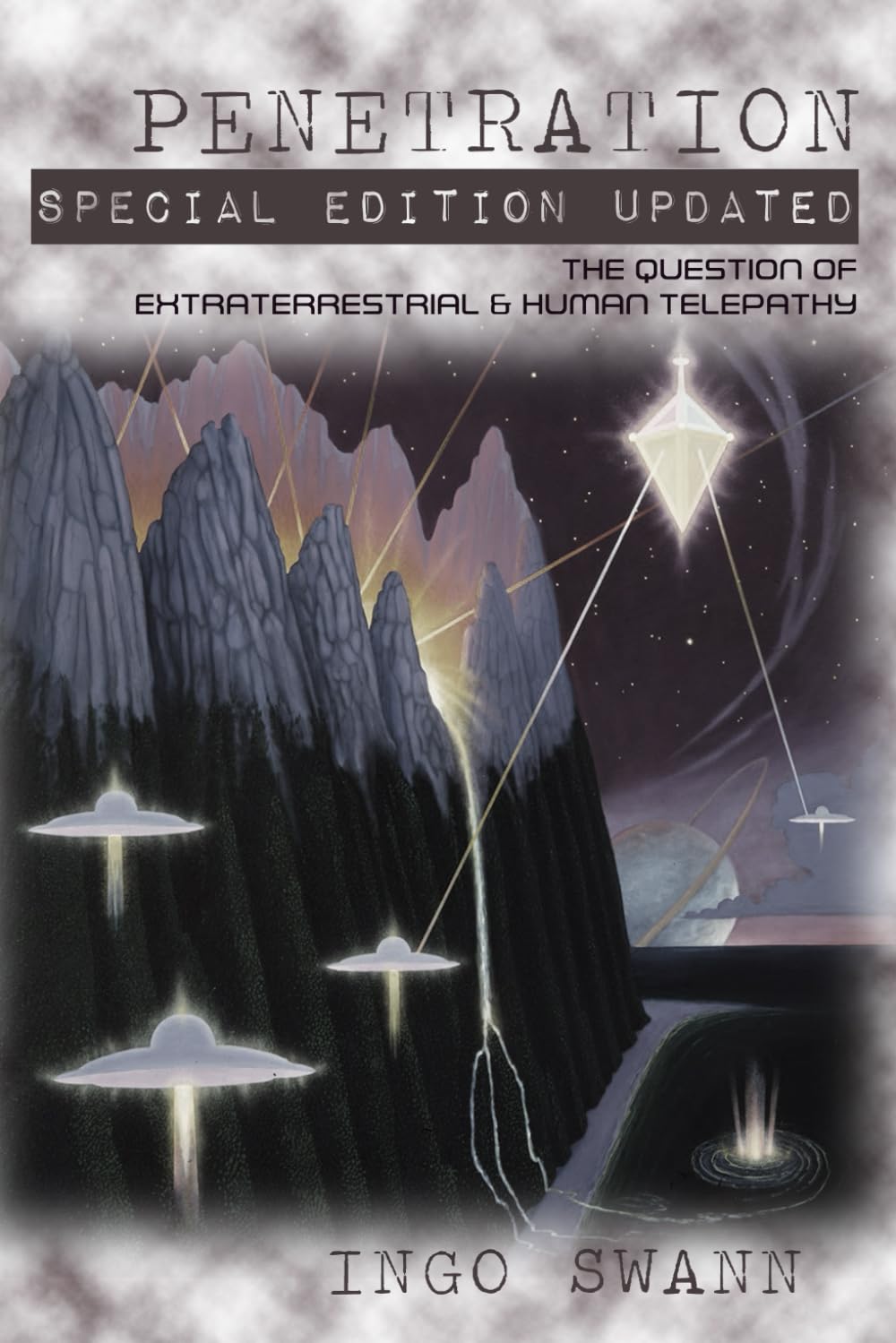
| Author | Ingo Swann |
| Publisher | Ingo Swann Books |
| Published | 1998 |
| Rating | ★★★★☆ |
The man who remote viewed the Moon — and what he says he found there.
What It Covers
In the early 1970s, Ingo Swann was already one of the most rigorously tested psychics in the world. He had worked with physicists at Stanford Research Institute — Hal Puthoff and Russell Targ — helping develop the remote viewing protocols that would eventually become the CIA’s classified Project Stargate program. His credentials, within the strange world of government-funded psi research, were as solid as they came.
Then, according to Swann, a man he identifies only as “Mr. Axelrod” approached him for an assignment unlike any he had received. The target: the Moon. Not maps of the lunar surface, not geological features — but specific coordinates, specific structures. What Swann claims to have perceived at those coordinates forms the dark heart of Penetration: towers, domes, machinery, tunnels, and humanoid figures working in what appeared to be an environment not built by human hands.
The book moves through three distinct sections. The first recounts Swann’s encounters with what he believes were extraterrestrial beings operating on Earth — including a supermarket encounter in Los Angeles where he describes recognizing a figure as non-human, and a covert nighttime trip to a remote Alaskan lake where he witnessed a large craft rise silently from the water and disappear. The second covers the Moon remote viewing sessions themselves, with descriptions of the structures and entities he perceived. The third section steps back to present Swann’s broader thesis: that human beings possess natural telepathic abilities, and that these abilities have been deliberately suppressed — by whom, and why, he leaves deliberately open.
Why It Matters
The reason Penetration commands serious attention — despite being self-published and unverifiable at nearly every turn — is the identity of its author. Ingo Swann is not a UFO enthusiast who decided to write a book. He is a co-developer of remote viewing as a reproducible, laboratory-testable protocol, and his participation in the CIA/SRI program is now documented in declassified records available through the CIA’s own reading room. When Swann makes claims, they exist within a context of genuine government involvement in psi research that can no longer be dismissed.
The book also sits at an intersection that UAP research rarely visits: the relationship between psychic phenomena and the phenomenon itself. Most UAP literature treats them as separate categories. Swann’s account — and particularly his framing of the Moon sessions as something his government handlers found deeply alarming — suggests the two may be far more entangled than mainstream UAP discourse allows. The declassified Stargate documents confirm that the U.S. government spent decades and millions of dollars investigating exactly this intersection. Penetration reads as the account of what happened when that investigation got too close to something real.
There is also the structural problem the book poses. If Swann’s Moon perceptions were simply fantasy, why would Mr. Axelrod — and whatever organization he represented — have gone to the lengths described to terminate the sessions and extract Swann? The security apparatus surrounding the encounter, as Swann describes it, implies that someone with access to classified knowledge believed he was perceiving something accurately. That implication has never been adequately explained away.
Caveats
Readers should approach Penetration with clear eyes about what it is and isn’t. It is a self-published personal account. “Mr. Axelrod” has never been identified. The underground facility Swann was taken to has never been located. The Moon sessions cannot be corroborated. The book’s third section, on human telepathy and its suppression, moves into territory that is more speculative than investigative, and some readers will find it drifts from the precision of the earlier chapters.
Swann’s prose is also unconventional — direct, sometimes rambling, with an insider’s disdain for academic hedging that can read as either refreshing or frustrating depending on your tolerance for first-person certainty about extraordinary events. This is not a book that builds its case methodically with citations. It asserts, it describes, and it leaves the reader to decide.
None of this makes the account false. It makes it unverifiable — which is precisely the condition that the intelligence community, if Swann’s account is even partially accurate, would have had every reason to create.
Who It’s For
Researchers already familiar with the history of Project Stargate and the CIA’s documented interest in remote viewing. Readers exploring the consciousness-UAP intersection — the growing body of evidence suggesting the phenomenon interacts with human perception in ways that go beyond simple observation. Anyone who has read the declassified SRI documents and wants the account of the person at the center of those experiments. This is not a starting point for newcomers; it is essential reading for those who have already concluded that the government’s involvement in psi research was not accidental, and who want to understand what the researchers themselves believed they were encountering.
Where to get it
Enjoyed this review?
New reviews, reading lists, and UAP book recommendations — no spam. Drop your email on the contact page and ask to be added.
Frequently Asked Questions
What is Penetration by Ingo Swann about?
Penetration (1998) is Ingo Swann’s account of covert remote viewing missions he claims to have conducted for a classified intelligence group, including an alleged remote viewing of the lunar surface that discovered non-human bases, and a disturbing encounter suggesting UAP intelligences were actively monitoring his activities.
Who was Ingo Swann?
Ingo Swann was the American psychic who co-developed the remote viewing protocol used in the U.S. government’s STARGATE program at the Stanford Research Institute. He is credited with establishing the controlled remote viewing methodology adopted by military intelligence and tested for operational use.
Are the claims in Penetration verified?
Penetration describes events Swann could not discuss while classified programs were active and is primarily his personal account. The broader remote viewing program he helped develop is documented and partially declassified. The specific missions in Penetration have not been independently confirmed through government records.
Why is Penetration significant in UAP research?
Swann’s account — whether taken literally or not — comes from a figure whose remote viewing work is documented in government records and who operated at the intersection of classified intelligence research and UAP investigation. It raises questions about the government’s use of psychic methods for UAP-related intelligence gathering.