
Last updated: June 27, 2026
Affiliate disclosure: This review contains Amazon affiliate links. As an Amazon Associate I earn from qualifying purchases, at no extra cost to you.
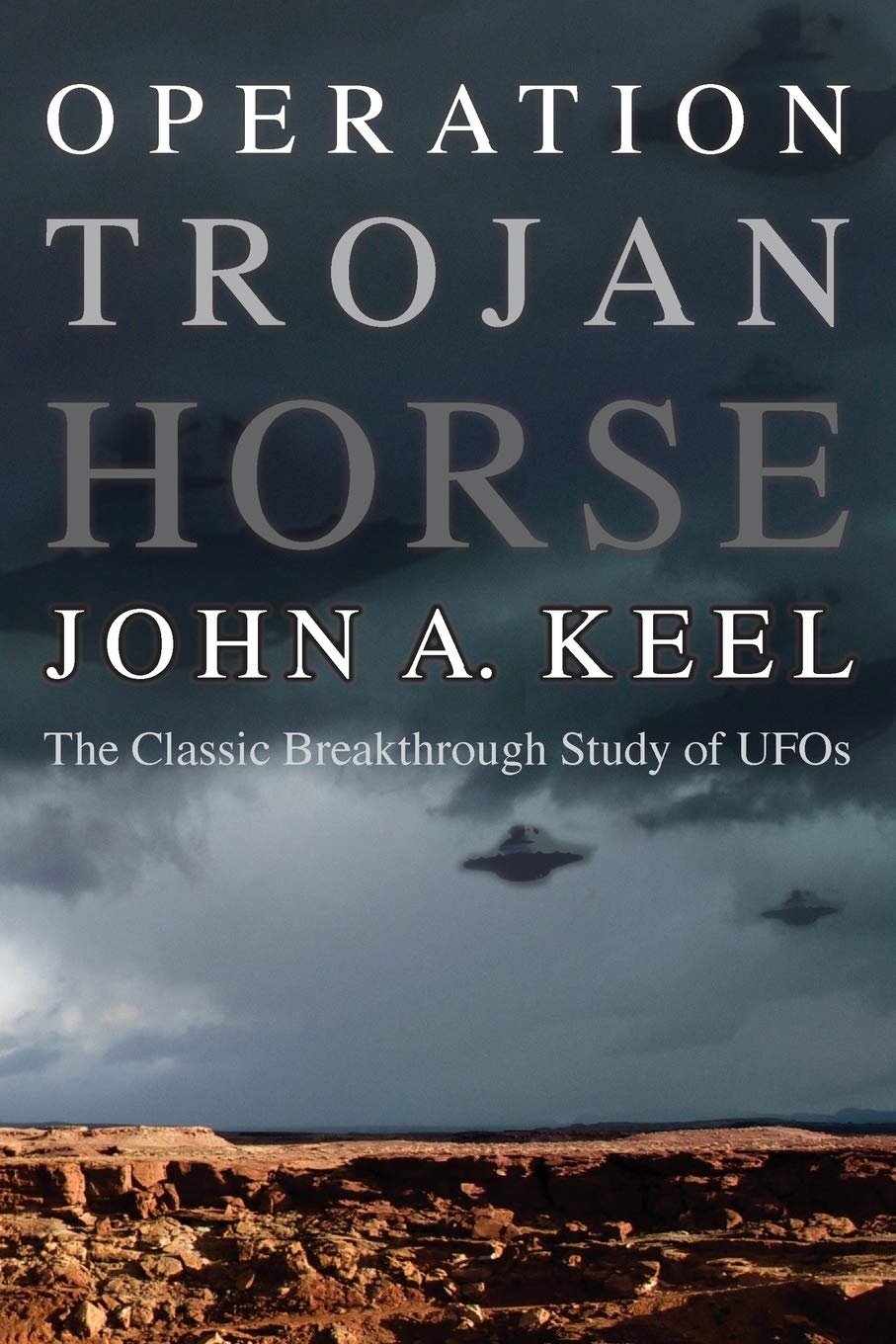
| Author | John A. Keel |
| Publisher | Putnam |
| Published | 1970 |
| Narrator | Check Audible listing |
| Rating | ★★★★★ |
John Keel didn’t believe in the extraterrestrial hypothesis. He thought it was bait — that the phenomenon itself was projecting an image of space visitors because that’s what we expected to see. Operation Trojan Horse, published in 1970, is the book where he made that case. More than fifty years later, it reads not as a historical curiosity but as a framework that grows more relevant the more we learn.
What It Covers
Operation Trojan Horse is Keel’s systematic demolition of the nuts-and-bolts ETH and its replacement with something stranger and more philosophically challenging.
Key arguments and themes:
- The phenomenon is deceptive by design — UAP consistently present themselves in forms matching the cultural expectations of their observers
- The ultraterrestrial hypothesis — the phenomenon originates not from outer space but from a co-existing realm, possibly paraphysical in nature
- The manipulation thesis — humanity has been interacted with, possibly managed, by this phenomenon throughout recorded history
- The psychic and paranormal connections — Keel systematically connects UAP to Mothman, Men in Black, poltergeists, and apparitions
Why It Matters
Keel was ahead of his time in ways that are now widely recognized. The Vallée hypothesis — that UAP function as a control system for human belief — draws directly on Keel’s earlier work, and much of what the most sophisticated current researchers argue about the phenomenon’s paraphysical nature echoes positions Keel staked out in 1970.
The “Trojan horse” of the title refers to Keel’s central warning: if the phenomenon is not what it presents itself as, then researchers who accept its apparent presentation at face value are being played. That warning has aged well.
Closing Recommendation
Who should listen: Essential for any serious UAP reader, particularly after you’ve absorbed the foundational government/military literature. Keel is the corrective to naive ETH thinking.
Who can skip it: Not recommended to start here. Build your baseline with Hastings and Jacobsen first.
Bottom line: A classic that deserves its reputation. Keel was wrong about some specifics and decades ahead of the field on the fundamentals.
🎧 Listen on Audible 🛒 Buy on Amazon
Frequently Asked Questions
What is Operation Trojan Horse by John Keel about?
Operation Trojan Horse (1970) argues that UFOs are not extraterrestrial craft but rather a deceptive phenomenon designed to manipulate human perception and belief — potentially an intelligence using us for unknown purposes. Keel documents patterns suggesting the phenomenon actively adapts to cultural expectations rather than operating on fixed physical laws.
What is the “ultraterrestrial” theory?
Keel’s ultraterrestrial theory holds that the entities behind UAP are not visitors from other planets but rather beings that have coexisted with humanity — possibly in dimensions or frequencies we cannot normally perceive. He argues they predate human civilization and have been misidentified as gods, demons, angels, and fairies throughout history.
How does Operation Trojan Horse challenge the extraterrestrial hypothesis?
Keel documents cases where UAP behavior — including apparent knowledge of witness psychology, shape-shifting, and deliberate deception — is inconsistent with physical spacecraft from another star system. He argues the phenomenon’s intelligence and adaptability point to something far stranger than interstellar travelers.
Why is Operation Trojan Horse influential in UAP research?
Keel’s work helped shift UAP research from a focus on physical craft to consideration of the phenomenon’s possible consciousness-affecting dimensions. His skepticism of the extraterrestrial hypothesis influenced researchers like Jacques Vallée and continues to inform debates about UAP’s nature today.