Last updated: June 30, 2026
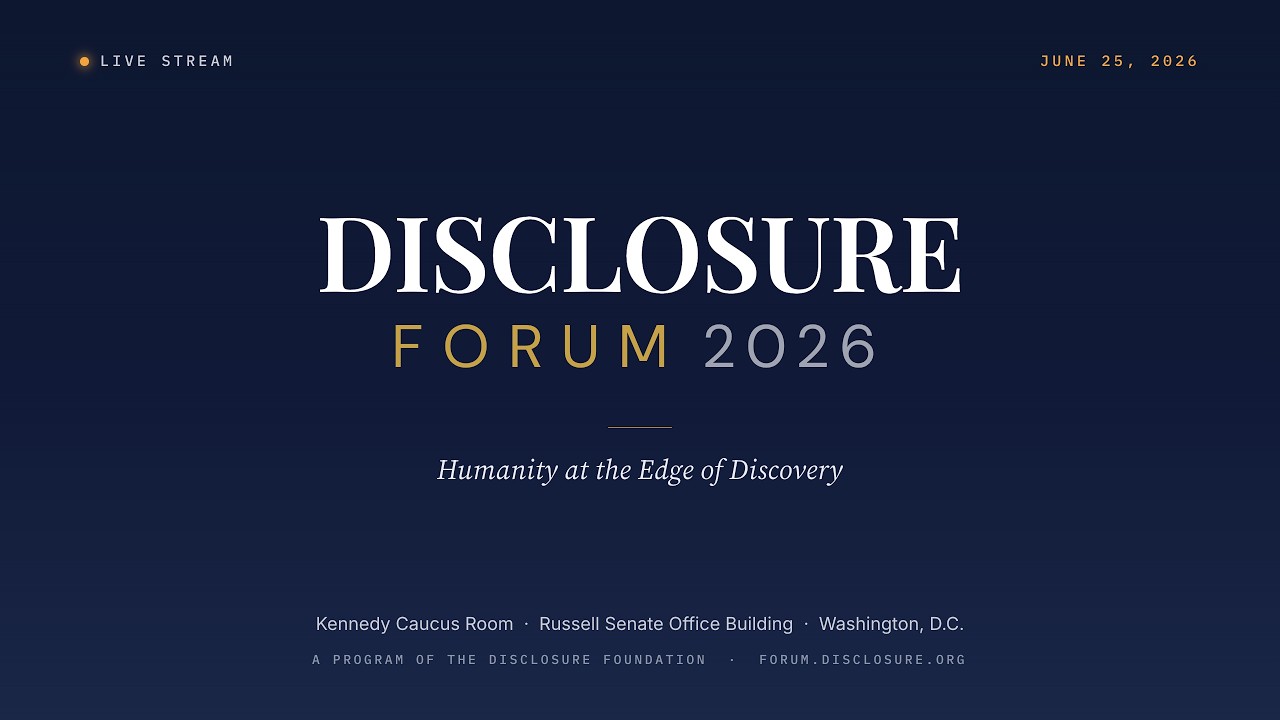
The Disclosure Forum 2026 convened today on Capitol Hill for what organizers called the first institutional public forum designed to chart a concrete path forward for UAP disclosure. From 9:00 a.m. to 4:30 p.m. in the Kennedy Caucus Room of the Russell Senate Office Building, a coalition of sitting U.S. senators, House members, scientists, and former defense officials gathered under the theme “Humanity at the Edge of Discovery” — speaking on the record, to a public audience, about unidentified anomalous phenomena and what the government should do about them.
Organized by the Disclosure Foundation — a nonpartisan 501(c)(3) dedicated to advancing UAP transparency — the forum was open to the public on a first-come, first-served basis and livestreamed in full. Some speakers announced in the original lineup were unable to attend due to last-minute scheduling conflicts. What follows is a verified account of what actually unfolded.
What Was the Disclosure Forum 2026?
Congressional hearings on UAP have multiplied since 2023, but they share a common limitation: they are reactive, constrained by classification, and dictated by committee schedules and political agendas. The Disclosure Forum 2026 was architected differently. It was proactive, entirely public, and organized outside the congressional committee structure — which meant participants could speak without the filter of a formal government setting.
The Disclosure Foundation, chaired by former Deputy Assistant Secretary of Defense for Intelligence Christopher Mellon, designed the event to move the conversation from “is this real?” to “what do we do now?” The shift in framing matters. Every credible speaker at the forum operated from the premise that something genuinely anomalous is occurring in U.S. airspace. The debate is no longer about existence — it is about accountability, transparency, and what institutional infrastructure a post-disclosure society needs to build.
Polls released at the forum underscored how far public opinion has moved. The Disclosure Foundation presented polling showing that approximately 90 percent of both Republicans and Democrats who responded said they want the federal government to release more information about UAP. That degree of bipartisan agreement, on any topic, is extraordinary — and it gave the lawmakers in the room a clear political mandate to point to.
Who Participated at the Disclosure Forum 2026?
Christopher Mellon — Chairman and Forum Chair
Christopher Mellon, who served in the Clinton and George W. Bush administrations as Deputy Assistant Secretary of Defense for Intelligence, opened and chaired the full-day proceedings. Mellon has been one of the most consequential figures in the modern UAP disclosure movement — he was among the first former officials to validate the 2017 New York Times reporting on Pentagon UAP programs, and he helped broker the Senate’s early legislative interest in the topic. At today’s forum, he referenced 1950s radar incidents in which military aircraft appeared to merge with an unidentified object on radar and never returned — cases still officially unresolved — as evidence that the government’s long silence on UAP is no longer defensible.
Scientists and Researchers
Harvard astrophysicist Avi Loeb, PhD — founder of the Galileo Project, which deploys a global network of calibrated sensors to detect UAP — spoke about what rigorous scientific investigation of the phenomenon actually requires. His position at the forum was characteristically direct: “We should keep our eye on the orbs, not the audience.” The line encapsulates his view that scientists must prioritize data collection and analysis before drawing public conclusions, rather than letting the spectacle of the disclosure debate drive the inquiry.
Loeb’s presence carried additional weight in light of a White House-connected announcement made in the days preceding the forum: the formation of a UAP Science Advisory Council, with Loeb named as its lead. The council is intended to provide formal scientific guidance to the U.S. government on UAP research methodology — a structural shift from advocacy to institutional infrastructure.
Retired Rear Admiral Timothy Gallaudet, PhD — former Acting Administrator of NOAA and one of the most senior military officials to speak publicly on UAP — addressed the scientific and institutional challenge the field faces. Gallaudet argued that scientific inquiry is the most reliable path for separating legitimate UAP encounters from misidentifications, and issued a direct call for academic institutions to enter the field. His argument: the stigma that has kept universities away from the topic is itself a national security liability, because it deprives the government of the independent expertise it needs to evaluate what it is seeing.
Mike Gold, former NASA Associate Administrator and Disclosure Foundation board member, also participated in the day’s proceedings.
Bipartisan Congressional Delegation
The congressional presence at the Disclosure Forum 2026 was the largest and most bipartisan yet assembled for a UAP-focused event outside of a formal congressional hearing:
- Sen. Kirsten Gillibrand (D-N.Y.) — Author of the statutory provision establishing AARO in the 2022 NDAA and one of the Senate’s most active voices on UAP oversight
- Sen. Mike Rounds (R-S.D.) — Co-author of the Schumer-Rounds UAP Disclosure Act and co-sponsor of its 2026 revival
- Rep. Eric Burlison (R-Mo.) — Member of the House Oversight Committee, credited with the 2025 MQ-9/Yemen footage revelation, and holder of one of the forum’s most significant announcements (see below)
- Rep. Tim Burchett (R-Tenn.) — Among the most outspoken members of Congress on UAP since 2023, recipient of the Disclosure Foundation congressional honor
- Rep. Anna Paulina Luna (R-Fla.) — Chair of the House Task Force on the Declassification of Federal Secrets, actively coordinating with the White House on whistleblower immunity
- Rep. Suhas Subramanyam (D-Va.) — Member of the House Oversight Committee
- Rep. Andre Carson (D-Ind.) — Former member of the House Permanent Select Committee on Intelligence, recipient of the Disclosure Foundation congressional honor
The presence of members from both parties — and from both intelligence oversight and general oversight committees — signals that UAP has moved beyond a fringe legislative interest into a genuine bipartisan policy priority. These are not backbench members. They chair task forces, sit on armed services committees, and hold intelligence clearances.
Key Announcements and Revelations
The 1952 MIT Lincoln Lab UFO Recording
The single most operationally significant disclosure at today’s forum came from Rep. Eric Burlison, who announced that MIT Lincoln Laboratory has agreed to hand over a classified 1952 film of a UFO briefing given to its scientists by the U.S. Air Force.
The file is catalogued as “AF-ATIC-FILM, 03/52” and labeled “flying saucer talk.” The briefer was Edward J. Ruppelt — the Air Force officer who ran Project Blue Book and who coined the term “unidentified flying object.” The briefing is believed to be connected to a series of UAP incidents over Washington, D.C. in July 1952 — the so-called “Invasion of Washington” — in which objects were tracked on radar over the Capitol and the White House and intercepted by Air Force jets, only to disappear before engagement. Those incidents remain officially unresolved.
Burlison said MIT Lincoln Laboratory’s attorneys responded quickly and committed to comply within 30 days. If the recording surfaces as described, it would represent one of the most significant primary source documents on early U.S. government UAP activity since the declassification of Project Blue Book files in the 1970s. The congressman had previously made clear that he was targeting private contractor archives — not just government agencies — for UAP-relevant material. Today’s announcement was the most concrete result of that effort yet.
Luis Elizondo Receives the Disclosure Award
Former Pentagon official Luis Elizondo received the Disclosure Foundation’s Disclosure Award, the organization’s highest recognition for contributions to UAP transparency. Elizondo served as the director of the Advanced Aerospace Threat Identification Program — AATIP, the classified Pentagon UAP program that became public in the 2017 New York Times investigation — and has since become the most prominent government-insider voice in the disclosure movement.
Accepting the award, Elizondo called the forum “more history in the making.” The line carried deliberate weight: Elizondo has been making that same argument — that history is being made, and people are on the wrong side of it — since 2017, and for years it was met with institutional silence or denial. The fact that sitting senators are now in the same room honoring him is itself a measure of how much the landscape has shifted.
Reps. Burlison, Burchett, Luna, and Carson were also recognized with Disclosure Foundation congressional honors for their sustained work advancing UAP transparency legislation.
Congress Demands White House Immunity for UFO Whistleblowers
Rep. Anna Paulina Luna made one of the most consequential statements of the day: she confirmed that there is a list of individuals who want to come forward with information about alleged recovered non-human craft and biological materials — but who cannot legally do so without immunity granted by the White House. Luna said she is actively working with the White House on that immunity question.
Rep. Eric Burlison went further, calling explicitly for non-disclosure agreements covering “anything regarding life outside of Earth” to be unilaterally waived. His argument is straightforward: if the U.S. government possesses evidence of non-human technology or biology, the private contractors and government employees bound by NDAs should not be legally blocked from disclosing that information to Congress. The NDA system, designed to protect legitimate national security secrets, cannot ethically extend to cover the concealment of contact with non-human intelligence from the public’s elected representatives.
Forum panelists reinforced the point: the existing whistleblower protection framework is inadequate, the stigma around the topic continues to damage careers, and those who disclose risk their reputations and livelihoods in ways that no statute currently protects against. The pattern of retaliation documented in congressional hearings since 2023 makes clear that without enforceable immunity, the full picture of what the government knows about UAP will not surface through voluntary disclosure.
Schumer and Rounds Revive the UAP Disclosure Act
Sen. Mike Rounds announced at the forum that he and Sen. Chuck Schumer (D-N.Y.) are once again co-sponsoring an amendment to the National Defense Authorization Act that would mandate expanded executive branch disclosure on UAP. The original UAP Disclosure Act — modeled on the JFK Assassination Records Collection Act and co-authored by Schumer and Rounds — was stripped by the House of Representatives during conference negotiations in December 2023 after sustained resistance from the defense establishment.
The 2026 revival targets the same core goal: a presidentially appointed review board empowered to declassify UAP records and compel agencies to hand them over, with a defined timeline. The Schumer-Rounds partnership remains remarkable for its durability. Schumer is a Democrat who has led the Senate; Rounds is a Republican from South Dakota. Their continued co-sponsorship signals that the legislative push for UAP disclosure is not a fringe position within either party.
UAP Science Advisory Council Takes Shape
The Disclosure Foundation’s announcement of a formal UAP Science Advisory Council, led by Harvard’s Avi Loeb, marks an important structural development. The council will advise the U.S. government on UAP research methodology and scientific standards — providing the kind of credentialed, independent scientific infrastructure that congressional UAP hearings have repeatedly identified as missing from the government’s approach.
Loeb’s framing at the forum was precise and worth taking seriously: the scientific community needs to be collecting data before it draws conclusions, and the data collection infrastructure needs to be built now, at scale, with the same rigor applied to any other unknown physical phenomenon. The Galileo Project has been doing this in a limited capacity for several years. The Science Advisory Council is intended to extend that approach into formal government advisory channels.
Science, Religion, and the Weight of What Disclosure Means
One of the forum’s panels addressed a question that disclosure advocates sometimes sidestep: what happens to existing human institutions — religious frameworks, scientific paradigms, cultural identities — when the reality of non-human intelligence is formally acknowledged?
The panel examined how societies historically function when confronted with ideas once deemed impossible, and what disclosure asks of those frameworks. It is a question that serious researchers have been raising for decades. The fact that a Capitol Hill forum dedicated a formal panel to it — in 2026, with senators in the room — is a measure of how seriously the implications are now being taken at the institutional level. The answer is not simple, and the panel made no pretense that it was.
What the Forum Means for UAP Policy
The Disclosure Forum 2026 will not be remembered as the moment the government admitted contact with non-human intelligence. It will be remembered as something arguably more important: the moment when the infrastructure for that admission began to be formally assembled.
Consider what was established in a single day. A bipartisan group of senior lawmakers — drawn from both intelligence and oversight committees — appeared on record to call for whistleblower immunity, NDA waivers, and legislative revival of the disclosure framework. A Harvard astrophysicist with a direct line to the White House announced a formal science advisory council. A sitting congressman announced that a classified 1952 Air Force UFO briefing — held at a private laboratory for 74 years — is coming out within 30 days. Polling confirmed that nearly 90 percent of the public, on both sides of the aisle, supports more transparency.
None of that happened by accident. The Disclosure Foundation built a venue where these threads could be woven together publicly, on the record, in one of the most symbolically significant rooms in the U.S. Senate. The Kennedy Caucus Room has hosted some of the most consequential hearings in American history — Watergate, the Titanic inquiry, the Army-McCarthy hearings. Whether the Disclosure Forum 2026 eventually joins that list depends on whether the momentum generated today translates into legislation, declassification, and enforceable protections for the people who know the most.
For the most complete record of how we got here, see our UAP Disclosure Timeline, the full primary source documents index, and our profiles of Christopher Mellon, Luis Elizondo, and Rear Admiral Gallaudet. For the legislative background on the Schumer-Rounds effort, see the UAP Disclosure Act page and the Sen. Schumer profile.
Frequently Asked Questions: Disclosure Forum 2026
Frequently Asked Questions
What is the Disclosure Forum 2026?
The Disclosure Forum 2026 is an all-day public event held June 25, 2026, in the Kennedy Caucus Room of the Russell Senate Office Building in Washington, D.C. Organized by the Disclosure Foundation, it brought together senior lawmakers, scientists, and national security officials to advance the public conversation on UAP disclosure, whistleblower protection, and scientific accountability.
Who organized the Disclosure Forum 2026?
The event was organized by the Disclosure Foundation, a nonpartisan 501(c)(3) nonprofit dedicated to advancing the understanding of unidentified anomalous phenomena. It was chaired by Christopher Mellon, former Deputy Assistant Secretary of Defense for Intelligence and Chairman of the Disclosure Foundation.
Who spoke at the Disclosure Forum 2026?
Confirmed participants included Christopher Mellon (forum chair), Avi Loeb (Harvard), Rear Admiral Timothy Gallaudet (Ret.), and Mike Gold. Congressional representatives included Sen. Kirsten Gillibrand, Sen. Mike Rounds, and Reps. Eric Burlison, Tim Burchett, Anna Paulina Luna, Suhas Subramanyam, and Andre Carson.
What was the biggest announcement at the Disclosure Forum 2026?
Rep. Eric Burlison announced that MIT Lincoln Laboratory has agreed to hand over a classified 1952 Air Force film of a UFO briefing by Project Blue Book director Edward J. Ruppelt — catalogued as “AF-ATIC-FILM, 03/52” — within 30 days. The recording is believed to be connected to the July 1952 Washington D.C. UAP radar incidents known as the “Invasion of Washington.”
What did Congress say about UFO whistleblowers at the forum?
Rep. Anna Paulina Luna disclosed that a list of individuals want to come forward about alleged recovered non-human craft and biologics, but need White House immunity first. Rep. Eric Burlison called for all NDAs covering “life outside of Earth” to be waived. Sen. Mike Rounds announced he and Sen. Schumer are reviving the UAP Disclosure Act as an NDAA amendment.
Who received the Disclosure Award at the 2026 Forum?
Former Pentagon official Luis Elizondo received the Disclosure Foundation’s Disclosure Award for his sustained advocacy and public disclosure work. Congressional honors went to Reps. Eric Burlison, Tim Burchett, Anna Paulina Luna, and Andre Carson for their legislative work on UAP transparency.
Where can I watch the full Disclosure Forum 2026?
The full Disclosure Forum 2026 was livestreamed on the Disclosure Foundation YouTube channel. The recording is embedded above and available at youtube.com/@DisclosureFoundation.