

Last updated: June 27, 2026
Affiliate disclosure: This review contains Amazon affiliate links. As an Amazon Associate I earn from qualifying purchases, at no extra cost to you.
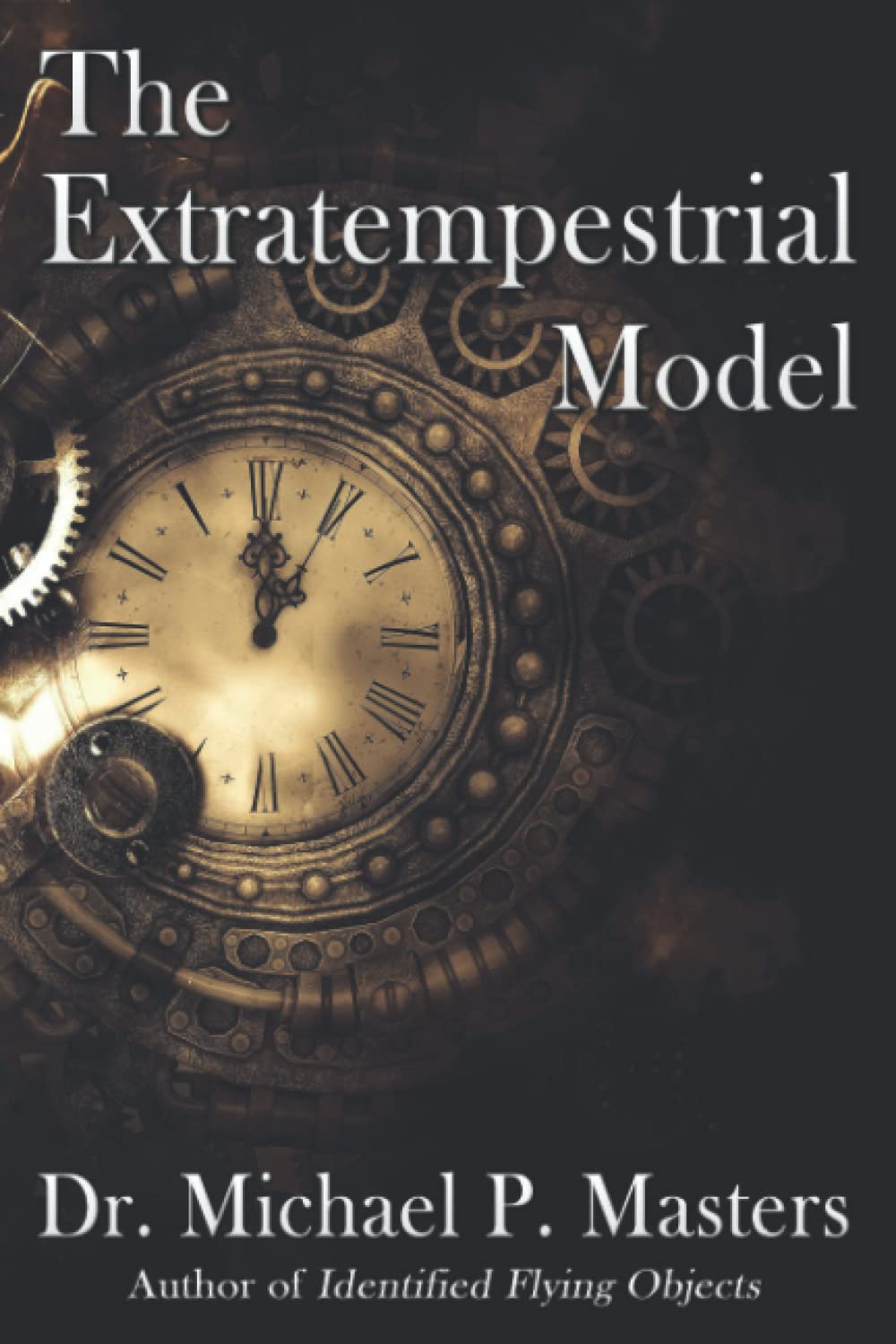
| Author | Dr. Michael P. Masters |
| Publisher | Independently Published |
| Published | 2019 |
| Narrator | Dr. Michael P. Masters |
| Rating | ★★★★★ |
What if the beings reported in UAP encounters aren’t from another planet — but from another time? Dr. Michael Masters is a professor of biological anthropology at Montana Tech, and his thesis is exactly that: the entities described by experiencers across decades are Homo sapiens from the distant future, returning through time to study their own evolutionary past.
What It Covers
The Extratempestrial Model presents Masters’s case that the “extraterrestrial” hypothesis misidentifies the origin of UAP occupants. His alternative argues that the beings are future humans, and that UAP are time-displacement vehicles. Masters builds his argument across several disciplines:
- Evolutionary biology — projecting human evolutionary trajectories forward; the match to reported entity descriptions is striking
- Anthropological consistency — cross-cultural consistency in entity descriptions, reflecting contact with the same population of future humans
- Linguistic evidence — reported instances of experiencers communicating with entities, analyzed through language evolution
- The nature of contact — why future humans might conduct systematic biological and anthropological study of their ancestors
Why It Matters
Masters’s model is notable for several reasons. First, it’s proposed by a working academic with relevant credentials. Second, it actually fits the physical descriptions of reported entities better than the ETH does: if these beings evolved from us, they should look like us but different.
The model also sidesteps some of the ETH’s most difficult problems: interstellar travel distances, the Fermi paradox, and the oddity of aliens inexplicably interested in human biology. Future humans studying their own past would be interested in exactly those things.
Closing Recommendation
Who should listen: Readers with scientific backgrounds, or anyone who finds the standard extraterrestrial hypothesis increasingly hard to reconcile with the full body of evidence. An excellent complement to Keel’s Operation Trojan Horse.
Who can skip it: Casual readers looking for narrative-driven content. This is academic in structure and demands attention.
Bottom line: One of the most original and rigorously argued books in the UAP space. Masters makes the extratempestrial hypothesis genuinely credible.
🎧 Listen on Audible 🛒 Buy on Amazon
Frequently Asked Questions
What is The Extratempestrial Model by Dr. Michael P. Masters about?
The Extratempestrial Model (2019) proposes that the entities reported in UAP encounters are not aliens from another planet but rather future humans who have developed time travel technology. Masters, an anthropologist, argues that consistent physical descriptions of “greys” match what evolutionary science predicts future humans might look like.
Who is Dr. Michael P. Masters?
Dr. Michael P. Masters is a professor of biological anthropology at Montana Tech who applies evolutionary biology and physical anthropology to analyze the physical characteristics described by UAP witnesses and abductees. His model attempts to provide a scientifically grounded alternative to the extraterrestrial hypothesis.
What is the “extratempestrial” hypothesis?
The extratempestrial hypothesis holds that UAP are operated by future humans traveling backward in time — rather than beings from other star systems. Masters argues this explains reported entities’ humanoid appearance, their apparent interest in human biology and reproduction, and their knowledge of human language and culture.
Is the extratempestrial model scientifically credible?
Masters’ evolutionary analysis is grounded in established biological science. Time travel itself remains theoretical, but the hypothesis is more falsifiable than most UAP theories and aligns with current scientific understanding of human evolution. It is a minority view but one developed with academic rigor.