

Last updated: August 1, 2026
Affiliate disclosure: This review contains Amazon affiliate links. As an Amazon Associate I earn from qualifying purchases at no extra cost to you.
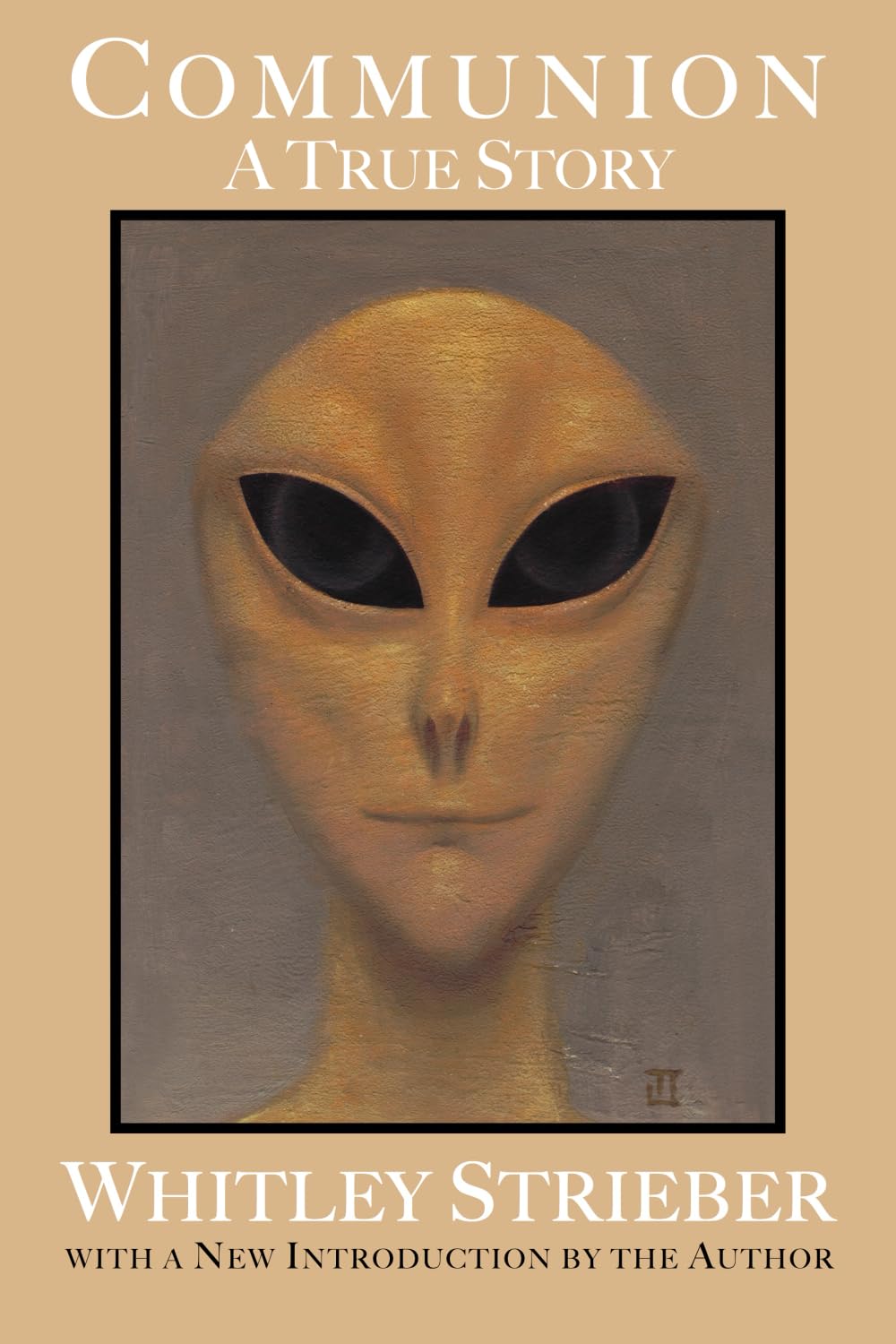
| Author | Whitley Strieber |
| Publisher | William Morrow |
| Published | 1987 |
| Narrator | Whitley Strieber |
| Rating | ★★★★★ |
The book that brought abduction to the mainstream
Whitley Strieber’s Communion is the best-selling UAP book ever published, and one of the most consequential. It was the first first-person abduction account to reach a mass audience, and it arrived at a cultural moment — 1987 — when the phenomenon of apparent alien contact was beginning to accumulate enough testimonial weight that serious researchers could no longer simply dismiss it. Whether you find Strieber’s account credible, partially credible, or not credible at all, engaging honestly with UAP literature requires engaging with this book.
What it covers
Strieber describes a series of encounters beginning in December 1985 at his upstate New York cabin, in which he believes he was abducted and subjected to examinations by beings he describes with careful phenomenological precision. The beings he encountered — now iconic from the book’s cover illustration — are depicted as small, large-eyed figures whose affect is neither benign nor malicious but profoundly alien.
Strieber approaches his own experience with a mixture of literalism and philosophical uncertainty that distinguishes this book from simpler abduction accounts. He is not claiming simply that aliens took him. He is grappling, genuinely and at length, with what such an experience means — for his identity, his sanity, his understanding of reality — in ways that make the book valuable regardless of whether the encounters were physical, psychological, or something else entirely.
Why it matters
The scale of Communion‘s cultural impact is difficult to overstate. It introduced millions of readers to the abduction phenomenon, established the visual iconography that persists to this day, and inspired John Mack — a Harvard psychiatrist and Pulitzer Prize winner — to take the phenomenon seriously enough to conduct years of rigorous research. The book’s influence on UAP culture is comparable to Hynek’s influence on UAP science.
Caveats
Strieber’s account is, at its core, a personal testimony without independent corroboration of its most dramatic elements. He underwent hypnotic regression, which is methodologically problematic as a memory recovery tool. And his subsequent writing has moved in directions that many serious researchers find difficult to follow. Read this as an important phenomenological account, not as evidence in the evidentiary sense.
Who it’s for
General readers; anyone interested in the experiencer phenomenon; those studying the cultural impact of UAP on modern consciousness. Not a starting point for skeptics — begin with Kean or Hynek instead.
Where to get it
Frequently Asked Questions
What is Communion by Whitley Strieber about?
Communion (1987) is Whitley Strieber’s account of his claimed encounters with non-human entities at his cabin in upstate New York, recovered through hypnotic regression. The book became a defining cultural touchstone for alien abduction narratives and sparked widespread public discussion of the phenomenon.
Who is Whitley Strieber?
Whitley Strieber is an American author known for horror fiction (The Wolfen, The Hunger) who claimed a series of alien abduction experiences beginning in December 1985. Communion was his first non-fiction work and became one of the best-selling books about the UAP/abduction phenomenon.
How should Communion be read in the context of UAP research?
Communion is best understood as a primary account — Strieber’s subjective experience — rather than documented evidence. Researchers like John Mack and Budd Hopkins investigated similar accounts from hundreds of witnesses, finding consistent patterns that are difficult to explain through conventional psychology alone.
What impact did Communion have on UAP culture?
Communion sold millions of copies, was adapted into a film starring Christopher Walken, and introduced the grey alien archetype into mainstream culture. It also opened serious public conversation about the abduction phenomenon and influenced subsequent researchers, including the Harvard psychiatrist John Mack.