

Last updated: August 1, 2026
Affiliate disclosure: This review contains Amazon affiliate links. As an Amazon Associate I earn from qualifying purchases at no extra cost to you.
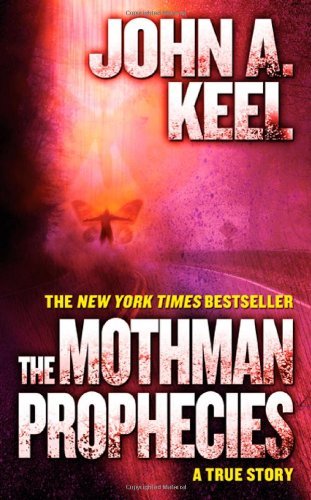
| Author | John A. Keel |
| Publisher | Saturday Review Press |
| Published | 1975 |
| Rating | ★★★★★ |
The book that broke the ET hypothesis
John Keel’s The Mothman Prophecies is unlike almost any other book in UAP literature. Where most researchers ask “what are these craft and where do they come from,” Keel asks a more disturbing question: what if the phenomenon is not from another planet but from somewhere — or somewhen — that has always been intertwined with human experience? The book that emerged from his investigation of Point Pleasant, West Virginia, in 1966–67 remains one of the strangest and most intellectually challenging works in the field.
What it covers
Between November 1966 and December 1967, the area around Point Pleasant experienced an extraordinary convergence of anomalous events: a winged humanoid creature with glowing red eyes seen by hundreds of witnesses, UAP sightings reported nightly, poltergeist activity, mysterious phone calls, and precognitive experiences that seemed to foreshadow the collapse of the Silver Bridge on December 15, 1967, which killed 46 people. Keel investigated all of it personally, conducting hundreds of witness interviews and documenting patterns that he found impossible to reconcile with the extraterrestrial hypothesis.
His conclusion — developed here and expanded in later books — is that the phenomenon is ultraterrestrial rather than extraterrestrial: not beings from another star, but entities that have coexisted with humanity throughout history, manipulating perception and staging encounters for purposes we don’t understand.
Why it matters
Keel’s ultraterrestrial hypothesis directly influenced Jacques Vallée’s interdimensional framework, which has become the most intellectually serious alternative to the ET hypothesis. The Mothman events themselves remain genuinely unexplained — the number and credibility of witnesses, the documented timing of precognitive experiences relative to the bridge collapse, and the physical evidence reported all resist easy dismissal.
The book also introduced a methodological principle that serious researchers still apply: the phenomenon may be deliberately deceptive, staging encounters to mislead investigators. That idea, strange as it sounds, is now a mainstream position among serious UAP researchers.
Caveats
Keel’s writing blurs the line between documented events and speculation without always signaling which is which. Some of his claims about Men in Black and direct communication with unknown entities are unverifiable. Readers should approach this as a serious speculative hypothesis supported by witness testimony, not as a straightforwardly documented account. It is also — unlike Vallée’s more academically careful work — sometimes sensational in tone.
Who it’s for
Essential for readers exploring the ultraterrestrial and interdimensional hypothesis. Read alongside Vallée’s Passport to Magonia for the more rigorous academic treatment of the same theoretical territory.
Where to get it
Frequently Asked Questions
What is The Mothman Prophecies by John Keel about?
The Mothman Prophecies (1975) documents the wave of strange phenomena that struck Point Pleasant, West Virginia in 1966–1967, including sightings of a large winged humanoid (“Mothman”), UFO activity, Men in Black encounters, and prophetic phone calls. Keel investigates these as interconnected phenomena rather than isolated incidents.
Who was John Keel?
John Keel was an American journalist and author who investigated paranormal phenomena for decades, developing the “ultraterrestrial” hypothesis — the idea that UAP and related phenomena may originate from an intelligence sharing our environment rather than from outer space. His work influenced a generation of UAP researchers.
Is the Mothman a real phenomenon?
Dozens of witnesses reported encountering a large, winged, red-eyed humanoid entity in the Point Pleasant area between 1966 and 1967. The Silver Bridge collapse in December 1967 — which killed 46 people — occurred shortly after peak sighting activity, adding to the area’s folklore. The Mothman’s nature remains unexplained.
How does The Mothman Prophecies connect to UAP research?
Keel’s book is notable for treating Mothman sightings, UAP encounters, and Men in Black reports as part of a single unified phenomenon — an approach that influenced later researchers who see UAP as part of a broader, possibly non-physical or interdimensional phenomenon rather than conventional spacecraft.