Last updated: August 1, 2026
Watch the video review:
Affiliate disclosure: This review contains Amazon affiliate links. As an Amazon Associate I earn from qualifying purchases at no extra cost to you.
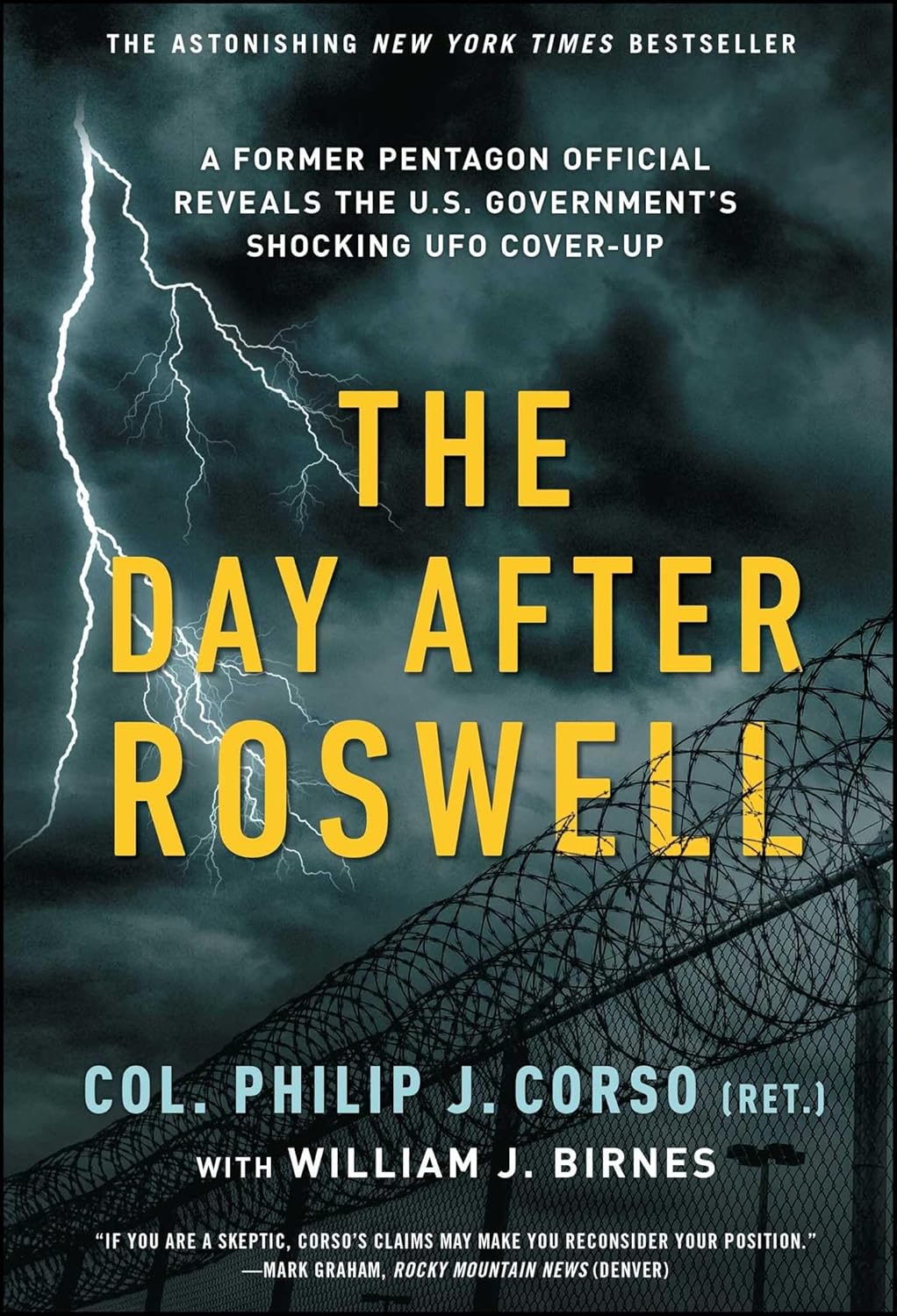
| Author | Philip J. Corso & William J. Birnes |
| Publisher | Pocket Books |
| Published | 1997 |
| Rating | ★★★☆☆ |
What The Day After Roswell Is About
In July 1947, something fell near Roswell, New Mexico. The Army Air Force initially announced they had recovered a “flying disc.” The next day, they retracted the statement and said it was a weather balloon. The Day After Roswell is Philip Corso’s claim that the first statement was closer to the truth — and that he knows what happened next.
Corso’s central argument: recovered material from the Roswell site was transferred through Army channels over the following years, eventually landing on Corso’s desk at the Pentagon’s Army R&D division in 1961. There, under the direction of General Arthur Trudeau, Corso claims he spent two years seeding recovered extraterrestrial technology into American defense and commercial research programs — not by handing over alien hardware directly, but by identifying underlying principles and steering contractor R&D in those directions without ever disclosing the source.
Who Was Philip Corso?
Philip J. Corso was not a fringe character. Born in 1915 in Pennsylvania, he served in the Army for 25 years across World War II, the Korean War, and the Cold War. His documented assignments include service on President Eisenhower’s National Security Council staff from 1953 to 1955 — a role that gave him access to some of the most sensitive intelligence of the era. Later, as Chief of the Foreign Technology Division at Army R&D from 1961 to 1963, he worked under Lieutenant General Arthur Trudeau, himself a significant figure in Army intelligence.
He co-wrote the book with William J. Birnes, a journalist and television producer known for the History Channel series UFO Hunters. Corso died in July 1998, approximately a year after publication. He maintained the accuracy of his account until his death. His documented career — the NSC posting, the Army intelligence assignments, the Pentagon R&D role — is verifiable. The specific claims he makes about what he saw and did within those roles are not.
The Most Controversial Claim in UAP Literature
Corso was a real person with a verifiable and distinguished military career: a decorated Army officer who served on Eisenhower’s National Security Council staff and retired as a Lieutenant Colonel. The claims he makes in The Day After Roswell — that he personally managed a file of recovered Roswell materials and was responsible for seeding recovered UAP technology into US defense industry R&D programs — are not verifiable, and some have been disputed. Understanding the distinction between the man and the claims is the key to reading this book honestly.
The Technology Transfer Claims — In Detail
This is what made The Day After Roswell the most contested book in UAP literature. Corso doesn’t just claim the government recovered a craft — he names specific technologies he says were derived from Roswell artifacts and steered into American industry:
- Fiber optic cables — Thin, hair-like filaments in the recovered material that transmitted light without loss. Corso says these principles were introduced to research programs that produced modern fiber optic technology.
- Integrated circuits — Wafer-thin chips found in the craft’s guidance systems, which Corso claims informed transistor and microchip development of the late 1950s.
- Night vision technology — Light-amplifying devices found among the artifacts that he says he introduced to Army contractors working on night vision equipment.
- High-strength fibers — Mesh material covering the biological specimens, said to be incredibly strong, which Corso believes influenced high-strength polymer research including what became Kevlar.
- Particle beam weapons — Energy weapon principles derived from the craft’s systems, which Corso directed toward Army particle beam research programs.
- Stealth and radar-absorbent materials — The craft’s surface properties absorbed radar, and Corso claims this informed early stealth technology development.
- Neural interface device — A headband-like device that Corso theorized allowed the craft’s occupants to interface with their ship through thought or neural signals, influencing early brain-computer interface research.
All of these technologies have well-documented independent development histories. Historians trace fiber optics to Narinder Singh Kapany’s work in the 1950s, integrated circuits to Jack Kilby and Robert Noyce — none of which required extraterrestrial input. Corso’s counter is that recovered technology accelerated these developments by decades. This is not verifiable in either direction.
The Biological Evidence
Corso describes a brief but disturbing encounter in 1961 at Fort Riley, Kansas. He was shown a wooden crate in a basement storage room. When he opened it, he found a preserved biological specimen: a small being with a large head, disproportionately large eyes, and a slender, child-sized frame. This encounter anchors his certainty throughout the book — whatever the technology debates, he believes he saw direct physical evidence of non-human intelligence.
No corroborating witness to this specific encounter has come forward publicly, and the specimen is not publicly accounted for. Corso does not claim to know what ultimately happened to the biological remains.
Caveats and Credibility
Reading The Day After Roswell honestly requires holding two things simultaneously.
First: Corso’s documented military career is legitimate. His service, clearances, and senior positions are real. His access to sensitive information during the Eisenhower administration is real. This gives his account more weight than claims from anonymous or uncredentialed sources.
Second: the specific claims — the technology seeding, the Roswell connection, the biological specimens — have not been independently confirmed. Some of Corso’s technology timelines conflict with documented development histories. The collaboration with Birnes, who had a commercial interest in a sensational book, creates legitimate questions about editorial shaping. And the decision to publish in 1997 — at age 82, a year before his death — made independent verification of specific claims nearly impossible.
Corso is best understood as a credentialed witness making extraordinary claims. His credential is verifiable. His claims are not.
Legacy: How This Book Shaped UAP Disclosure
Whatever its factual status, The Day After Roswell has been enormously influential. Published in 1997, it was among the first accounts by a credentialed military insider to make specific, named claims about crash retrieval programs and technology back-engineering. It established the narrative template — verifiable biography, classified programs, technology transfer, non-human biological evidence — that subsequent insider accounts have followed.
The threads in David Grusch’s 2023 congressional testimony — crash retrievals, non-human biologics, reverse-engineered technology programs held by private contractors — trace directly back to the framework Corso built in this book. Whether you see this as corroboration or as subsequent witnesses building on Corso’s template depends on your interpretation. Either way, understanding current UAP disclosure arguments requires engaging with this book’s foundational claims.
Who It’s For
Researchers studying crash retrieval claims and whistleblower accounts will find The Day After Roswell essential. Anyone trying to understand the Grusch testimony and current disclosure arguments needs the context this book provides. Read it critically, alongside the documented histories of the technologies it describes, and with the understanding that Corso’s verified career is real even when his specific claims cannot be confirmed.
If you’re new to UAP literature, build context first with Imminent by Luis Elizondo or UFOs and the National Security State, then return to this one.
Where to get it
Frequently Asked Questions
What is The Day After Roswell about?
The Day After Roswell (1997) is Philip Corso’s account of his alleged role in overseeing the “seeding” of extraterrestrial technology — recovered from the Roswell crash — into U.S. defense and commercial industries. Corso claims he directed the introduction of technologies including fiber optics, integrated circuits, and night-vision devices derived from alien hardware recovered in 1947.
Who was Philip Corso?
Philip Corso was a retired U.S. Army Lieutenant Colonel who served on the National Security Council under President Eisenhower and later as Chief of the Foreign Technology desk at Army R&D from 1961–1963. He co-wrote The Day After Roswell with journalist William Birnes and published it in 1997, the year before his death in 1998.
How credible are Corso’s claims?
Corso’s specific claims about technology transfer from Roswell artifacts remain unverified and have been disputed by historians of those technologies. However, his documented career — the NSC posting under Eisenhower, the Pentagon R&D role under General Trudeau — gives his account more weight than most insider claims. The book should be read critically alongside corroborating sources.
What technologies does Corso claim came from Roswell?
Corso claims the following technologies were derived from Roswell artifacts and seeded into U.S. industry: fiber optic cables, integrated circuits, night vision devices, high-strength polymer fibers (similar to Kevlar), particle beam weapons technology, radar-absorbent stealth materials, and a neural interface device that allowed thought-controlled operation of the craft.
What does The Day After Roswell say about the 1947 Roswell crash?
Corso claims the July 1947 Roswell incident involved the recovery of a non-human craft and its occupants, that this was known at the highest levels of the U.S. government, and that a systematic program was established to back-engineer the recovered technology while maintaining complete secrecy from the public and most of Congress.
Did The Day After Roswell influence David Grusch?
Corso’s book established the core narrative template — crash retrievals, non-human biologics, private contractors holding recovered material, technology back-engineering programs — that reappears in David Grusch’s 2023 congressional testimony and other recent whistleblower accounts. Whether Grusch’s claims corroborate Corso or simply follow his template is a key interpretive question in contemporary UAP research.
Is there an audiobook version of The Day After Roswell?
Yes. The Day After Roswell is available as an audiobook on Audible, covering the full text of the 1997 book.