
Last updated: July 21, 2026
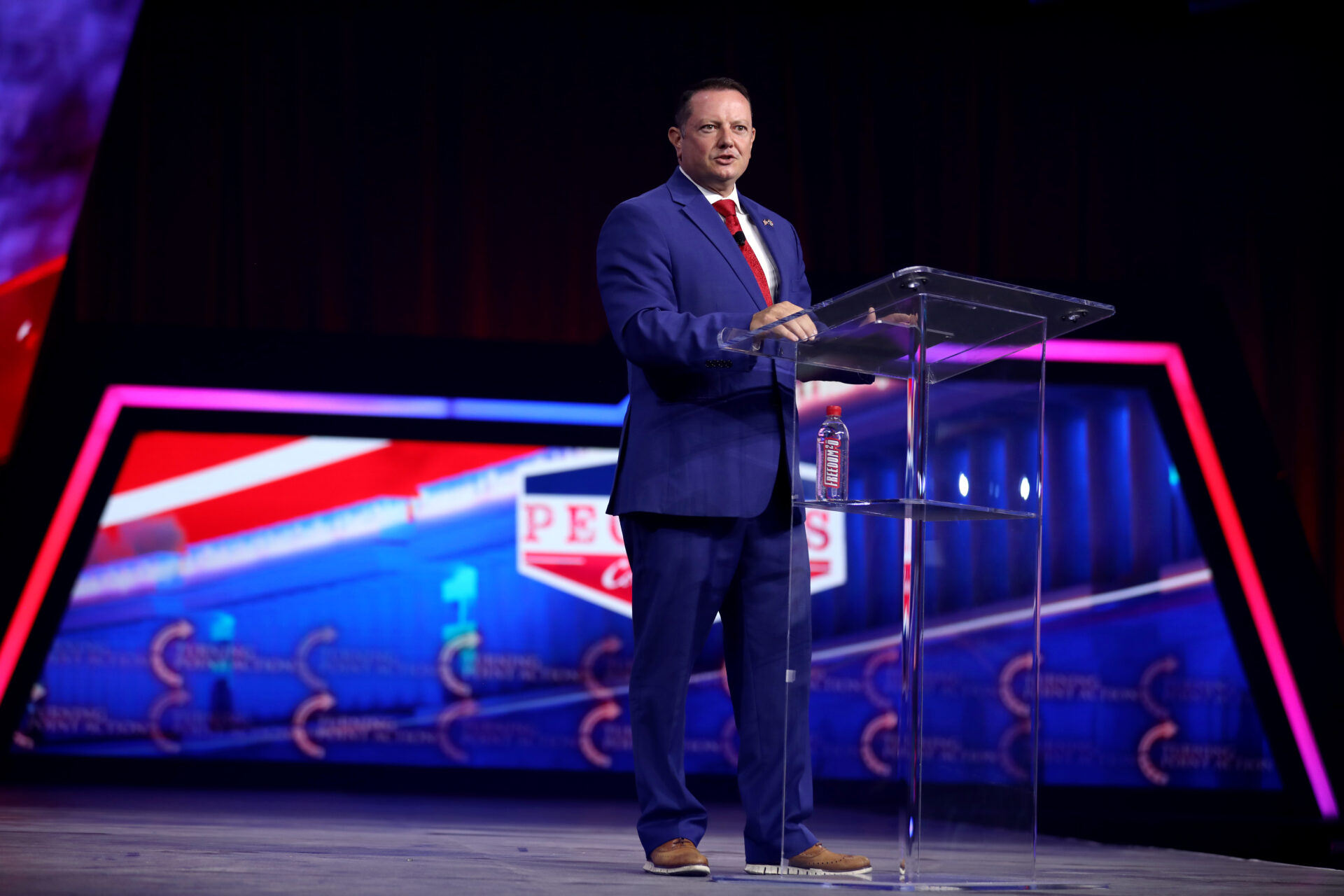
In one of the most candid UAP interviews given by a sitting U.S. lawmaker in 2026, Rep. Eric Burlison (R-Mo.) sat down with NewsNation‘s Ross Coulthart for an on-the-record conversation that covers territory most members of Congress still avoid: what he personally witnessed inside a classified SCIF, which UAP footage he is pushing hardest to make public, why he believes defense officials were not fully transparent even in classified briefings, and what physical evidence he most wants to access. The interview — part of NewsNation’s Reality Check series — arrives at a pivotal moment in the congressional UAP push, weeks after the Disclosure Forum 2026 generated the most significant cluster of congressional UAP commitments since the July 2023 House Oversight hearing.
Burlison sits on the House Oversight Committee and has emerged as one of the most operationally focused members of Congress on UAP transparency — credited with the 2025 MQ-9/Yemen footage revelation, recognized at the Disclosure Forum 2026 with a congressional honor, and now on record as the first lawmaker to secure a commitment from MIT Lincoln Laboratory to hand over a classified 1952 Air Force UAP film. His Reality Check interview extends that record into territory he had not previously addressed at this level of detail.
Watch: Rep. Eric Burlison on UAP Material He Saw Inside the SCIF
Ross Coulthart is an award-winning investigative journalist and NewsNation special correspondent widely regarded as one of the most sourced reporters covering UAP disclosure. His Reality Check series has produced some of the most substantive on-the-record conversations with congressional and military figures pushing for UAP transparency.
Who Is Rep. Eric Burlison?
Eric Burlison is a Republican member of the U.S. House of Representatives from Missouri’s 7th congressional district, serving on the House Oversight Committee — the body constitutionally charged with monitoring and checking the executive branch. He has been one of the most aggressive members of Congress in pursuing UAP transparency since 2023, working alongside colleagues including Rep. Tim Burchett (R-Tenn.), Rep. Anna Paulina Luna (R-Fla.), and Rep. Andre Carson (D-Ind.) to push for declassification, witness testimony under oath, and access to contractor-held records.
Unlike some members who have engaged with UAP primarily through committee hearings, Burlison has taken a distinctly investigative approach — pursuing tips from insiders, identifying specific files held by private contractors, and pressing for firsthand access to physical evidence. His track record on the issue is unusually concrete: the 2025 MQ-9 footage revelation, the forced commitment from MIT Lincoln Laboratory, and now this unusually detailed public accounting of what classified UAP briefings have — and have not — contained. He is not a spectator. He is an active investigator operating with a security clearance and the formal authority of the House Oversight Committee behind him.
Inside the SCIF: What Burlison Witnessed
A SCIF — Sensitive Compartmented Information Facility — is a shielded, electronically secured room in which classified material can be shown to personnel with appropriate clearances. Members of Congress can be brought in for UAP briefings inside these facilities, but they cannot bring devices, take notes out, or publicly describe the specific classified content they receive. The SCIF is supposed to be the one place where the government tells Congress the full truth.
Burlison’s assessment of what happened inside those rooms is pointed and troubling. “They weren’t transparent to us in a SCIF setting,” he said in the NewsNation interview — meaning that even in the one channel the government controls entirely, where there is no public audience and no political incentive for concealment from Congress specifically, officials provided filtered rather than complete information. That claim carries enormous weight. The House Oversight Committee’s explicit constitutional function is to check the executive branch. If its members are receiving curated information inside classified settings, the implication is that the withholding of UAP-related material operates at a level that congressional oversight currently does not reach.
This is not a new concern — former Pentagon official Luis Elizondo has made similar arguments, and the UAP Disclosure Act was in part designed to create oversight mechanisms strong enough to pierce the informal secrecy architecture that transcends normal classification channels. But it carries different weight coming from a sitting congressman who has personally sat in those briefings and is characterizing them as insufficient.
The “Low-Hanging Fruit” Problem: What the Government Has Actually Released
Since 2023, the U.S. government has released or acknowledged a series of UAP-related materials: declassified footage, All-domain Anomaly Resolution Office reports, congressional testimony transcripts, and various documents surfaced through oversight requests. Burlison’s characterization of this body of material is clear and measured: it is the easy stuff.
“The first wave of government UFO files is low-hanging fruit,” he told NewsNation — documents and footage that had already circulated widely, been attributed to conventional explanations, or represented the least sensitive portion of what the government holds. The implication is direct: what has been released is not representative of what exists. The public has been given a curated sample designed to demonstrate openness while leaving the most significant material undisturbed.
Burlison is explicit about what the next stage requires. Moving beyond government channels, he argues, means targeting the private contractors and federally funded research organizations that have been the custodians of the most sensitive material for decades — organizations that operate with less transparency, less accountability to elected officials, and fewer legal obligations to respond to congressional oversight than executive branch agencies do. “To get to the real bottom of this,” he has said, “they’re going to have to dig very hard and deep.” His team is already doing exactly that.
The Orb Videos: Glowing “Balls of Plasma” Moving With Intelligence
One category of evidence Burlison identified as particularly significant — and still unreleased — is footage of luminous, spherical objects. “Most of what has not been released that to me is the really mysterious thing are the glowing orbs,” he told NewsNation. He characterized these objects as “balls of plasma” that appear to move with directional intelligence: hovering without any visible means of propulsion, then accelerating suddenly in ways that violate the performance envelope of any known human aircraft or atmospheric phenomenon.
The plasma characterization is worth parsing carefully. Plasma is a fourth state of matter — ionized gas — not a propulsion mechanism. Calling a UAP a “ball of plasma” describes what it looks like, not what it is or how it moves. It does not resolve the underlying question: what generates the plasma field, what propels it, and who or what controls its direction? Those questions remain open, and Burlison — characteristically — does not pretend otherwise.
“When I see those videos, I can’t tell you this is clearly from another planet,” he said — but the footage, he argued, depicts something genuinely unknown that defies conventional explanation. He also expressed confidence that some of the orb videos will eventually reach the public. His team is actively pursuing those specific files. The orb designation connects to a broader pattern documented in U.S. military UAP encounter data: luminous spherical objects have been among the most consistently reported UAP types by Naval aviators and other military personnel since at least 2014, appearing in the Office of the Director of National Intelligence’s UAP reports as one of the dominant observed morphologies.
The Egg-Shaped Craft: “I’m from Missouri — You’re Going to Have to Show Me”
When NewsNation’s Ross Coulthart asked Burlison which single piece of evidence he most wants to see, the answer was not a document, a testimony, or a video. It was a physical object.
“A lot of the people that have talked about interacting with these egg-shaped craft that we have in our possession — I want to see the craft,” Burlison said. The line is significant on multiple levels. First, it confirms that Burlison is treating multiple witness accounts of a physically recovered egg-shaped craft as credible enough to warrant direct investigation — not dismissing them as speculation. Second, it reflects the evidentiary standard he consistently applies: firsthand inspection, not secondhand testimony. Third, the phrase “that we have in our possession” — used by a sitting congressman with a security clearance who has received classified UAP briefings — is not casual. It implies familiarity with the underlying claims that goes beyond public reporting.
He went further, referencing accounts from individuals who claim to have physically entered the craft and experienced missing time afterward. “We’ve heard people that have claimed that they’ve gone into it and they’ve lost time,” Burlison said. “I want to go into the craft. I want to see for myself. Again, I’m from Missouri. You’re going to have to show me.” The invocation of Missouri’s unofficial motto — “Show Me State” — is deliberate. Throughout his UAP work, Burlison has been consistent: he wants verifiable, physical, firsthand evidence. Witness accounts are a starting point for investigation, not a conclusion.
Targeting the Contractors: MIT Lincoln Lab, MITRE, and RAND
A central argument that Burlison has been developing — and which distinguishes his approach from most congressional UAP work — is that a significant portion of the most sensitive material is held not by government agencies but by private contractors and federally funded research institutions. These organizations operate with considerably less transparency than executive branch agencies: they are not subject to the same FOIA obligations, they are not directly accountable to congressional oversight committees in the same way, and their employees are bound by non-disclosure agreements that the existing whistleblower protection framework does not adequately cover.
Burlison has named MIT Lincoln Laboratory, MITRE Corporation, and RAND Corporation as specific targets of his investigation — institutions that have worked at the intersection of national security and advanced aerospace research for decades, and where, according to tips his team has received from insiders, UAP-relevant documents, photographs, and video files are held. “We’ve heard a lot of really outrageous stories and testimonies from people,” Burlison said. “But I want to see the receipts.”
The most concrete result of this contractor-focused strategy so far: at the Disclosure Forum 2026, Burlison announced that MIT Lincoln Laboratory had agreed to hand over a classified 1952 Air Force UAP film — a briefing delivered by Project Blue Book director Edward J. Ruppelt, catalogued as “AF-ATIC-FILM, 03/52” and labeled “flying saucer talk” — within 30 days. The film is believed to be connected to the July 1952 Washington D.C. UAP radar incidents, in which objects were tracked over the Capitol and the White House and intercepted by Air Force jets, only to disappear before engagement. Those incidents remain officially unresolved. The laboratory’s attorneys responded quickly and committed to comply. If the recording surfaces as described, it would represent one of the most significant primary source documents on early U.S. government UAP activity since the declassification of Project Blue Book files in the 1970s.
Why Is the Government Still Hiding This?
The standard justification offered for UAP secrecy is public panic: the argument that widespread disclosure of anomalous craft operating in U.S. airspace — or of recovered non-human technology — would destabilize society, undermine institutional trust, or cause mass fear. Burlison offered a different and arguably more plausible explanation.
His view is that the primary driver of secrecy may not be what the government knows, but what it does not know. Governments may be fundamentally reluctant to acknowledge that objects are operating in restricted airspace — including over military installations and nuclear facilities — that they cannot identify, cannot intercept reliably, and do not understand. Admitting that the most advanced military on Earth has been encountering phenomena it cannot explain carries its own severe institutional cost. It invites questions about the adequacy of air defenses, the reliability of sensor systems, and the competence of the agencies tasked with protecting U.S. airspace. Admitting ignorance on this scale, publicly and on the record, is not something bureaucratic institutions do willingly.
That framing, if accurate, changes the political calculus of disclosure significantly. Public panic is a problem that can be managed with careful communication strategy. Institutional embarrassment — the admission that a 70-year program of suppression was driven in part by the fact that nobody inside it knew what they were dealing with — is a different order of problem, with different implications for accountability.
The Broader Congressional Push: Where Disclosure Stands in 2026
Burlison’s interview is not an isolated event. It arrives in the middle of what is arguably the most sustained and organized congressional push for UAP transparency in U.S. history — a push that has accelerated sharply since the Disclosure Forum 2026 on June 25.
The Schumer-Rounds UAP Disclosure Act — Again. Sen. Chuck Schumer (D-N.Y.) and Sen. Mike Rounds (R-S.D.) have introduced their UAP Disclosure Act as an amendment to the 2026 National Defense Authorization Act — the third consecutive year they have attempted to attach this legislation to the defense authorization bill. The original act, modeled on the JFK Assassination Records Collection Act and calling for a presidentially appointed review board with authority to compel declassification, was stripped from the FY2024 NDAA in conference negotiations after sustained resistance from the defense establishment. Its 2026 revival carries the same core mandate: mandatory disclosure, a defined timeline, and independent review authority. Rounds has stated directly: “Leader Schumer and I will again offer this vital legislation as an amendment to this year’s NDAA, and we hope to finally bring it over the finish line.”
UAP Whistleblower Protection Act (H.R.5060). The 119th Congress has introduced H.R.5060, the UAP Whistleblower Protection Act, which would establish formal legal protections for government employees, service members, and contractors who disclose UAP-related information to Congress, the Inspector General, or AARO. Existing whistleblower protections — codified in 50 U.S.C. § 3373b — have not been sufficient to protect those with the most sensitive knowledge. H.R.5060 is designed to close that gap. Rep. Anna Paulina Luna, who chairs the House Task Force on the Declassification of Federal Secrets, confirmed at the Disclosure Forum 2026 that she is actively working with the White House on granting immunity to individuals who want to come forward about alleged recovered non-human craft and biological materials — but who cannot do so without explicit presidential protection.
Burlison’s NDA Waiver Push. At the Disclosure Forum 2026, Burlison went further than any existing legislation, calling explicitly for non-disclosure agreements covering “anything regarding life outside of Earth” to be unilaterally waived. The argument is straightforward: if the U.S. government possesses evidence of non-human technology or biology, then the private contractors and government employees bound by NDAs should not be legally blocked from disclosing that information to Congress. The NDA system was designed to protect legitimate national security secrets — not to conceal contact with non-human intelligence from the public’s elected representatives.
The UAP Science Advisory Council. Harvard astrophysicist Avi Loeb, founder of the Galileo Project, was named as lead of a new UAP Science Advisory Council announced at the Disclosure Forum 2026. The council will advise the U.S. government on UAP research methodology and scientific standards — providing the independent scientific infrastructure that congressional UAP hearings have repeatedly identified as missing from the government’s approach. Loeb’s framing at the forum: “We should keep our eye on the orbs, not the audience.” The council represents a structural shift from advocacy to formal institutional infrastructure.
The March 2026 SCIF Briefing. A classified congressional UAP briefing inside a SCIF in March 2026 — which Burlison attended — was described by participants as one of the most bipartisan events in Washington. But as Burlison’s Reality Check interview makes clear, bipartisan interest in the topic and full transparency about what the government holds are not the same thing. The briefing included members from both parties; it did not, according to Burlison, include everything the government knows.
For the complete legislative and historical record, see the UAP Disclosure Timeline, the UAP Disclosure Act page, and the primary source documents index. For profiles of the key figures driving this push, see Rep. Tim Burchett, Sen. Chuck Schumer, Luis Elizondo, and Rear Admiral Timothy Gallaudet.
What Burlison Wants to See Next
Burlison’s next steps are as concrete as his characterization of where things stand. He wants witnesses who claim knowledge of UAP programs to testify under oath — not in informal settings, not in private conversations, but on the record, with the legal weight that sworn testimony carries. He wants physical access to the alleged egg-shaped craft. He wants the unreleased orb videos to reach the public. He wants MIT Lincoln Laboratory’s 1952 Ruppelt film within the 30-day window that laboratory attorneys committed to. And he wants to expand the contractor investigation to pull in MITRE, RAND, and other federally funded research institutions that have, according to insider tips his team has received, relevant material sitting in their archives.
Underlying all of it is an epistemological standard Burlison has held consistently since he entered this investigation: he wants to see for himself. “I’m from Missouri. You’re going to have to show me.” In a field where the gap between extraordinary claims and verifiable evidence has been the central problem for decades, that standard — demanding receipts, demanding physical access, demanding sworn testimony — is not skepticism. It is exactly the evidentiary discipline that a credible congressional investigation requires.
Frequently Asked Questions
What did Rep. Eric Burlison see inside the SCIF?
Burlison has attended classified UAP briefings inside a SCIF (Sensitive Compartmented Information Facility) and has stated on the record that defense officials were not fully transparent even in that classified setting — meaning the briefings contained less than the complete picture of what the government holds. He has not publicly specified which classified materials he viewed, as those details remain classified.
What UAP files is Rep. Burlison forcing open?
Burlison’s team is pursuing UAP-related documents, photographs, and video files held by private contractors and federally funded research organizations, including MIT Lincoln Laboratory, MITRE, and RAND. His most significant result to date: MIT Lincoln Laboratory agreed to hand over a classified 1952 Air Force film of a UAP briefing by Project Blue Book director Edward J. Ruppelt within 30 days, announced at the Disclosure Forum 2026.
What did Burlison say about the unreleased UAP orb videos?
Burlison called the unreleased orb footage the “most mysterious” withheld UAP evidence, characterizing the objects as “balls of plasma” that appear to move intelligently — hovering without propulsion and accelerating suddenly. He said the footage depicts something genuinely unknown and stopped short of calling it extraterrestrial. He expressed confidence that at least some of the orb videos will eventually be released to the public.
What is the egg-shaped craft Rep. Burlison mentioned?
Burlison referenced accounts from multiple witnesses describing an egg-shaped craft allegedly in U.S. government possession, including individuals who claim to have entered the craft and experienced missing time. When asked what single piece of evidence he most wants to see, Burlison said: “I want to see the craft.” He applies a consistent firsthand standard — he wants direct physical access, not second-hand testimony.
Why does Rep. Burlison think the government is hiding UAP information?
Burlison argues the primary driver of UAP secrecy may be institutional embarrassment rather than public panic concerns. His theory: governments may be concealing the fact that they do not fully understand objects operating in restricted airspace — because admitting that the most advanced military on Earth cannot identify or intercept these phenomena carries severe institutional and political costs.
What is the UAP Whistleblower Protection Act?
H.R.5060 — the UAP Whistleblower Protection Act introduced in the 119th Congress (2025–2026) — would establish formal legal protections for government employees, service members, and contractors who disclose UAP information to Congress, the Inspector General, or AARO. Rep. Anna Paulina Luna is also working with the White House on granting direct immunity to individuals who want to come forward about alleged recovered non-human craft and biological materials.
Where can I watch the full Eric Burlison UAP interview with Ross Coulthart?
The full interview with Rep. Eric Burlison is embedded above and available on the NewsNation YouTube channel. The segment is part of the Reality Check series hosted by Ross Coulthart and covers what Burlison witnessed in a SCIF, the orb videos, the egg-shaped craft, and the contractor files he is pursuing.