
Last updated: June 16, 2026
Affiliate disclosure: This review contains Amazon affiliate links. As an Amazon Associate I earn from qualifying purchases, at no extra cost to you.
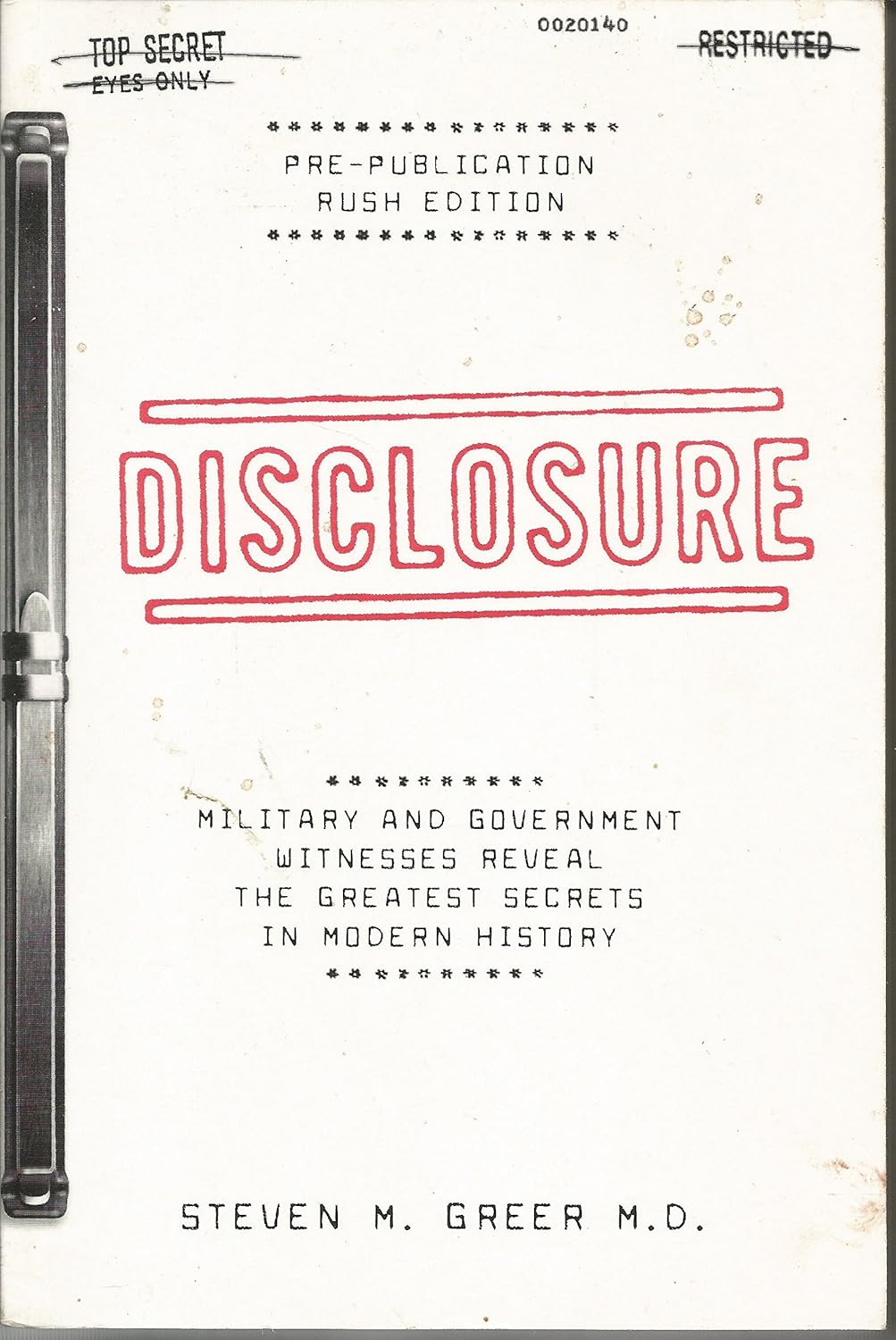
| Author | Steven M. Greer, MD |
| Publisher | Crossing Point |
| Published | 2001 |
| Narrator | Check Audible listing |
| Rating | ★★★ |
In May 2001, Steven Greer organized what he called the Disclosure Project press conference at the National Press Club in Washington, D.C. Over twenty military, government, intelligence, and corporate witnesses presented testimony about UAP — on camera, on the record. It was one of the most significant public UAP events before the 2017 New York Times revelations.
What It Covers
Disclosure (2001) is primarily a testimony anthology. Greer conducted extensive interviews with witnesses — many with high-level clearances and credible professional backgrounds — and the bulk of the book consists of their accounts in their own words.
Themes across the testimony include:
- Craft retrieval and reverse-engineering programs — multiple witnesses describe programs to back-engineer UAP technology
- UAP interaction with nuclear assets — corroborating Hastings’s later research from a different angle
- Institutional suppression — witnesses describe being threatened or debriefed into silence
- The compartmentalization problem — how secrecy programs are structured to prevent any single person knowing the full picture
Why It Matters
The witness testimony in Disclosure is the book’s genuine strength. Many of the individuals Greer interviewed have strong credentials and told consistent stories. The 2001 press conference remains a landmark event in UAP public history.
The controversy enters with Greer himself. His supporters see him as the architect of the modern disclosure movement. His critics point to a pattern of increasingly speculative claims and commercial ventures that many in the community view as undermining his credibility. Treat the witness testimony as the valuable primary-source material it is, and hold Greer’s own framing to a higher evidentiary standard.
Closing Recommendation
Who should listen: Researchers who want access to the 2001 Disclosure Project testimony in a single volume. The witness accounts are worth your time and can be evaluated on their own merits.
Who should approach carefully: Anyone inclined to accept Greer’s broader narrative framework without independent verification.
Bottom line: A historically important document housed in a contested frame. Read it as a primary source archive and apply your own judgment to the editorial voice.
Frequently Asked Questions
What is Disclosure by Steven Greer about?
Disclosure (2001) compiles testimony from over 70 military, government, and intelligence witnesses — collected through the Disclosure Project — covering UAP encounters, crash retrievals, cover-up operations, and secret energy programs. It served as the companion text to the 2001 National Press Club disclosure event.
What witnesses appear in Disclosure by Steven Greer?
The book includes testimony from former military pilots, intelligence officers, FAA officials, NASA employees, and government scientists who describe firsthand UAP encounters or knowledge of classified programs. Many testify under their real names with full credentials.
How does Disclosure relate to the 2001 National Press Club event?
The 2001 National Press Club event was organized by Greer to present a selection of these witnesses publicly, calling on Congress to hold formal hearings. Disclosure contains the full testimony of those witnesses plus many more who could not appear in person. It predates the modern disclosure movement by over 20 years.
Is the testimony in Disclosure verified?
The witnesses are named, credentialed individuals — not anonymous sources — which gives their accounts more weight than typical UAP claims. However, the testimony is not independently verified by government records in all cases. The value lies in the consistency of themes across dozens of independent, credentialed witnesses.