
Last updated: June 23, 2026
Affiliate disclosure: This review contains Amazon affiliate links. As an Amazon Associate I earn from qualifying purchases.
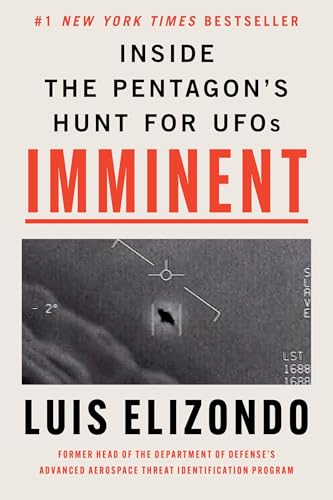
| Author | Luis Elizondo |
| Publisher | William Morrow |
| Published | 2024 |
| Narrator | Elizondo; foreword by C. Mellon |
| Rating | ★★★★☆ |
The view from inside the program
Imminent is the memoir of a man who ran a classified government program investigating UAP for the United States Department of Defense — and then left, went public, and spent years trying to get Congress and the public to take what he found seriously. It is the most consequential insider account of UAP disclosure to be published so far, and it is careful, measured, and specific in ways that make it difficult to dismiss.
Who is Luis Elizondo?
Luis Elizondo served in the United States Army Counterintelligence and later as a senior intelligence officer at the Department of Defense. From approximately 2010 to 2017, he directed the Advanced Aerospace Threat Identification Program — AATIP — a classified program within the Office of the Under Secretary of Defense for Intelligence that investigated unidentified aerial phenomena reported by military personnel.
Elizondo resigned from the DoD in October 2017 in protest of what he described as excessive secrecy, internal obstruction, and the failure to take UAP seriously as a matter of national security. He joined To The Stars Academy alongside former Blink-182 musician Tom DeLonge and subsequently worked with journalists who published the first wave of serious UAP reporting in mainstream media, including the New York Times stories that broke in December 2017 and led directly to the Senate’s renewed interest in UAP oversight.
His credibility is institutional: he is not a researcher or a journalist but a former career intelligence officer with documented DoD employment and a security clearance background that has been independently verified by colleagues and congressional staff. His account can be — and has been — checked against public records, congressional testimony, and the accounts of other former officials.
What the book covers
Imminent covers three interwoven threads. The first is autobiographical: Elizondo’s path to AATIP, what the program actually was, how it operated, and what it found. He is careful to stay within what his security obligations permit, but he provides more operational specificity about the program than has previously appeared in public sources — the structure of reporting chains, the kinds of evidence collected, the resistance encountered from within DoD when investigators sought resources or access.
The second thread is the specific UAP cases the book details. The Nimitz encounter of 2004 — in which Navy pilots from the USS Nimitz carrier strike group tracked and filmed objects exhibiting capabilities far beyond known aircraft — is covered at length, with Elizondo drawing on interviews and program documentation that supplement the public record. The 2015 encounters involving the USS Theodore Roosevelt, which produced the now-declassified Gimbal and Go Fast videos, receive similar treatment. These are not presented as mysteries to be speculated about; they are presented as documented events with witnesses, sensor data, and official documentation that Elizondo argues have not been adequately explained.
The third thread is the disclosure process itself: how Elizondo and a small group of colleagues decided that what they had found was too important to remain classified and too strange to be handled through normal channels, and what happened when they began to push it into public view.
What makes it worth reading
The foreword by Christopher Mellon carries unusual weight. Mellon served as Deputy Assistant Secretary of Defense for Intelligence under both the Clinton and George W. Bush administrations. He vouches for Elizondo directly and at length — not as a friend or ally, but as a former colleague in the defense intelligence community who examined the same evidence and reached the same conclusions. His endorsement is not peripheral to the book; it is an argument in its favor that serious readers should weigh independently.
Elizondo writes like an intelligence officer: direct, organized, unhurried even when describing events that should be startling. He does not reach for dramatic effect. The controlled, analytical tone is, paradoxically, what makes Imminent more alarming in places than books that try harder to alarm. When a man describing government programs destroying evidence and retaliating against investigators sounds this calm and this organized, it carries more force than if he were writing at the pitch of outrage.
The core UAP cases are corroborated independently. The Nimitz encounter, the Roosevelt incidents, the Belgian UAP wave — these events are supported by multiple independent witnesses, official government acknowledgments, and declassified sensor data. Elizondo’s account of them adds program context and investigator perspective, not new facts that rest solely on his credibility.
The pattern of obstruction Elizondo describes — the reassignment of investigators, data destruction, the weaponization of classification against legitimate inquiry — is consistent with patterns documented by other former officials and in the congressional record. In 2023, the Senate passed legislation specifically designed to address the kind of oversight gaps Elizondo describes, which is itself a form of independent confirmation that the structural problem he identifies was real.
How this connects to the congressional hearings
The UAP disclosure timeline that Elizondo helped initiate in 2017 culminated — for now — in the July 2023 House Oversight Committee hearing in which David Grusch, Ryan Graves, and David Fravor testified publicly about UAP, crash retrieval programs, and direct UAP encounters. Imminent provides the backstory that the hearing assumed without explaining: how the disclosure effort began, who was involved, and what the internal resistance looked like.
Elizondo did not testify at the July 26, 2023 hearing. He has testified and spoken extensively before Congress in other contexts, and the book should be read as the most complete public account of the disclosure effort he was part of — more detailed than congressional testimony, more specific than media interviews, and written for readers who want to understand the full arc rather than catch individual moments.
Caveats
Elizondo writes under security constraints that limit what he can disclose. The most specific and striking claims in Imminent are supported by his professional credibility and corroborating accounts from other former officials, but they cannot be independently verified against primary program documents that remain classified. Readers who require documentary proof will find the book persuasive but not conclusive.
Imminent is also a memoir with a point of view. Elizondo believes he found something important, believes the government has mismanaged the response, and believes the public has a right to know. The book is not neutral — it is an argument, and readers should evaluate it as such. The cases and corroborating details are real; the interpretive frame is Elizondo’s.
A note on the audiobook
Elizondo narrates the audiobook himself. His delivery is measured, deliberate, and exactly what you would expect from a career intelligence officer: no flourish, no amplification, no performance. For a book in which credibility is the central question, hearing the author’s own voice and cadence adds a layer of verification that the print edition cannot provide. The audiobook is the recommended format if you want the full effect of the writing’s unusual composure.
Who it’s for
This Imminent book review is essential for anyone following UAP disclosure seriously. This is the primary insider account of how the current disclosure push began, who was involved, and what evidence motivated it. It belongs on the shelf alongside The Day After Roswell by Philip Corso as one of the few UAP books written by someone who held a relevant position inside the government — but unlike Corso’s account, Elizondo’s is recent, corroborated by named colleagues, and documented in the congressional record.
If you are reading UAP books in order of credibility, Imminent belongs near the top. Pair it with Dimensions by Jacques Vallée for the theoretical framework and with UFOs and the National Security State by Richard Dolan for the historical context that precedes Elizondo’s tenure.
Where to get itFrequently Asked Questions
Who is Luis Elizondo and why does it matter?
Luis Elizondo directed the Advanced Aerospace Threat Identification Program (AATIP), a classified DoD program investigating UAP from approximately 2010 to 2017. He resigned in protest in October 2017 and subsequently worked with journalists whose reporting led to renewed congressional oversight of UAP. His credibility is institutional — he is a former career intelligence officer whose DoD employment has been independently verified.
What is AATIP and what did it find?
AATIP — the Advanced Aerospace Threat Identification Program — was a classified Department of Defense program that investigated unidentified aerial phenomena reported by military personnel. According to Elizondo, the program documented encounters exhibiting capabilities beyond known human technology, including the Nimitz (2004) and Roosevelt (2015) encounters that produced the now-declassified Gimbal and Go Fast videos.
Is Imminent credible?
Elizondo’s account is corroborated by multiple former officials, including Christopher Mellon (former Deputy Assistant Secretary of Defense for Intelligence), who wrote the foreword and vouches for Elizondo directly. The core UAP cases he describes are supported by independent witnesses, official government acknowledgments, and declassified sensor data. His account of structural obstruction within DoD is consistent with Senate legislation passed in 2023 specifically designed to address those oversight gaps.
How does Imminent relate to the 2023 congressional UAP hearings?
The July 2023 House Oversight Committee hearing — at which David Grusch, Ryan Graves, and David Fravor testified — was the public culmination of a disclosure push that Elizondo helped initiate in 2017. Imminent provides the backstory: how the effort began, who was involved, and what the internal resistance looked like. Elizondo himself testified before Congress in other contexts, and the book should be read as the most complete account of the disclosure effort he was part of.
How does Imminent compare to other UAP insider accounts?
Imminent is among the most credible UAP insider accounts published. Unlike older books, Elizondo’s account is recent, corroborated by named colleagues still active in the defense and intelligence communities, and partially documented in the congressional record. It is complementary to The Day After Roswell by Philip Corso and provides the most detailed account of how the current UAP disclosure movement began.
Should I read Imminent in print or as an audiobook?
Elizondo narrates the audiobook himself. His measured, intelligence-officer delivery adds a layer of credibility that the print edition cannot replicate. The audiobook is recommended if you want the full effect of the writing’s unusual composure — hearing how calmly he describes extraordinary events is itself informative.
What other books should I read alongside Imminent?
Pair Imminent with Dimensions by Jacques Vallée for the theoretical framework for what UAP might be, and with UFOs and the National Security State by Richard Dolan for the historical context of government UAP programs that preceded Elizondo’s tenure. The Day After Roswell by Philip Corso provides an earlier insider account for comparison.