
Last updated: June 23, 2026
Affiliate disclosure: This review contains Amazon affiliate links. As an Amazon Associate I earn from qualifying purchases at no extra cost to you.
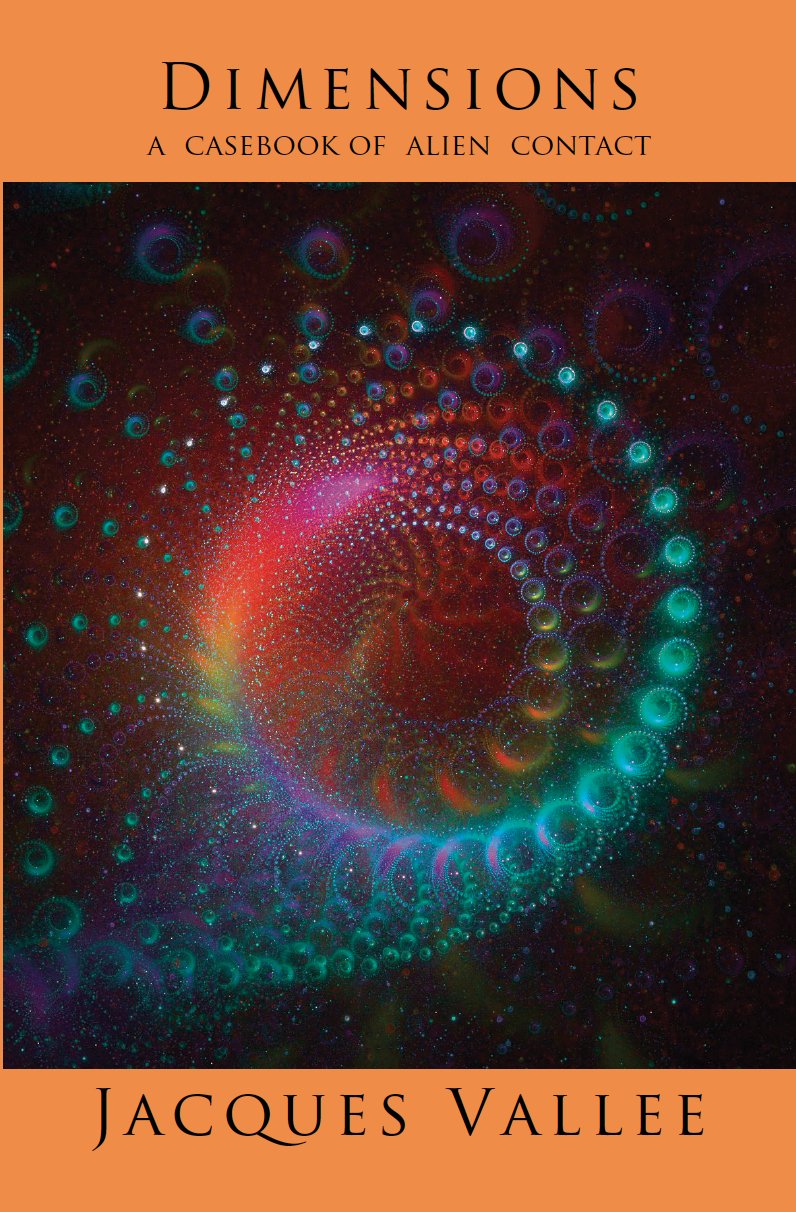
| Author | Jacques Vallée |
| Publisher | Contemporary Books |
| Published | 1988 |
| Rating | ★★★★★ |
The most rigorous case for non-ET origins
Dimensions: A Casebook of Alien Contact was first published in 1988 and remains the most scientifically disciplined statement of the non-extraterrestrial hypothesis in UAP literature. This is not a book about believing in flying saucers. It is a book by a working scientist who examined the complete documented record and concluded that the dominant explanation — spacecraft from other planets — fails to account for the evidence.
Who was Jacques Vallée?
Jacques Vallée (born 1939) is a French-American scientist and computer scientist. He earned degrees in mathematics and astrophysics before completing a PhD in computer science at Northwestern University, where he collaborated with J. Allen Hynek — the Air Force’s scientific consultant on Project Blue Book — developing one of the earliest computerized databases of UAP reports.
Vallée’s influence reaches into popular culture in ways that are easy to miss: the character Claude Lacombe in Close Encounters of the Third Kind was modeled directly on him by Steven Spielberg, who consulted Vallée during production. After the Alien Contact trilogy, Vallée worked with the To The Stars Academy and has continued to consult on materials analysis for alleged UAP physical samples. He is not a peripheral figure in UAP research — he is one of its founding scientific voices, and Dimensions is his most complete theoretical statement.
What it covers
Vallée develops the argument that UAP represents what he calls a “control system” — a phenomenon that has been shaping human consciousness, belief systems, and cultural development throughout history. This is not a benign hypothesis. Vallée is not arguing that the phenomenon is helpful or enlightened, but that it operates on human psychology in ways that are deliberately manipulative, presenting different faces to different cultures and historical periods while maintaining consistent underlying patterns.
To build this case, Vallée draws on three distinct categories of evidence. First, mythological parallels: the behavioral signatures of UAP encounters — appearing in light, landing at specific sites, producing physical effects on witnesses, distorting time perception — match in precise documented detail the accounts of encounters with supernatural beings across dozens of pre-modern cultures that had no contact with each other. Second, physiological and psychological effects: witnesses across cases and continents report the same specific aftereffects, from healing to lasting psychological damage, suggesting a consistent mechanism rather than cultural projection. Third, informational manipulation: the phenomenon consistently provides information that is partly verifiable and partly false — a pattern more consistent with disinformation than sincere communication.
The interdimensional vs. extraterrestrial debate
The ETH — the extraterrestrial hypothesis — posits that UAP are spacecraft from another planet. It is the default assumption in popular discourse. Vallée’s core contribution in Dimensions is to show why this assumption is inconsistent with the full documented record.
The volume of documented close encounters is the starting problem. Vallée’s analysis of global UAP databases concludes that the number of credible close encounters is orders of magnitude larger than would be expected from an interstellar visitation program. Physical spacecraft capable of crossing interstellar distances would not appear in these frequencies, in these locations, with this behavior. The scale alone is incompatible with the ETH as a sufficient explanation.
The interdimensional hypothesis does not require physical spacecraft crossing physical space. It proposes that the phenomenon originates from a different frame of reference — a dimension or level of reality that has always coexisted with ours. This accounts for features of UAP encounters that the ETH cannot: instantaneous appearance and disappearance, apparent materialization and dematerialization, violation of known physical laws. The hypothesis is speculative, but it is the more parsimonious explanation for the observed data. Developments in theoretical physics since 1988 — string theory, M-theory, and brane cosmology — have made additional spatial dimensions scientifically mainstream rather than fringe speculation.
Why it matters
Dimensions was published in 1988. The UAP landscape has been transformed since then. Congress has held open hearings. David Grusch testified under oath in July 2023 about non-human intelligence, retrieved materials, and programs operating outside congressional oversight. The Pentagon has acknowledged unresolved encounters with objects exhibiting characteristics inconsistent with known physics. In this environment, the framework Vallée built in Dimensions has not become obsolete — it has become more relevant.
Grusch’s congressional testimony is consistent, in structural terms, with what Vallée documented and theorized about decades earlier. The questions Dimensions raises — about the nature of the phenomenon, its relationship to human consciousness, the possibility of non-physical origins — are precisely the questions that official investigations have not yet been able to answer. Consciousness researchers, theoretical physicists, and scientists connected to government programs including AATIP have all cited Vallée’s interdimensional framework as the most parsimonious accounting for the full dataset. The book has shaped serious UAP research for forty years and shows no signs of becoming less relevant.
Caveats
The control system hypothesis cannot currently be tested with available scientific tools. Vallée is honest about this, and readers who require falsifiable hypotheses will find the book frustrating in places. The case data in Dimensions comes primarily from pre-1988 sources and does not include the post-AATIP era of sensor-corroborated encounters, government acknowledgments, and declassified program disclosures that now form the core of serious UAP research. The analytical framework holds up; the evidentiary base needs supplementing with newer material.
The writing is dense and systematic. Dimensions is not designed to entertain — it is designed to build a rigorous argument. The case documentation chapters can feel repetitive. The analytical sections are where the book earns its reputation.
Reading order: the Vallée trilogy
Dimensions is the theoretical core of a three-book sequence. Reading order matters:
- Passport to Magonia (1969) — establishes the historical and mythological case database that Dimensions builds its argument on.
- Dimensions (1988) — develops the control system hypothesis with scientific rigor and a theoretical framework for what the phenomenon might be.
- Confrontations (1990) — investigates physical evidence and injury cases, testing the hypothesis against empirical data. The most grounded volume of the three.
Dimensions can be read standalone, but the argument is stronger with Passport to Magonia as foundation.
Who it’s for
Essential for anyone who wants to understand why the extraterrestrial hypothesis remains contested among serious UAP researchers — not because UAP are not real, but because ETH may not be the correct explanation. Required reading before forming a settled view on UAP origins.
Best read after Passport to Magonia and before Confrontations. If you have read Imminent by Luis Elizondo or The Day After Roswell by Philip Corso, this provides the theoretical context that insider accounts assume without fully establishing.
Where to get itFrequently Asked Questions
What is Jacques Vallée’s interdimensional hypothesis in Dimensions?
Vallée argues that UAP represents a non-physical phenomenon that originates from a different dimension or frame of reality, not from another planet. He calls it a ‘control system’ that has interacted with human consciousness and culture throughout history, appearing as demons, angels, or extraterrestrials depending on the cultural context of each era.
How does Dimensions differ from books arguing UAP are extraterrestrial?
Dimensions argues that the extraterrestrial hypothesis fails to explain the documented data — particularly the sheer volume of close encounter cases, the mythological parallels across pre-contact cultures, and behavioral patterns inconsistent with spacecraft from another planet. The interdimensional hypothesis is the more parsimonious explanation for the full evidence.
Is Dimensions still relevant given recent UAP disclosures?
Yes. Congressional testimony from David Grusch in July 2023 and the broader pattern of official government acknowledgment raise the same questions Dimensions raised in 1988: what is the nature of these phenomena, what is their origin, and what are their effects on human consciousness? Vallée’s framework has become more relevant, not less.
What is the control system in Dimensions?
Vallée’s control system hypothesis posits that UAP systematically shapes human perception, belief, and behavior — not through benevolent guidance but through deliberate manipulation. It presents different symbolic faces to different cultures and eras while maintaining consistent underlying behavioral patterns. The phenomenon, in this reading, actively manages how humanity perceives it.
Do I need to read Passport to Magonia before Dimensions?
It helps significantly. Passport to Magonia establishes the historical and mythological case database that Dimensions builds its argument on. Dimensions can be read standalone, but the argument for the control system hypothesis is stronger with Passport to Magonia as foundation.
Has Vallée’s work influenced current UAP research and government programs?
Yes. Scientists, consciousness researchers, and figures associated with government programs including AATIP have cited Vallée’s interdimensional framework as the most parsimonious accounting of the full UAP dataset. His influence on serious UAP research spans four decades.
Is Dimensions the best Jacques Vallée book to start with?
Passport to Magonia is the better starting point — it establishes the historical foundation in more accessible prose. Dimensions is the theoretical core of the trilogy and assumes some familiarity with the case record. Read Passport to Magonia first, then Dimensions, then Confrontations.