Affiliate disclosure: This review contains Amazon affiliate links. As an Amazon Associate I earn from qualifying purchases at no extra cost to you.
The last entry in a 68-year diary
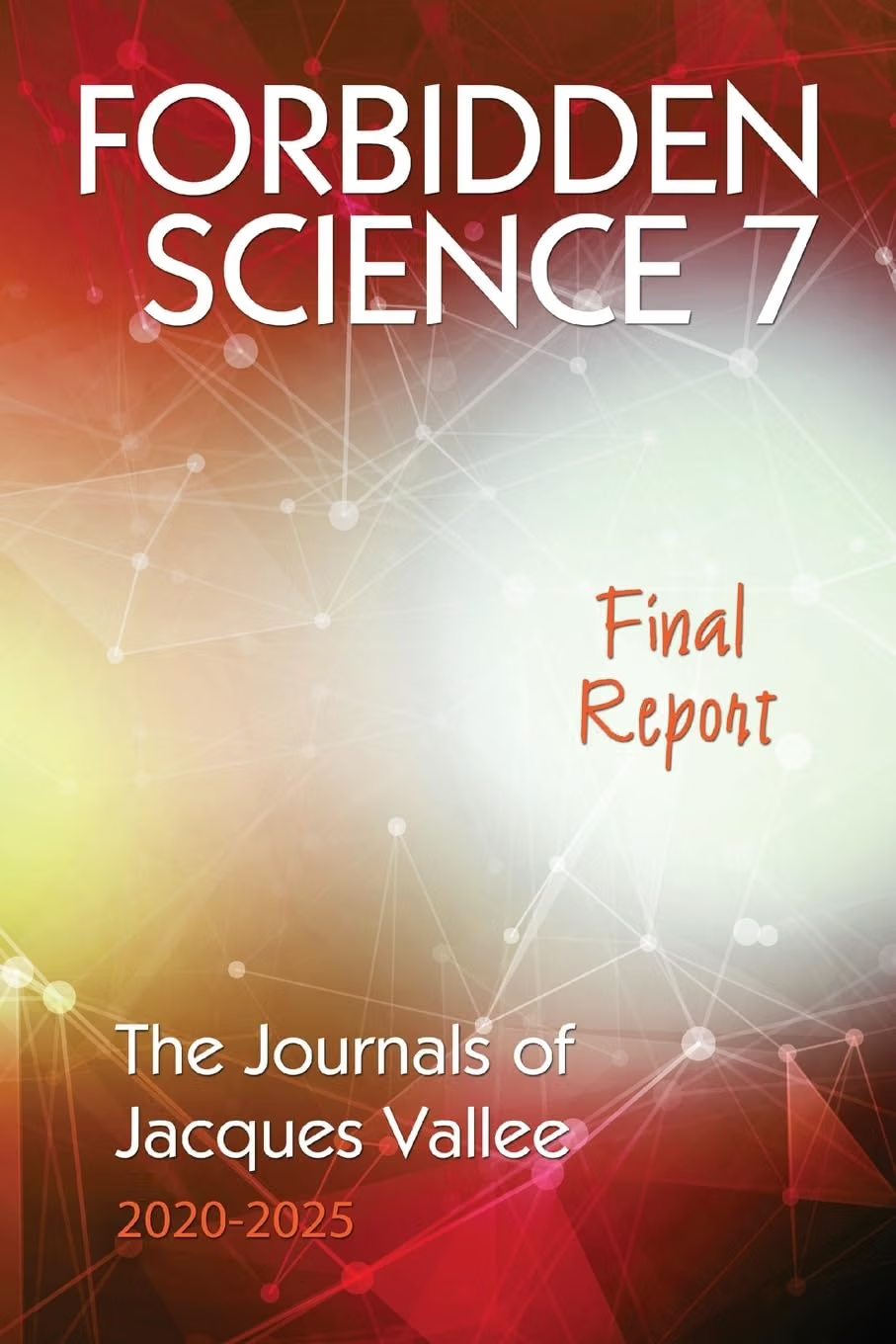
Jacques Vallée has spent nearly seven decades investigating the UAP phenomenon, and Forbidden Science 7: Final Report is where he closes the book on his own record of it. Covering January 11, 2020 through October 27, 2025, this seventh and final volume of his published journals takes him from age 80 to 86 — through a pandemic, the modern disclosure era, and a private correspondence that may be the most consequential thing he has ever published: the account of a source he calls “Gilbert,” a master remote viewer who says he was taken inside a government laboratory built into a mountain and brought face to face with a living nonhuman entity that communicated in configurations of light.
This is not a book that resolves the UFO mystery. By Vallée’s own account, it deepens it — and closes with him more skeptical of official “disclosure” than ever.
What it covers
Forbidden Science 7 runs across three parts — “The Days of COVID” (2020–2021), “Closures and Disclosures” (2022 to mid-2024), and “The Narrow Path” (mid-2024 to late 2025) — and follows Vallée from the isolation of the pandemic through the loudest years of public UAP disclosure in American history.
Structurally, it is a diary, not an argument: dated entries recording conversations, travel, correspondence, and reflection, in the tradition of the six volumes that preceded it. Vallée describes building a data warehouse of roughly 260,000 UAP sightings for a Bigelow Aerospace project funded by the Defense Intelligence Agency — work he says was cut off after about three years, before the analysis he had designed could actually run. He notes, pointedly, that he has never been debriefed from the security clearance that came with it.
The Gilbert story
The book’s most widely discussed passage concerns a source Vallée identifies only as “Gilbert” — a man he describes as “a discrete master remote viewer at the level of Uri Geller and Ingo Swann.” According to Vallée’s journal entries, beginning around October 2021, Gilbert described being guided through official channels to a controlled session inside a secure facility, where he was brought before what military personnel represented to him as a living nonhuman entity. The entity, in Gilbert’s account, did not speak in words but answered in configurations of light.
Vallée goes further still: he tells Ross Coulthart, in the interview below, that he has personally come face to face with an entity himself.
None of this is independently verifiable from outside the book. Gilbert is not named. The facility is not located. What exists is Vallée’s own record of the correspondence, and his decades of credibility as a source who has, by his own account, never previously staked his reputation on a claim this large.
Watch: Ross Coulthart interviews Jacques Vallée
NewsNation’s Ross Coulthart sat down with Vallée for Reality Check to discuss the book, including the Gilbert story, the Bigelow data warehouse, and a 1966 Louisiana case in which a physics professor watched an object radiate energy on the order of a nuclear power station. The full interview is embedded below.
Chapter markers include: 7:16 The Capella Database · 15:58 Why the AAWSAP Project Was Shut Down · 31:58 Gilbert and the Living Entity.
How it closes the Forbidden Science series
Readers who have followed the series — or reviewed Dimensions and Confrontations on this site — will recognize the register: careful, literary, allergic to overstatement. What’s different here is the ending. Vallée frames himself, in the introduction, as Pimen, the aged monk chronicler from Mussorgsky’s Boris Godunov, writing his final chronicle from a cell. The book closes not with a revelation in a hangar, but with an 86-year-old man watching the sun set over the hills of Piedmont after a quiet conference. There is no recovered spacecraft. No species is identified. No official explains what has been hidden.
Where Passport to Magonia built the historical case and Dimensions built the theoretical one, this final volume is personal: a reckoning with sixty-eight years spent on a question Vallée admits, in the end, he cannot fully close.
Why it matters
Vallée reports that a member in good standing of the National Academy of Sciences told him the Academy had been warned it could lose funding if it moved into the UAP subject — a claim, if accurate, about the institutional chilling effect surrounding the topic at the highest level of American science. After sixty years of investigation, Vallée concludes that nobody is actually in charge of the phenomenon inside the U.S. government — a notably different position from the tidy cover-up narrative that dominates most disclosure content.
The Gilbert account also lands in a specific moment. David Grusch’s 2023 congressional testimony described a “detainment situation” and a form of “consciousness communication” with recovered nonhuman occupants — language that echoes Gilbert’s reported experience closely enough that independent researchers have already started asking whether the two accounts describe the same program. Vallée does not make that claim explicitly. The resemblance is worth watching, not treating as confirmed.
Caveats
This book asks for trust in ways its predecessors didn’t need to. The Gilbert testimony is pseudonymous, uncorroborated outside Vallée’s own account, and describes an entity that communicated through a channel — “configurations of light” — that resists any kind of independent verification. Vallée is transparent about this; he does not claim proof, and the book’s tone is closer to testimony than argument. Readers should hold the Gilbert material at the same evidentiary distance Vallée himself applies to it: a serious claim from a source he trusts, not a documented fact.
Who it’s for
Essential reading for anyone who has followed Vallée’s Forbidden Science series from the start, or who takes the consciousness-centered wing of UAP research seriously. Newcomers should start with Passport to Magonia or Dimensions first — this closing volume rewards readers who already know the man and the decades of work behind it.
Where to get it
Frequently Asked Questions
Who is “Gilbert” in Forbidden Science 7?
Gilbert is a pseudonym Vallée uses for a source he describes as a discrete master remote viewer operating at the level of Uri Geller and Ingo Swann. Beginning around October 2021, Vallée’s journal records Gilbert’s account of being taken, through official channels, into a secure facility built into a mountain and brought before a living nonhuman entity. Gilbert’s real identity is not disclosed in the book.
What does the entity “answering in configurations of light” actually mean?
Per Gilbert’s account as recorded by Vallée, the entity did not communicate in spoken language but through patterns or arrangements of light, which Gilbert interpreted as responses. Vallée does not offer a physical mechanism for this and presents it as reported testimony, not a documented phenomenon.
Is the Gilbert story connected to David Grusch’s congressional testimony?
There is a notable resemblance. Grusch’s 2023 testimony described a “detainment situation” and “consciousness communication” involving recovered nonhuman occupants, language that parallels Gilbert’s reported experience. Vallée does not explicitly link the two accounts, and independent researchers caution that the similarity should not be treated as corroboration without further evidence.
Do I need to read the earlier Forbidden Science volumes first?
Not strictly, but it helps. Forbidden Science 7 assumes familiarity with Vallée’s decades of work and reads as a personal closing chapter rather than a self-contained introduction. Readers new to Vallée should start with Passport to Magonia or Dimensions, both reviewed on this site.
What is the Bigelow Aerospace data warehouse Vallée describes?
Vallée describes building a database of approximately 260,000 UAP sightings for a project funded through Bigelow Aerospace with support from the Defense Intelligence Agency. He states the project was terminated after roughly three years, before the statistical analysis he had designed could be run, and that he was never formally debriefed from the security clearance associated with the work.
Does Forbidden Science 7 reach a final conclusion about what UAP are?
No. Despite the “Final Report” subtitle, Vallée does not settle on a single theory. He concludes only that, after sixty years of investigation, no single entity or agency appears to be fully in control of the phenomenon within the U.S. government, and that the answer he found was “disturbing” in how precisely it aligned with older traditions he had not expected to revisit.