
Affiliate disclosure: This review contains Amazon affiliate links. As an Amazon Associate I earn from qualifying purchases at no extra cost to you.
| Author | Jay Stratton |
| Publisher | William Morrow |
| Published | October 13, 2026 |
| Narrators | Jay Stratton and Hal Puthoff |
| Rating | ★★★★★ |
The first book from the man who ran the task force
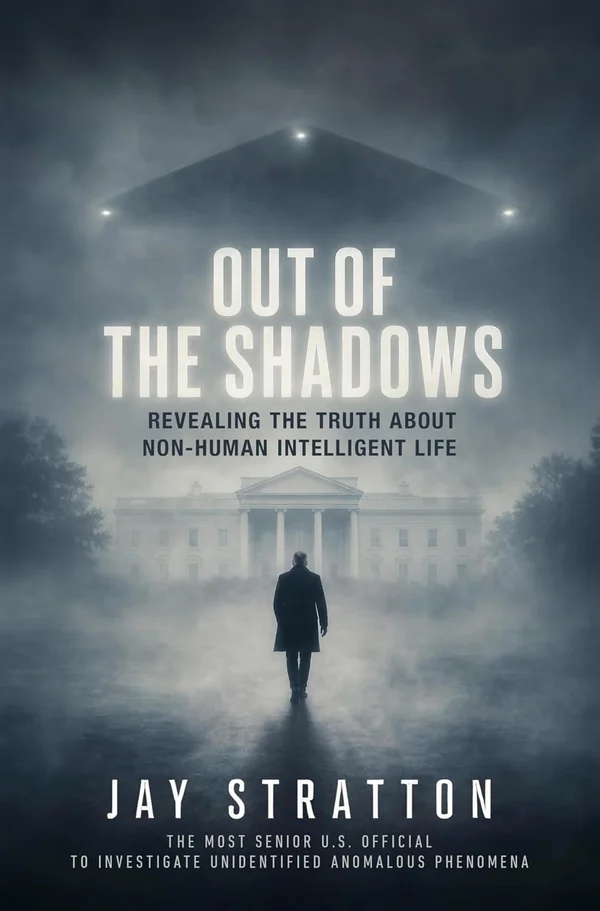
Out of the Shadows: Revealing the Truth About Non-Human Intelligent Life is the memoir of Jay Stratton, the intelligence officer who, according to the publisher, co-founded the Advanced Aerospace Weapon System Applications Program (AAWSAP), created the Advanced Aerospace Threat Identification Program (AATIP) and served as the first director of the Unidentified Aerial Phenomena Task Force (UAPTF). William Morrow, a HarperCollins imprint, released the 336-page hardcover on October 13, 2026, and Stratton promoted it the day before in a widely watched Fox News interview with Bret Baier.
It is the most detailed insider account yet of how the modern government effort to study UAP was assembled, funded, defended and, in the author’s telling, obstructed. It is also a gripping read, with bold assertions about a long-running crash retrieval and reverse engineering program and about strange events at the author’s own home. Our verdict in one line: a landmark insider memoir and an essential primary source for anyone following disclosure, written by an official the publisher describes as the most senior to have investigated the subject.
What it covers
The memoir traces Stratton’s path from a long military and intelligence career to the center of the government’s UAP effort. The publisher’s biography describes more than thirty years of service, eight deployments and assignments across the Army, the Air Force, Naval Intelligence and the Defense Intelligence Agency, where he rose to Chief of Air and Space Warfare. The book presents his specialty in emerging and classified aerospace technology as the reason he felt qualified to judge what he was shown.
The turning point, in his telling, is a video of an advanced aerospace vehicle over a sensitive nuclear weapons site. Press coverage of his book interviews reports that he dates the start of his interest to the autumn of 2005, when a colleague showed him footage said to have been recorded near a missile silo, in which a triangular object with colored lights accelerated rapidly and vanished. None of the accounts we found describes any independent analysis of that footage.
From there the narrative moves through the main stages of the story:
- AAWSAP. The first official U.S. government program to investigate UAP since Project Blue Book, which Stratton says he co-founded after learning of incursions over nuclear weapons sites.
- The alleged Legacy Program. A favorable review says Stratton uses this label for a compartmented crash retrieval and reverse engineering effort, run by government and contractor personnel, that he believes has hidden the topic for decades.
- Briefings to Congress. The same review says he describes briefing lawmakers repeatedly, beginning in 2007.
- The task force. The creation and leadership of UAPTF, which the book announcement coverage notes was recognized with a National Intelligence Meritorious Unit Citation in October 2024. Stratton also received the DIA Director’s Award.
- Case material. A detailed chapter on the Tic Tac encounter off the coast of San Diego, and a discussion of whether the craft’s propulsion could involve a warp bubble that isolates the vehicle from its surroundings, an idea associated with physicist Hal Puthoff.
- Skinwalker Ranch and the hitchhiker effect. After an early investigation at the ranch, Stratton says unexplained phenomena followed him home, including orbs and unfamiliar figures that frightened his wife, his two sons and the family dog. Reviewers on both sides single out these chapters as the emotional core of the book.
- The media chapter. A skeptical review says the final act is devoted to the making and reception of the documentary The Age of Disclosure, in which Stratton appeared.
The structure is brisk. The same skeptical review counts 68 short chapters, and critics on both sides agree the book moves quickly and is better edited than most books in this genre.
The claims that draw the most attention
- Crash retrievals and bodies. Coverage of his interview with People reports that the book repeats an account, attributed to an unnamed source, that a craft broke in two near Roswell in 1947 and that some occupants were recovered alive before dying. Stratton does not say he witnessed this. He also asserts that military contractors hold at least a dozen crashed craft. No physical evidence or documentation has been released.
- Personal sightings. In his Fox interview, as summarized by one outlet, Stratton said he has seen non-human craft and non-human beings with his own eyes. The interview did not independently establish that claim.
- The submarine operation. Reporting on the Fox segment says he described a naval operation off the East Coast in which an unidentified object appeared on the first mission and an aircraft collected sensor data. Date, location and mission details were not given.
- The chain of sourcing. One review identifies a former Lockheed Martin Space Systems executive, Dr. Jim Ryder, as the original source of the Legacy Program account, including the claim that bodies of more than one non-human species were recovered. A second review points out that this source died in 2018, so the account cannot be tested with him.
- Pre-publication review. A representative for Stratton says 21 agencies and departments reviewed the manuscript. As the same reporting notes, a security review is a check for classified material, not an endorsement of the book’s factual claims.
Watch: Jay Stratton on Fox News
The segment from Special Report with Bret Baier on October 12, 2026 is the best primary-source preview of the book’s tone and its boldest claims. Our companion article, Jay Stratton Fox News Interview: What He Said About UAPs, breaks it down point by point. The original clip is also on Fox News.
Video courtesy of Fox News.
The audiobook
The audiobook is read by Stratton together with Hal Puthoff, the physicist who appears in the narrative as an adviser to the AAWSAP effort. Hearing both men adds a layer of authenticity for listeners who want the testimony in the authors’ own voices, and the audio edition includes a supplemental PDF. The listed running time is 9 hours and 38 minutes. At the time of writing, the Audible listing showed a rating of roughly 4.9 out of 5 from about 166 ratings, and the Apple Books listing showed 4.8 from 15. Early listener reviews describe the account as plain and unembellished, and some say it confirms what disclosure followers already believe rather than adding new revelations. A separate listing on Amazon UK showed a lower average of 4.2 from 43 ratings. These are small, early and self-selected samples, so we treat them as a sign of the core audience’s reaction, not as a verdict on accuracy.
How the book has been received
Strong early momentum. At the time of writing, Amazon’s listings flagged the hardcover as a number one best seller in its UFO category and the Kindle edition as number one among Army biographies. The audiobook holds a rating of roughly 4.9 out of 5 on the Audible listing, and early listeners describe a straightforward account that feels personal rather than hyped.
Endorsements from the top. The publisher lists praise from a former Secretary of Defense, a retired Air Force general who commanded Air Force Space Command, a former White House National Security Council aviation security official, a retired senior CIA official and a retired Navy commander. They describe Stratton as a principled official who paid a personal and professional price and built the institutional foundation for today’s disclosure effort. As with any blurb these are promotional, but the seniority of the names is notable.
A favorable review. One longtime UAP author recommends the memoir, calls it fast-paced and finds the hitchhiker-effect chapters the most compelling. He credits Stratton with setting down the full institutional record for future historians and with giving voice to credible military witnesses who had been pressured into silence. His one reservation concerns the national security framing, which he feels leaves too little room for benign interpretations of the phenomenon.
A dissenting view. A prominent skeptical reviewer finds the book light on footnotes and documents and notes that much of the dialogue appears to be reconstructed from memory. Supporters will reasonably reply that a memoir by a former intelligence official is bound by classification rules. A representative for Stratton says 21 agencies and departments reviewed the manuscript before publication, as press coverage reports, which helps explain why the documentation is limited.
Adaptation. Trade press reported that Terence Winter and Dan Farah are developing a television series based on the memoir, which will also dramatize the collision between Stratton’s classified work and his family life.
How it compares with other books on the subject
Readers new to the field will find the book easier to place with a few comparisons:
- Imminent by Luis Elizondo is the closest companion. Both are insider memoirs about the same Pentagon programs, and each reader should weigh the two accounts against one another.
- Skinwalkers at the Pentagon and Hunt for the Skinwalker cover the Skinwalker Ranch and AAWSAP material from the scientists’ side, which helps readers judge Stratton’s account of the same period.
- In Plain Sight by Ross Coulthart takes the investigative journalist’s route, with named and unnamed witnesses assembled by an outsider.
- UFOs and Nukes by Robert Hastings documents the nuclear-site pattern that Stratton cites as his own starting point.
- Forbidden Science 7 by Jacques Vallée offers a very different and more cautious perspective from a researcher who has worked on the same questions for six decades.
If you want the memoir in context, we suggest reading it after one of the investigative titles above, so that you can separate what is documented from what is recalled.
Why it matters
His credentials earn the claims a serious hearing. Whatever one makes of the most extraordinary assertions, they come from an official with more than thirty years of service, a DIA Director’s Award, a task force recognized with a National Intelligence Meritorious Unit Citation and endorsements from senior defense, intelligence and military figures. Credentials are not proof, and several of his claims are very hard to believe. But a claim of this magnitude from a person with that record cannot simply be waved away. It deserves to be examined on its merits, which means testing it against documents, other witnesses and, ideally, sworn testimony, rather than accepting or dismissing it by reflex.
It is a historical record from inside the effort. Whatever one concludes about the extraordinary claims, the book documents how a small group inside the Pentagon obtained funding, built a task force and eventually produced the assessments that reached the public. The announcement coverage also says he continues to work with the White House, the Director of National Intelligence and the Department of War to identify and obtain evidence held in compartmented silos, a claim we cannot verify. That bureaucratic history is hard to find elsewhere, and it frames the more recent PURSUE file releases and the broader disclosure timeline.
It raises the stakes for a public hearing. Stratton told Fox that it would be a monumental moment for a president to say publicly that humanity is not alone. We agree that the next step that would matter most is not another memoir but sworn public testimony. We have found no record of Stratton testifying under oath in a public hearing. Briefings to Congress are not the same as public sworn testimony, and a hearing would let lawmakers question him on the specifics the book leaves open. Our UFO Disclosure Clock tracks the developments that would move the needle.
Why Stratton reads the phenomenon as a threat
It is easy to understand why Stratton approaches the phenomenon as a threat assessment. His career, as the publisher describes it, spans more than thirty years in the Army, the Air Force, Naval Intelligence and the Defense Intelligence Agency, with eight deployments and a final post as Chief of Air and Space Warfare. Coverage of his interviews adds that he was at the Pentagon on September 11 and has compared an unexpected threat to Pearl Harbor. For an officer trained to ask what an unidentified object over a nuclear weapons site could mean for national security, threat assessment is not alarmism. It is the professional habit of someone whose job was to warn.
That lens also comes with honesty about its limits. Stratton says he does not know the intent behind the sightings near nuclear facilities, and a favorable reviewer notes that he closes by asking whether the encounters might be deliberate invitations rather than provocations. We see the two readings as complementary: the cautious one that a military mind requires, and the open one that researchers such as Jacques Vallée and John Keel pressed for decades. Our discussion of the superspectrum hypothesis offers one more way to read the evidence. This paragraph is our editorial opinion and not a claim about what is true.
Our view: a witness stepping out of the shadows
Online discussion of disclosure sometimes raises the idea that books like this one belong to an influence operation. We do not read it that way. A person who puts his name, his career and his family’s experiences on the public record, accepts the personal cost the book describes and invites scrutiny does not fit the profile of an anonymous operation. In our view, Stratton is a witness who chose to step out of the shadows of secrecy and tell the world what he says he knows. This paragraph is our editorial opinion.
His standing is part of the reason. The publisher presents him as the most senior U.S. intelligence official to have investigated UAP, which we cannot independently rank against other agencies but which, if accurate, would place him above earlier public witnesses such as David Grusch, who has described much of what he knows as second-hand. Stratton says he has seen non-human craft and beings himself, which is a first-hand claim and therefore a different kind of testimony.
What would strengthen his credibility most is the step he has not yet taken, to our knowledge: testifying publicly before Congress under oath. A sworn hearing would let lawmakers press him on the specifics the memoir leaves open and would give the public a record that carries legal weight. We would welcome and encourage it, and we will track it on the UFO Disclosure Clock if it happens.
Reading it well
This review is based on the publisher’s materials, the author’s public interviews, early critical reviews and reader ratings available at the time of publication. We have not independently verified the book’s claims, and no one has publicly done so yet. A few points help readers get the most from it:
- The most extraordinary claims, including the Roswell account and the crash retrievals, rest on unnamed or deceased sources and on the author’s memory, so they are best read as testimony.
- No documents, images or physical evidence for those claims have been released, and the Pentagon’s all-domain office reported in March 2024 that it had found no verifiable evidence of recovered extraterrestrial technology. That gap is exactly why a public, sworn hearing matters so much.
- The book is tied to a planned television series, which is simply useful context for readers.
- A security review checks for classified material and is not an endorsement of the book’s facts.
Who it’s for
Essential for anyone who follows the disclosure story and wants the account of the man who led the Pentagon task force, in his own voice. It is also a strong pick for audiobook listeners who enjoy memoir and political-thriller pacing, for researchers who want a primary source to test against other accounts, and for newcomers who want one readable narrative of how the modern UAP programs began. Pair it with an investigative title such as In Plain Sight for context and with the Skinwalker books for the scientists’ side of the same period. Readers who want documentary proof for every claim will meet the limits of any memoir, which is why we suggest reading it as testimony from a central witness.
Where to get it
Frequently Asked Questions
Who is Jay Stratton?
Jay Stratton is a former senior U.S. intelligence official. According to the publisher, he served more than thirty years in the Army, the Air Force, Naval Intelligence and the Defense Intelligence Agency, co-founded the Advanced Aerospace Weapon System Applications Program (AAWSAP), created the Advanced Aerospace Threat Identification Program (AATIP) and served as the first director of the Unidentified Aerial Phenomena Task Force (UAPTF).
What is Out of the Shadows about?
It is Stratton’s memoir of the modern U.S. government investigation of unidentified anomalous phenomena. It covers the founding of AAWSAP, the creation of the UAP Task Force, his claim that a long-running crash retrieval and reverse engineering effort has been kept from the public, Congress and presidents, and a series of unusual events he says affected his family. William Morrow published it on October 13, 2026.
Does Stratton say he has seen non-human beings?
In his Fox News interview with Bret Baier, he said he has personally seen both non-human craft and non-human beings. Reporting on the interview notes that the segment did not independently establish those claims, and that he gave no date, location or documentation for them.
Is the Roswell claim in the book proven?
No. The passage rests on an unnamed source, and Stratton does not say he witnessed the events himself. The Air Force attributed the Roswell debris to a classified balloon program and later linked body reports to test dummies and unrelated accidents. The Pentagon’s all-domain office also reported in March 2024 that it found no verifiable evidence of recovered extraterrestrial technology. Readers should treat the passage as a claim, not an established account.
What is the Legacy Program?
It is the term Stratton uses for a long-running, compartmented effort that he says retrieves and reverse engineers craft of non-human origin and has concealed that fact for roughly eighty years. The book presents it as the source of institutional resistance he faced. No independent documentation of such a program has been made public.
Who narrates the audiobook?
Stratton reads the audiobook together with physicist Hal Puthoff, who also appears in the story as an adviser to the AAWSAP effort. The audiobook is available on Audible, and a supplemental PDF accompanies it.
How does it compare with Imminent by Luis Elizondo?
Both are memoirs by central figures in the Pentagon UAP programs, and critics have noted a similar mix of institutional detail and unverified claims. Stratton’s book is generally described as more tightly edited and more focused on bureaucratic history and the personal cost to his family. Our review of Imminent is linked in the related reviews box.
Is there a TV series based on the book?
Yes. Trade press reported in September 2026 that writer and producer Terence Winter and filmmaker Dan Farah are developing a television series based on the memoir. Cast, network and release date had not been announced at the time of writing.
Is Out of the Shadows a psychological operation?
Online discussion of disclosure sometimes suggests that books and interviews like this one could be part of an influence operation. We do not read Out of the Shadows that way. Stratton put his name, his career history and his family’s experiences on the public record, and publisher material describes him as the most senior U.S. intelligence official to have investigated UAP. The step most likely to strengthen his credibility further would be public testimony under oath before Congress.